the hour between dog and wolf
by Michael Holtzman
Her hand rested at her side, fingers curled around a heavy key. In the hour between the dog and wolf, the key slipped free and dropped into the long well of a waking dream, striking the metal bowl beside her chair.
Her breath hitched and, in a shard of midday light that split the blinds, she reached for the pencil and composition book.
She is in a noisome market under a blazing sun, wearing clothes from another life: East Village cardigan, black tights, Crocs, faculty-meeting smart blouse. Tourists—Arabs, Brits, Spaniards—duck in and out of the stalls, and locals in flowing robes move steadily through the heat. Her shoulder knocks another. She keeps walking.
“Ya sharmouta!” a man curses at her, already vanishing into the crowd.
She drifts past the vendors peddling jewelry, wooden carvings, Louis Vuitton—the things they say she cannot live without: the best quality, the best price.
“American? Français? Come look!”
She passes a toy stall and looks upon a miniature room—an empty doll’s bed with a felt blanket—and her stomach knots.
She sees the woman across the alley, leaning over a stand of spice sacks—a blur of saffron, paprika, clove. She is blonde—always blonde—this time in a pleated blue dress and a loose black headscarf that covers nothing.
“Al-khuzāma, madame—best price,” a vendor calls. “Try aker, yes? The Berber lipstick. Very good. Very red.”
The blonde woman leans and draws her eyes and lifts the lavender in a slow, tidal whirl. Eve imagines that hand on a man. That lipstick.
Deeper in the market, she sees her again by the handcrafts, in white cotton trousers and a sleeveless button down that gapes when she leans forward, revealing lace—nothing sensible, something meant to be torn off and left in a sweaty heap in some hovel or faculty office. She is laughing too loudly with a djellaba-garbed trader as he wraps a mother-of-pearl box. A man in open collars, fedora, and sunglasses comes and slides an arm around her waist. His fingers press into the crease of her thigh. She lets them stay.
Eve watches from behind a silk-spinner’s stall, where the ghazzāl al-ḥarīr draws a shining thread from nothing. Her breath thins. Phosphenes gather at the edges of her vision like false suns.
Soon she sees the woman everywhere in the souk—at the soap sellers, the crystal merchants, where the dyes dry and the metals melt, in faces old and young, in bare skin and veiled silhouettes, her likeness torn into a thousand pieces and scattered through the crowd.
*****
Eve’s editor had sent her to Marrakech not to find herself but to get lost. And here, in the Jamaa El-Fnaa—the labyrinth of rugs and leather and lanterns spilling into the vast square of storytellers and snake charmers—she was.
Her only compass was the minaret of the Koutoubia Mosque, peering over the western wall. Five times a day the call to prayer rose from here and a dozen other towers, a braid of voices strung from heaven.
The toothless fortune-teller who read her hand beneath a tattered umbrella in the shade of an orange stand told her she was living a dream from the Devil himself.
She didn’t need a fucking soothsayer, or to waste the ten dirhams. She had been lost for three months now, sleepwalking through a winter that never broke, dragging herself through the dingy snows of Greenwich Village, an inch from tears. Exiled by a blonde woman—a twenty-seven-year-old master’s student without a single publishing credit to her name—who wove through the drunken faculty at the Christmas party and delivered the news with a smirk.
“He picked me,” she said. “There it is, Eve. Now what’s your plan?”
At first, the blast from her breakdown tore outward, through friends, family, colleagues. But it soon receded inward.
Every place became a trigger.
Every face a minefield.
The blonde woman—a nobody—became omnipotent. She possessed Eve’s nights and days, stalked her through the warrens of her mind to here, at the end of the earth.
Her editor worried. She wasn’t sleeping. She wasn’t writing. Damage and vulnerability, he lectured her over lattes one cloudy day on winter break, could be wellsprings of creativity, even a kind of therapy. He talked to her about Mary Shelley and William Styron and Salvador Dalí, about their mental blocks and the inventions that rose in the twilight moment between sleep and waking, when strange images and sounds slipped effortlessly across the thin veil between reality and illusion.
“L’heure entre chien et loup,” he called it—the hour between the dog and wolf.
“The trick,” he said, “is to sleep without sleeping, to catch yourself at the transfer point before memory is lost. In that moment, you remain aware enough to shape the dream and to write it down. It’s called hypnagogia.”
As a critic, Eve scoffed at the surrealists—Breton, Kavan—dismissing them as “nonsense with a thesaurus.” Still, she hoarded the advice of her editor and friend because in her hell, his words sounded like salvation. Movement instead of drowning.
He grasped her hands. “You’ll come up with amazing stuff I’m sure of it.”
Along with air tickets to Marrakech, he gave her a gift bag containing a hammered metal bowl and a heavy brass key. He attached a note:
Travel well. Rest when you can. Use these when the hour strikes.
*****
Riad Al Hulm, her home for the next two weeks, was hidden in a shaded alley of dozing cats, date palms, and idled taxis. A boy in a fez opened the modest wooden door and led her through the darkened entry, down an oblique corridor, into a courtyard—the wast al-dar—of jasmine and falling water. A wisp of cool air followed her up the whitewashed stairs to a room with jewel-colored walls, arched windows, and beams carved to guard against the evil eye.
On the first morning, the Berber woman with the square, formidable face arrived to teach her tagines.
“I don’t feel like going out,” Eve said.
“Come,” the woman said. “Water is sacred. You will eat by the fountain tonight. A meal we prepare together.”
Through an alley. Past a milky-eyed beggar murmuring raja. Past the bakers with their clouded pitas. Toward the saline hum of the meat market.
Wire cages. Twitchy rabbits. Tidbitting chickens. Cats flicking snake-like tails atop the mesh.
“Here is a nice fat one,” the old woman said, pointing to a clucking hen.
“I can’t look at it,” Eve whispered. “I’ll feel like I know it.”
“Tsk. You Americans think food comes from a box. The animal is sacrificed for you. It is a gift.”
The boy pressed the hen to the board. The cleaver fell, slow and clean. A faint metallic clatter rang in Eve’s ears.
The bird’s body drained. Cats converged to lap the drippings.
Eve’s stomach turned. A moment ago, the chicken was alive—warm, aware in its small way, and was now an absence, a negative space, erased in a single stroke of steel.
“Shukran bizeff,” the old woman said as the boy dropped the dressed meat into a plastic bag, spun and knotted it, and handed it over.
“Afwan,” the boy replied, wiping his hands on his apron and already looking for his next customer.
In the spice market they collected cinnamon, carrots, clove, onion, apricots, saffron, parsley, and cumin. The old woman pushed a knob of orris root to Eve.
“Since the time of the Bedouin,” she said, “orris is perfume.”
Eve rubbed it on her wrists. It smelled like sleep. She tried to recall the fragrance the blonde woman wore that night at the University Club—a smell with a taste, like vanilla—and the old woman left a few dirham on the table.
“Today we will prepare the tagine as Ibn al-Adim did,” the woman said.
In the Riad, women of the house boiled the meat, fried it with the spices, made broth, and set it all in a clay pot, which they placed over thick, hot coals. The courtyard filled with sweet, inebriating steam while the old woman napped in a salon—until the evening, after the fifth prayer, when Eve would come down to eat by the fountain.
House sparrows chirruped in the courtyard, then fell still at the muezzin’s noon call. Eve was drawn to the window of her room. She saw the old woman’s feet sticking out from the umbra of a canopy, propped on a small, tiled table. In another open chamber, the boy removed his fez, laid down a prayer rug, and knelt.
The house fell silent after the last call settled into the riad like dust. Then the sparrows remembered their song.
Eve fastened the shutters, thick with layers of old iridescent paint, each coat piled atop the next like a vagabond wearing all his clothes at once. She dragged the carved cedar armchair to the window and settled against its red satin bolster. She placed the metal bowl beside the chair, pinched the key between thumb and forefinger, and held it above the bowl.
She closed her eyes and drifted into the shallows of sleep, which rose slow as a tide, its fingers swirling around her before they finally drew her under.
The dollhouse sits in a pool of shadow in her childhood home.
Eve kneels beside the miniature, her grandfather’s gift: balsa and cigar box wood, made for her fourth birthday.
The little upstairs bedroom is arranged with care: the matchbook bed neatly made; the curtain pulled back with a thumbtack she once took from her father’s study.
A small girl lies on the bed; one hand bent near her cheek. Dreaming. She is dreaming of the long hallway to her classroom—the rows of backpacks, the bulletin board with construction-paper suns.
She walks to her classroom door and finds it locked. A hand-shaped charm is pinned on the glass, its painted eye stares at her. From down the corridor, a drone rises—voices of men, commanding, swelling and folding over each other in strange tongues.
Eve’s hand reaches in to draw the felt blanket over the doll. The girl crumbles into a drift of sawdust, as fine as flour, spilling through the floorboards and into the dark below.
A metallic tone begins to gather at the edges of the dream, thin and rising.
The bowl rings.
Eve jerks awake.
*****
“I can’t eat it.”
“You are afraid.”
“It looked at me.”
“In dreams a hen means a blonde woman,” the old woman laughed.
“But I’m not dreaming.”
“Maybe you are, maybe not. Only God knows.”
“She follows me. I see her everywhere,” Eve rubbed her temples.
“Ya lalla, I hear you crying behind your door. I see you in the souk giving the evil eye. Yanni, you see this woman here because you followed her here.”
“Fatima, please—khalas. No more metaphors. They’re my stock in trade. Khalas means enough, right?”
“Habib,” the old woman said, settling herself. “In our tradition dreams are reality. God or the Devil is sending you a message about your life.” She paused. “Maybe you want to kill her, eh?”
A finger drawn across the throat.
“But if you lie to yourself, ya lalla, it is the Devil’s dream—shaytaan. Whoever wants true dreams must try to live a true life: speak honestly, eat halaal food like this. Do these things, and your dreams cannot be untrue.”
Eve cradled her head, fingers tracing the thin bones around her eyes.
“So, if I eat this chicken, I will be true to myself? I’ll be good with God?”
“Eat the chicken, hayete.”
They laughed, and the old woman took her leave.
Eve ate alone by the fountain that flowed like life while the sparrows slept.
*****
She walks through the souk, its canvas-veiled alleys lined with twinkling lights that look like stars. It is twilight.
A blind man sips spiced tea on a plastic chair. A vendor collects his stack of oranges into a sack. Far off drums from a wedding rise from beyond the walls. The city settles in for the evening.
She comes upon the dollhouse.
In the corner, a small girl sleeps on a matchbook bed, one hand curled near her cheek. Her blanket is gone. A cork end table is toppled. A hairbrush and small books are on the floor. A toothpick chair lies broken.
Through the cardboard window a ghost hovers on strings, waiting, watching the child’s closed eyes, the small ruin of her world.
A thin metallic tone begins to tremble through the air—not from the market, but from somewhere far outside it.
The bowl strikes.
The sound shivers through the winding passages, the galleries, the hammam, the courtyard. It stills the birds. It silences the muezzins. It freezes the beggar woman in her poverty.
And then she is back in her apartment on 4th Street in the drab of winter, free for a single breath.
It was only a dream.
“Oh Christ,” Eve sobs.
But the light shifts, the haze thins, and the red plaster of the riad wall resolves around her.
The hour between dog and wolf is gone.
She does not write.
She does not rise.
Scooters sputtered outside. Donkeys clapped in the alley. The sun had set. She remained in bed.
A tray of yogurt and dates waits at her unanswered door.
She read the letter again:
Dear Martin,
I’ve tried for an hour to begin this with dignity and can already see I’m failing. It’s embarrassing, really—Woolf walked into a river with a line fit for scripture, and here I am crossing words out on hotel stationery like a student who’s lost the plot of her own paper.
I don’t know what’s happening to me. Why am I so weak. Sometimes I think I’m awake when I’m not, and other times I’m sure I’m dreaming but everything hurts anyway. You see how poorly I’m explaining this.
I’ve been walking through something dark for months. You told me once to look for the light at the end, but the end keeps moving and the light keeps shrinking.
I’m sorry to burden you and Jackie with this. I am grateful for your kindnesses, more than I can say. I wish I had better words—I wish I could leave you something clearer, something that sounded like the person I used to be. Something publishable.
This is the hour between the dog and wolf.
Eve
She crumpled it and dropped it into a pile of runny tissues.
Her whole world, once as far-flung as her ken, was now too close, cabined in the walls of the Riad al Hulm, confined behind the latched shutters of her stilled room, cribbed in the narrow passages of her mind where her comforts and family and work drifted far away, distant as a dream’s flight, somewhere beyond the dappling stars over Marrakech where the sun still shone its favor while she lay pinned beneath her own life, unable to rise.
She rubbed the orris root on her wrists and breathed in the sweet fragrance. It smelled like sleep. She drank the lemon verbena tea. It tasted like dreams. It made the Mirtazapine she kept folded into a tissue in her bag go down easy.
She set the metal bowl beside the carved cedar chair and leaned into the bolster. Her fluttering gaze drifted to the bedsheet folded across the foot of the bed. She imagined the beam above, carved to ward off evil.
It would do.
She sighed from the hollows of her throat and squeezed the key in her hand. Her eyes began to sink and the waters came.
It was simple, tidal, lifting her, weightless, and she falls—
—down the long well of a waking dream.
She steps out of her door and follows the twist of stairs to the courtyard.
The night is moonless, the jasmine vines motionless, the fountain dry.
The dollhouse is waiting in the stilled wast al-dar. She drifts around it and peers through the cardboard window at the sleeping child. The little body rises and falls with its tiny breath. The room is tidy, the furniture right.
From an alcove, a voice:
“There it is, Eve. Now what’s your plan?”
“I want to be free.”
In the miniature house, the little girl’s breath stills.
The key slips from Eve’s hand.
It drops like a stone into a deep sea.
Silence.
It’s okay to wake up now.
It’s okay to wake up now.
It’s okay—
It…
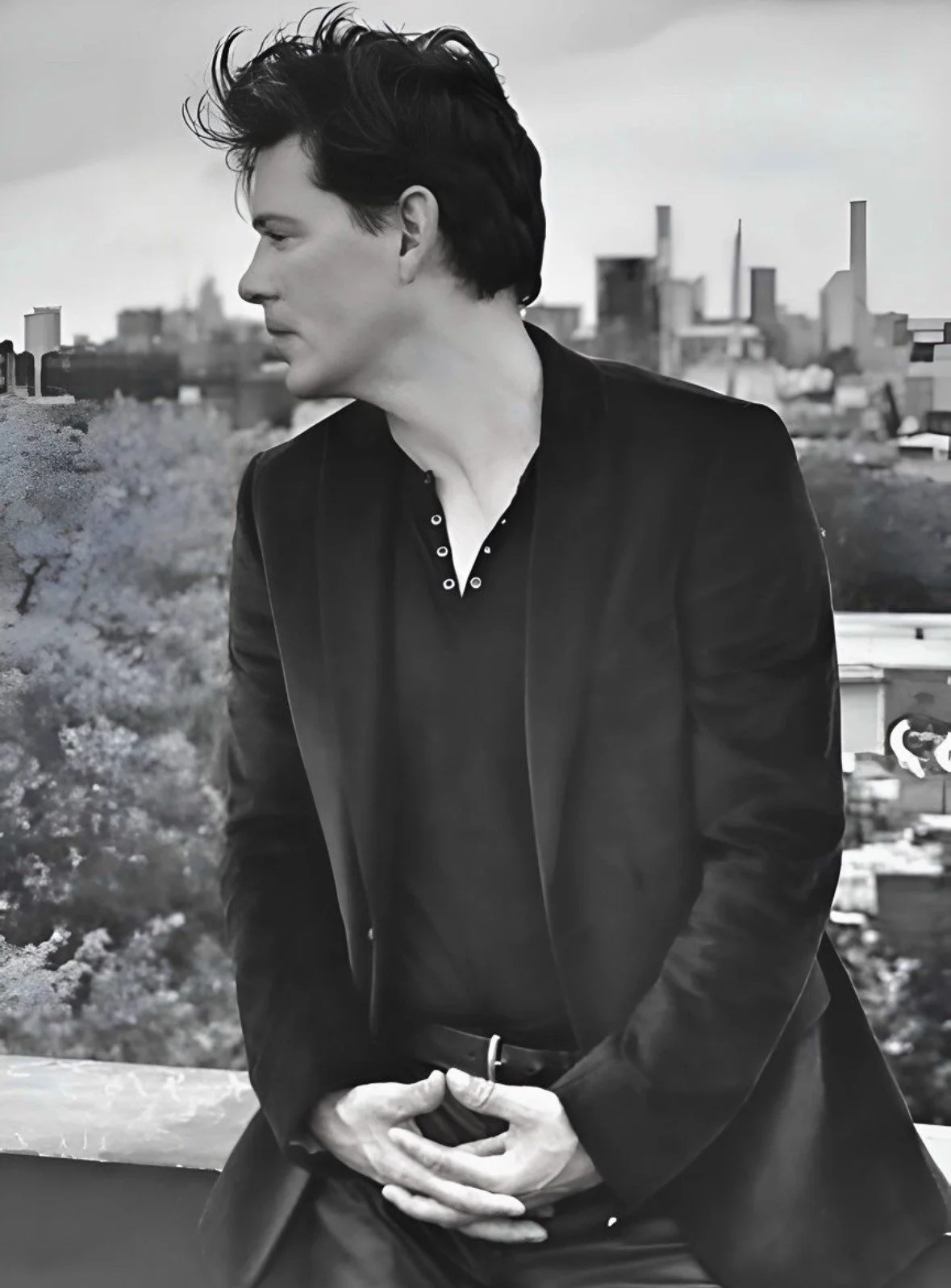
Photo of Michael Holtzman
BIO: Michael Holtzman is a musician and artist from Westchester, New York. His non-fiction writing has appeared in The New York Times and his fiction writing has been published in Solstice Literary Journal and elsewhere. His debut, “Paper Dolls of the East,” was a finalist for the Lorian Hemingway Award and the Tucson Festival of Books Literary Prize.