next year’s holiday
by Hayden Taylor
It was a misty afternoon, and the morning dew was coming late. A cat with spots like neglected ice cream pounced on a shivering blade of grass. On the other end of the lawn, another blade quaked. Then another. Then another. Soon enough, the entirety of the green fuzz rumbled in unison. The yards next to it, as well as the other duplicates emanating over and over again in a suburban landscape, imitated the shaking. The green tide swished back and forth as though a heavy breeze crashed against a rubbery wall. But the trees did not reflect the other greenery’s reality. That was until the grass ceased any movement at all, and the cat scrambled in confusion.
Among her shallow pounces, she spotted a hole expanding in the flowerbed. It consumed hydrangeas, daisies, and weeds all the same. They fell into the hole and became oblivion on the flip of its contained horizon. The cat, fearful of the street’s danger and the unknown of the hole, rushed around the side of the house, hopping over flakes of rotted white paint. A pair of eyes followed her through the vinyl window.
In the backyard, another hole paraded around, consuming plants and fallen acorns. It moved quickly toward the cat. Just as it was prancing around with vibrancy and intention, it was nothing in an instant.
Inside the mouldering home, Martha, a woman just outside her mid-fifties, ran her hand through thinning gray hair and whisked a concoction in a shallow metal bowl. The clattering rang around the kitchen, bouncing off the collection of completed whiskey bottles at the top of the cabinets, whistling by the oven’s radiance, and reverberating through the dining area into the living room. There, Martha’s daughter, Nancy, and husband, Monroe, sat looking out the front window.
They watched as a group of men wearing raggy clothes and carrying jury-rigged weapons passed by on the street. The noses of their early twentieth-century chemical masks swung like pendulums as they scanned the area. One of them looked toward Nancy and Monroe. Nancy waved, and the man waved back with a nail gun. Another member yanked on his sleeve and they moved on.
“Tried and true,” Monroe said. The sides of his head caved together with thick veins. His eyes were beady little things, residing deep within sunken skin. His teeth were crooked, and his breath always smelled of the bottom shelf. He looked to the street with admiration and respect for those stomping onward. He kept his proud gaze when he glanced at his daughter.
He saw Nancy as a clone of her mother, but not of his wife. A distinction he feared others would not make. Her lush blond hair floated on her shoulders, and glasses framed her light-catching eyes. Nancy was always in a dress and yearned to host.
“What are they doing?” Nancy asked her father. “Are they not going to go?”
“They’ve been left to preside. Some people have to ensure marauders don’t come here looking.”
“But we’ll be gone, won’t we?”
“Yes. But this will all still be ours,” Monroe said, moving his hand in a grand fashion to indicate the whole of the home.
Cabell, the youngest son of Martha and Monroe, strummed his guitar lightly and sang soft words under his breath. The fireplace warmed the right side of his face and the stool he sat on opposite the sofa. He stopped playing to peer across the room to his father and sister.
“I’ve got my ticket,” Cabell said. “Have you all got yours?”
“You don’t even know if your ‘ticket’ will be valid, Cabell,” Nancy replied.
“It will come to us whether we’ve got something planned like Cabell or not,” Monroe said. “We’ve lived our whole lives to get there.”
“Even Mindy? I saw her go around to the back of the house. Should we let her in to join us?”
“Not sure about cats, honey.”
“Dinner is almost ready,” Martha shouted from the kitchen. “Prepare the table, the lot of you!”
Monroe, Nancy, and Cabell did their part to set the table with plates, utensils, and napkins. Three cups of water created rings on the table where Martha, Nancy, and Cabell usually sat. A short glass of bourbon was in Monroe’s hand, soon to be refilled. Church bells rang in the distance, drawing Nancy back to the window.
The atmosphere was tranquilized with the scent of a fading autumn filtered through cracks in the wall. Soot crystallized on the windowpane like frost. It cascaded from the bottom to the top, darkening the entire window in a snap.
Nancy rushed to the other windows of the home to find them in the same condition. The house was enshrined in a damp ambiance, whose only light was that from the fireplace and that from the oven’s glow.
“Mother, where did you put the candles?” Cabell asked.
“They’re everywhere, boy,” his father cackled. “Ask her where the lighter is.”
“It’s by the front door,” Martha said. “On the mantle.”
Cabell went to the front and patted his hand in darkness until he felt the curve of the lighter’s base. Soon, the candles that littered the space lit it up. Now visible was the velvet furniture, the scrupulous etching on entryways, the pile of worn, hand-bound journals, and the soot still encompassing the windows.
Monroe rocked in a cushioned recliner because he knew, despite her proclamation, the serving of Martha’s meal was far from happening. Table preparation was a midpoint marker. Mediocre meals take time, he thought in the circumstance of his opinion. He stared at the ashing wood and stale flames in the fireplace. He thought of his father’s teachings, which came at a time of great unrest in the country, and how they brought him comfort during the witness of distressing rabblements and insincere violence.
He remembered his father’s heart attack on Monroe’s wedding day, and how his mother inconspicuously carried him out of the ceremony to not disrupt. Then, he thought of his role as a father. How he failed his first son, Cameron, by allowing his curiosity to blossom. How he wished to reconcile with the eldest and convince him that there was still an opportunity for penance. How he didn’t make the same mistake with Nancy and Cabell. How his teachings, evolved from his father’s, would permit them all asylum, even the child who didn’t listen. He then thought how neat the neighborhood yards would be if soldiers were to cut them.
Monroe saw a minuscule ember float out of the fireplace and onto the dusty Navarre rug. It likely wouldn’t have done much damage, but he figured he might as well stomp it out just in case. As soon as he got up, he collapsed in a spastic shock.
Nancy was the first to notice the sound of her father’s watch scratching against the battered floorboards. She held his head on her knee when she knelt next to him. Cabell shouted for his mother. She ran into the scene illuminated only in feeble ovals.
The candles flickered at the same pace as Monroe’s pulsating neck. His eyes shut and would not open again, no matter how hard he shook. He breathed at a steady tempo despite his violent convulsions. His thrashing soon became calm after Nancy stroked his hair to comfort him. Cabell watched on with his teeth uncontrollably biting his tongue. Martha didn’t tremble a nerve.
“Is it already his time?” Nancy asked.
“His body is still here, though,” Cabell said. “It’s not supposed to stay.”
“It could be catching up to his soul,” Martha added in a placid tone. “We have to wait.”
“What if it’s not a relief? What if he needs to go to the hospital?” Nancy worried.
“He wouldn’t want that. He couldn’t want that, either. The hospitals are overrun by this time with corrupted and needy. We can’t risk leaving now. We’re so close to going.”
The children’s intuition of piety soon subsided the invading trepidation within them. Cabell helped Nancy raise their father from the floor, and they struggled to put him upright at the head of the table. His thighs upset the table balance and knocked a candle from its holder. The diminutive blaze reached the carpet and, before it could spread, Nancy stomped it out.
Just a few moments after they settled Monroe, the soot on the windows retreated into the ether. However, it did not change the ambience of the interior, as the sun had fully set. There were only distant specters of luminescence from the city under siege by widespread fires and teal beams. These beams reached below the ground and above the clouds, suddenly appearing and disappearing with only phosphorescence left as evidence.
“It’s happening!” Nancy shouted to the house, pressing her nostrils against the window.
“I’ve got to get the guitar in tune,” Cabell said to himself.
“We’ve got to eat dinner now,” Martha told her children as she entered the dining room with hands full. “Your song can come after, Cabell. Get away from that window, Nancy. Come to the table now!”
Before Nancy was able to peel herself from the poor insulation, she saw hollow turtle shells rolling down the street like tumbleweeds. Behind them was a tank adorned with poppy seeds, whose movement replicated the sound of rattling coins. The lawn’s dew floated upward from the lawn and evaporated before reaching above the trees.
At the table, Martha laid out the meal: mashed potatoes, cornbread, and a turkey. Cabell did the honor of carving the meat, but struggled as the house shook from the tank’s passing by. Nancy filled a plate for her father in case he returned.
Martha looked at Monroe’s pale, sleeping face and wondered what it would be like without the body she’d been with her whole life. Would it be a new life? An extension of this one? What had she earned?
“We didn’t want to wait for Cameron?” Cabell asked with an untouched plate.
“You still think he’s coming?” Nancy replied. “We didn’t set out a plate for him.”
“He said he was on his way.”
“And when did he say this?”
“You saw the letter.”
“Anyone could have sent that; it was typed. Even if he did send it, why would we believe him?”
“Your brother is welcome to enter if he comes,” Martha said. “But we cannot wait on someone who may or may not join us.”
“What about the city? I wonder how he could get through all that. Plus the troops roaming by,” Nancy added. “Cameron is smart, but I’m not sure he’s that lucky.”
“Don’t worry about the city. You really shouldn’t be looking out that window so much. I wish they would cover themselves up again.”
“Do you think Cameron will join us?” Cabell asked his mother. “Not here, I mean.”
“I love that boy with every blood cell,” she replied. “I wish he did the same.”
“But it was only a try! He should still have as much of a chance as the rest of us.”
“There’s a chance, Cabell. But we can’t wait for him; he may already be there.”
“If he isn’t, I would like to see him here before we go.”
“It’s not up to us. It’s up to Cameron. Now eat before this goes cold.”
“Thank you for the meal, mother,” Nancy said.
“Yes, thank you, mother,” Cabell mimicked.
“You’re all welcome.”
Once they had eaten, Cabell and Nancy took the leftover food and dumped it in the trash, which was nearing overflow. They left their father’s plate in front of him. Martha sat in the living room, writing a note about how to fix the shower knob if it gets loose. Nancy soon joined her on the couch. Cabell grabbed his guitar.
“Can I do it now?” he asked.
Martha nodded and put her pen down. She and Nancy maneuvered to the center cushion and sat across from Cabell. On the wooden stool, he breathed deeply and adjusted his instrument.
“Can’t believe I’m getting stage fright in a living room,” he laughed before getting back to stoic. “This is for father and the whole family. Especially Cameron.”
He strummed the thin strings to produce a shaky harmony. With it, he added poems of a shrinking violet. The words he sang matched the strident melody.
If I were to die tomorrow
Who out of Earth would know my sorrows
Sailing hardships
Some can’t afford to eat
Only some can afford to taste
The past makes a little more of
A man you are
A little less of
A man you want to be
Thousands of dusty field handshakes
Millions of backroom dealings
When was the first time we got it wrong?
Fear the sliver of the percentages
Eventually
Pebbles and boulders erode all the same
The eventually
That’s what irritates
After the final note, Cabell’s body met the floor just like his father's did. This time, there was no lashing. He laid still on his back as Nancy and Martha spectated.
“Is this it?” Nancy frantically wondered.
“Perhaps,” Martha replied.
“Where’s the light? Father didn’t have a light, either.”
Cabell’s skin became flaky at a rapid pace as if he were soaked for a millennium and dried in an instant. It shriveled and fell off his body in snowy chunks, exposing his flesh. His tendons and muscles were open to the nature of the home. He kept a smile on his face, and no blood seeped into the floor.
“This can’t be it!” Nancy cried.
“Pray for him,” Martha shouted. “Pray for your brother!”
Nancy wanted to do as her mother told her, but panic rose above and made her weep. Martha tried to recall a prayer Monroe once taught her, but she could not recite it. Quickly after his body was fully peeled, patches of foliage appeared on Cabell’s flesh to replace the lost skin. Moss and dead leaves created a dress, a mask, and a skin. The structure of his body remained as its essence was replaced. The smile stayed on his face as it became surrounded by green and brown. Nancy tried to touch the emerging replacement.
“Don’t!” Martha yelled at her.
Nancy continued to cry hysterically as Cabell’s body became fully encased in verdure. Once fully covered, he floated. Nancy’s tear-filled eyes followed her brother as he went with the upward air. He reached the ceiling and sank into it.
Nancy ran up the stairs to see if her brother’s body would appear through the upstairs floor. In Cabell’s bedroom, which was above the living room, there was silence and repose. No body. She went back down. No body. Not in the ceiling. Not in the floor. The thin barrier between the two could hold no body.
Martha continued to pray with common passages and began weeping uncontrollably. Nancy stopped her tears and paced about the room.
“The light. There was no light!” Nancy exclaimed to herself. “First father and now Cabell. Am I next?”
She looked to her mother, who was on the verge of expelling her dinner. “Am I next? Are you next? Mother, answer. Please.”
Martha could not hear Nancy’s pleas over her empty heaves.
“This isn’t what we were promised,” Nancy continued, trying to drown out her mother’s wails. “This isn’t what we merited! We must be of the cursed forgotten. Cameron must have known. That’s why he did all those things. All those bloody veins and reckless objectives.”
Nancy fell to her knees and looked up to the parts of the sky she could see through the window. It was swirling into a vortex with the wind pulling in objects and any surviving amphibians.
“Did he think he was protecting us by not telling us?” she pleaded, putting her hands together. “Cameron was never going, and he’s cursed our generation to stay. But why punish my father and mother?”
Nancy hit her head against the sill of the window. In the distance, a tornado made landfall. In that instant, she realized cursed conditions cannot remain. “We stayed after Cameron left. We should have followed suit so they could go. Tell me this truth is so.”
Her eyes became refracted, turning her view of the roof’s shingles flying into the storm into a vision of thousands of cicadas swarming the firmament. Her ears became inverted, with her mother’s keening tremoring Nancy’s tympanum. The sounds of drawers sliding from dressers and smacking the floor squealed like wounded sheep.
Through bastardized sight, Nancy rushed over to her mother, who was hunched over and crying dry, and hugged her from behind. She kissed Martha on the cheek. When she felt the warmth of her mother’s tears, she knew it was time to go.
“I’m sorry for your children. There’s still a chance for you and father. I love you.”
Martha looked up just in time to see Nancy open the front door and run into the world.
“Nancy, no!” Martha wept. She got up and went to the open entrance, but she could not step past it. She shouted and cried for Nancy, who was already gone in the fog. The tornado’s winds muddled her vision even further. Stuffed animals, bracelets, traffic signs, and electrical wiring were stuck in a circular pattern.
Martha fell back to her knees and sat with a reduced heart. She thought it was a million, but she moved after twelve seconds. She crawled back to the dining room and dragged herself onto the chair next to her husband. He was still unmoving. The food in front of him was gelid.
She sat in silence with him for hours as the storm abated. The tornado reeled into the clouds, and the neighborhood objects it had swept up fell back to the Earth. Soup cans, finger paintings, walking sticks, and broken tricycle wheels crashed through the roof and bounced off the bedrooms’ floors.
She poked Monroe’s plate with a fork and watched the turkey slide into the side of the mashed potatoes. She stared at the intricate design of the plate and how the food interacted with it, creating a canvas of organic and manufactured materials. She pierced a piece of turkey with the fork and put it in her mouth. She chewed it and spat it onto the plate. She did the same with the three other pieces of turkey until the plate was all mashed.
Eventually, Martha spoke. “He’s still on his way. Cameron said he’s coming home.”
Monroe blinked.
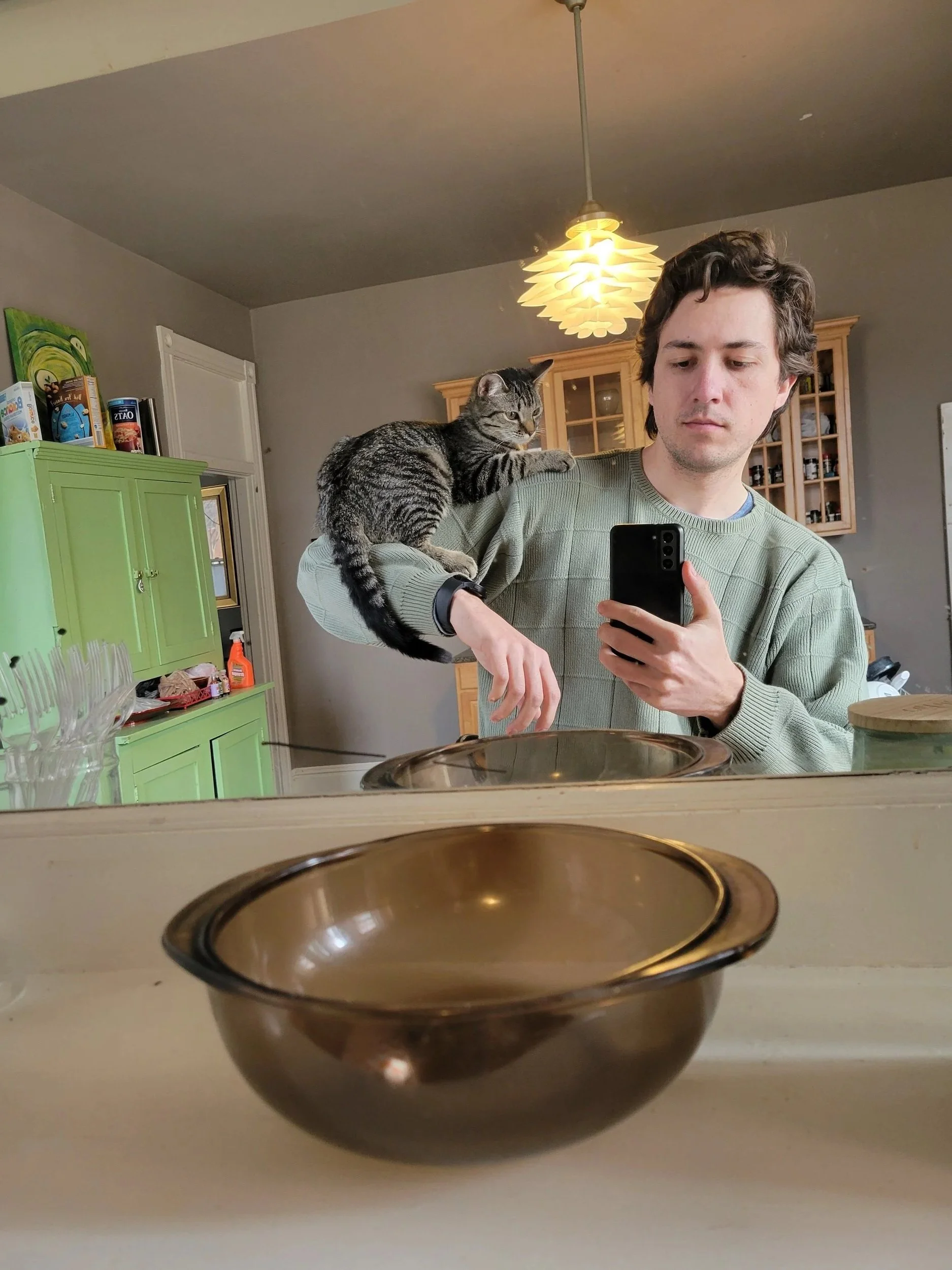
Photo of Hayden Taylor
BIO: Hayden Taylor is a writer from Richmond, Virginia. He graduated from Virginia Commonwealth University in 2022 and is unpublished as of now.