funnel
by Stuart Watson
Glen the Goon was alternately poking me and my brother Fred in the chest until we backed as far as the classroom wall would let us.
“We been to Disney,” Glen sneered, proud like he had done something big. “Bet you ain’t never been to Disney.”
It wasn’t a question. Just a gut punch, like he knew, and we knew, and that was that.
We shook our heads.
Glen turned his head sideways and looked at Dewey, his acolyte.
“What I told you?” Glen said. “These babies ain’t been nowhere. And you know what? They ain’t never gonna. ‘Cuz their dad’s white trash. Sweepin’ and moppin’ sawdust all day.”
He said dust like it was a curse word, not something that needed tending, like the posts and planks the mill turned out. He seemed not to care that somebody had to gather it up so his own dad and all the others at Pine Products wouldn’t choke on it.
“Ain’t you two the shit sandwich,” Glen said and shoved Fred back into the wall. He pivoted like he was going to walk away but before I could step away from the wall, Glen’s left elbow jerked backward and nailed me in the eye. I doubled over, grabbed my pain, tears flowing.
“Babies!” Glen said to Dewey as they strolled all cocky back to the playground, where he stole the ball from the four-square crew and kicked it over the fence.
The school nurse put an ice bag on my eye, but when she – and after her, the principal – asked about its cause, we didn’t say a thing. In fourth grade, I knew enough to hold my tongue, fight my own battles. I didn’t know it, but Fred looked to me for wisdom, a practice he later abandoned when he realized I wasn’t any smarter than the average towhead.
The nurse phoned home, though, and Mom was waiting as we walked toward the backsteps. She had Kool-Aid and Twinkies waiting for us, but we still wouldn’t talk.
“Whoever did that,” Dad said, chewing his pot roast, “next time, you kick him in the–”
Mom reached out, touched his arm. They exchanged looks.
He shot her a look, resumed chewing. After a brief pause, he put his fork down.
“Look,” he started. “World’s full of bullies. Glen got it from his dad. No point fightin’; fire with fire. Always somebody bigger. You boys are smarter than ten Glens. Use your smarts. Don’t have to score touchdowns to beat a Glen. Field goals. Just kick it between the uprights.”
He looked at each of us and winked.
After a brief silence, we asked our folks about Disney. They just chewed and looked out the windows for signs of twisters. Thinking about the things that big people think about when none of the answers were clear or easy or worth sharing at the dinner table.
The trees had leafed out and the air turned thick like after a hot shower. Northwest Arkansas underscored the appeal of air-conditioning, which we didn’t have. “It sure is mugging,” we would complain, and Mom would smile at us, like she did often, as if she knew something we didn’t. Mugging.
Every day for the next week or so, we asked about Disney. A week before school let out for spring break, Dad told us he had heard enough about Disney.
“Got a better idea,” he said. “We’re goin’ vacation to Georgia. See somethin’ better. Half as close. The Folkston Funnel.”
“Like a funnel cloud?” I asked, thinking there maybe was such a thing as a tornado you could visit, instead of waiting for it to visit you. All I knew about Disney was that Glen had been and acted like it made him special. So, the idea of this funnel thing sounded pretty good. Having something nobody else did, that’s all we needed to feel special. Mom had a funnel, so I had a picture in mind. Place we were going was probably just way bigger.
“What’s the Folkston Funnel like?” I asked.
“You’ll see,” Dad said.
When we arrived home after the last day of school, he had our bags up on the roof of the car, between the two racks, bundled in the blue tarp. The tarp that covered the hole in the roof two years before when a tiny twister lifted some shingles. Dad and Mom wanted to leave early, before dawn, so shooed us to bed right after dinner.
“Twelve hours,” Dad said. “Half today, half tomorrow.”
Years later, I would examine his words. Where we were going was two-thirds as far as Orlando. By then, I could see it as a harmless fiction offered in service of a better climax.
As Dad led us to the car, we could smell the fecund ponds where he raised catfish. “They don’t need babysittin’,” he told Mom when she asked why he took the mill job. “They raise themselves.”
Mom carried a wicker basket of sandwiches and potato salad to the car’s trunk. “We’ve got cold pop, boys,” she said, smiling at us, like she had told us Santa just left. We spent the first night in a roadside motor court outside Pensacola, finished the drive late the next day.
It wasn’t much to look at, this vacation destination. First of all, it was in Georgia, not Florida. But we left Florida, to get there, so it was like two-for-one. As our car drove a straight line through miles of loblolly pine, Fred and I joked about all the things you could stuff through a funnel. Gravy. Whiskey. Salt. Down pillows.
“Down pillows?” he yelled at me. “No way. That doesn’t count.”
“Counts with me. Game on.”
He snorted, but what could he do about it? It was a game without rules, not at all like the life we were living and learning inside. A house with a leaky roof, but a house.
After what seemed like a billion miles of boring, the sun sunk behind the treetops off to the left. Lights twinkled ahead. Dad slowed. “Here we are,” he said. “Folkston, USA.”
“What’s here?” Fred asked.
Dad pulled into a mini-gas, stopped in front of the pumps. After he turned the engine off, he braced his right arm across the seat back and twisted and looked back at us.
“Your mom and Lester and you and me,” he said. “What else is there?”
Fred never quit.
“I dunno. What else is there?”
Dad ignored him and went in with Mom to get some snacks and pay for the gas.
“We’re close,” he said when they got back.
Two blocks down and to the right lay the Okefenokee Motel. As I came to know later in life, it was a motor court. Pull up in front of your room. Short walk with the bags. Our room had two double beds and the bath in back. This was just before cable. The TV sported limp looking rabbit ears.
“Drop your bags,” Dad said. “We’re gonna check out the prime attraction.”
Fred and I swapped this sucks looks. Not a sign, anywhere, for anything Disney. We were about as far from the Magic Kingdom as one could imagine. As he shuffled past me toward the car, I muttered “this is Mickey.” He smiled.
It was three blocks back along the highway before Dad turned right and we came to Folkston Funnel Street. All I could see were train tracks just ahead. Dad parked and we got out and wandered off to the right where we found a sheltered viewing stand. It was empty.
“This must be where people watch,” Dad said.
“Watch what?” I asked.
Dad looked at me, then Mom, who seemed equally curious. All this mystery, but about what?
“The trains,” Dad said. “All day long, trains come through here, heading north, heading south, just blasting past. And people come here.”
“Why?” Fred asked. “We got trains in Arkansas.”
“Them’s just spur lines,” Dad said. “That D&R up by us, you see pokin’ along with five flatcars? It don’t go no more’n five miles. Trains right here in Folkston? They’s long-haul. From everywhere. Going everywhere. North to south. Get a head a steam going and whoo-wee, it’s somethin’ to see.”
Twenty years on, I could’ve told him it wasn’t steam but diesel. Dad opened the trunk and pulled out a hand-made sign, two pieces of cardboard sandwiching a wooden stake. Painted in rough script on each side of the sign were the words: Disneyland for Dads. Then he pulled out a maul and walked over to the grass between the parking lot and the tracks and pounded the stake in, so we could see the sign from our folding chairs.
“Bet none of them kids at your school ever had a spring break like this,” Dad said over his shoulder, walking back to the car.
“Lucky them,” Fred said, slumping along in Dad’s wake.
Come dinnertime, we could hear Mom and Dad discussing where to go. This was before phones. Smart phones, that is. We had a phone with a dial in our motel room.
Mom thumbed through the yellow pages of a thin phone book, pausing to look at ads.
“There’s a buffet,” she said.
“Bet that’s good,” Dad said. I didn’t give it much thought, but years later, I would recall that moment and wonder how he equated “buffet” in Folkston, Georgia, with good. Perhaps the eat-until-you-pop option appealed to his frugal life sentence.
Mom and Dad went first. “Anything you want,” Mom said as we grabbed our plates. “All you can eat.”
I stood looking at a hotel pan full of greasy water. Niblet corn and green beans floated forlornly in the swamp, waiting for an EPA cleanup. The fried chicken was no better, decimated by the early birds. Overcooked wings remained. Gravy, like liquid Jesus, saved our bacon.
After piling as much as we physically could balance on our plate and weaving to our booth, Fred and I giggled about how awesome this was until Mom told us we didn’t have to pile our plates so full.
“You can go back,” she said. “Grab a fresh plate. As many times as you like. You could have waited for your dessert.”
She looked at Fred. He was eating a scoop of vanilla ice cream from chocolate cake resting in a pile of light brown gravy overcoating a mound of mashed potatoes while two forlorn fried drumsticks looked on from the side. Dad said nothing, chewing and gently shaking his head. I saw him smile once, when I followed his fork of salisbury steak in brown gravy to his waiting mouth.
That was when I saw the man come slowly through the door. He was filthy. He had long, unruly gray hair, a patchy beard, stained overalls over a shirt that shared grime from who-knows-how-long since the last washing. Back then, everybody would have called him a bum.
A woman with dark hair and a notepad in a flowery apron stepped from behind the cash register. She said something to the man. He didn’t move, just stared at the buffet line. The woman stepped between him and the stacked plates, said something else.
One of the people seated at a booth opposite ours, a big guy wearing a plaid shirt with cutoff sleeves and bib overalls, stood up with a loud curse and approached the guy.
“Get out,” he yelled at him. “Can’t you see you ain’t welcome here? Filthy bum. Take a goddamn bath and put on some clean clothes. Get a job. Then come back.”
The goon grabbed the man, just before our dad tapped him on the shoulder. He turned.
“You can go back to your seat,” Dad told the guy, calm as can be. “We’ve been waiting for our brother to get here. Join us for dinner. Ain’t seen him in a long while.”
The big guy’s face flushed red as a stop light, confused, unsure how to shelve his power play.
“Go on, now,” Dad said. “Your dinner’s getting cold. My brother needs to serve himself.”
The goon started jawing at Dad and grabbed his shirt. Calm as could be, Dad brought his linked hands up sharply to dislodge the grip, then pulled back his right and clocked the brute. He staggered backward, crashed into the buffet line, grabbed at it to steady himself and pulled a pan of gravy from its well. He crashed to the floor, in time for the gravy to coat him head to hips.
Dad turned to the cashier, handed her ten dollars, and slipped his billfold back in his hip pocket. “We’re just over there,” he said to the man, pointing. “We’ll add a chair.”
After Dad sat back down and picked up his fork, Mom cautioned him. “You don’t know what these types will do,” she said.
“These types?” he said. “It's all these types understand.”
After the man finished serving himself and joined us, we didn’t talk much. Mom asked his name: Marvin. We chewed. He chewed. We went back for more. So did he.
“Did you like the cake and ice cream?” Fred asked the man, after he had finished his dessert.
He nodded. Smiled a little, but seemed embarrassed to show his teeth. After everybody had stuffed themselves, we all five walked to the door. Outside, bugs dancing beneath a barn light mounted over the door, our “brother” turned and shuffled away from us.
“Good night, Marvin,” Mom said.
The man kept moving.
In gray light the next morning, Mom and Dad holding cups of coffee, Fred and I devouring Krispy Kremes from a paper bag, we returned to the viewing platform. Two other people were there. Mom and Dad set up their folding chairs. Not twenty minutes later, “Here it comes!” Fred cried out from the far edge of the parking lot, and suddenly it was upon us, the engine and its comet’s tail of freight cars chasing it south.
In between trains, Fred and I ran to opposite ends of the lot and then toward each other, like engines on a colliding course, our inner arms extended, and as we passed, we would slap each other and cry “Whooosh!”
Or place rocks on the rails, to get squashed.
Or wander the lot, looking for any lost object of value.
Or read the comic books that littered the floor of our car.
Mom went and bought us burgers and fries, and the afternoon passed swiftly, until it was time to go back to our motel. We slept well and left at dawn for the long drive home.
School started the next day. No sooner had we approached the playground than we were greeted by Glen and Dewey. To mollify my tormenter, I handed him my lunch bag. “Brought you a present from Folkston,” I said.
“The fuck is Folkston?” Glen sneered but grabbed the bag and turned toward class and the cabinet where everyone stored their lunches.
Anticipating this pass, I had removed the real lunch from the bag and replaced it with a baggy that contained a sandwich composed of white bread slices smeared with fresh dog droppings, hidden beneath shredded Velveeta and cabbage. It looked like a Dixie burrito.
I didn’t anticipate someone else stealing the lunch that Glen stole from me. Or that person taking a bite of it before realizing what it was. And, in a fit of rage, chasing Glen down and kicking him in the nuts.
Fred and I laughed ourselves crazy on the walk home. To this day, when I recall the domino effect, I wrestle with feelings of gratitude and sympathy and confusion. I got a little clarity the next day, when Lewis Gribble showed up wearing a nice, white ankle cast. We all signed it, even Glen. I wondered why, but it took me a decade before I figured out how he was just trying to shift attention away from the part of him that Lewis kicked.
Whenever I think about that craziness, I drift into headshaking. Who won? Who lost? And why did I never get another chance to kick a field goal with Glen’s balls myself?
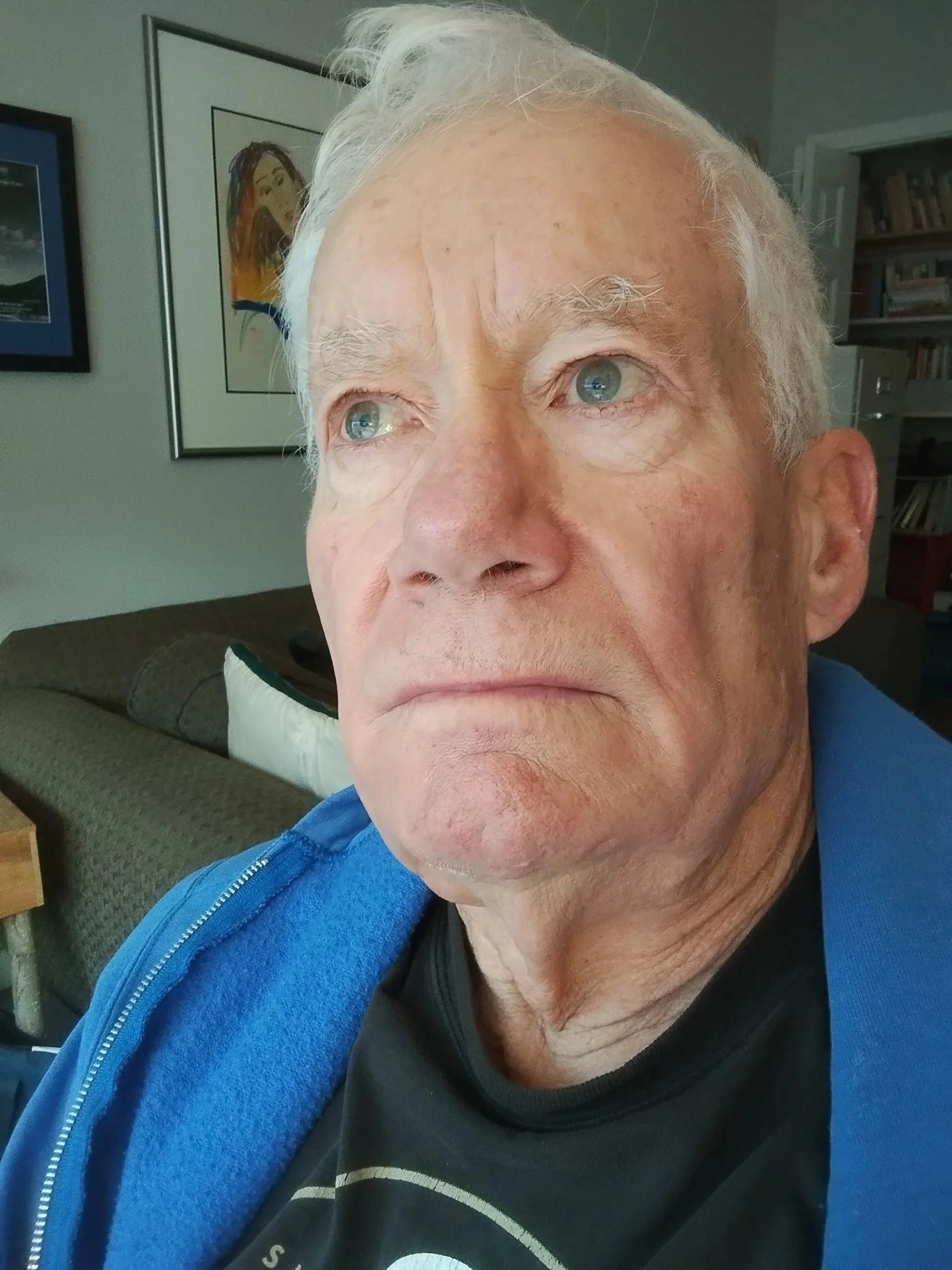
Photo of Stuart Watson
BIO: Stuart Watson worked at newspapers in Anchorage, Seattle and Portland. Second place honoree in the 2025 Cambridge Short Story Prize, Watson has literary work in Bull, Barzakh, MacQueen’s Quinterly, Bending Genres (Best Microfictions nominee), The Writing Disorder, Rattle, The Muleskinner Journal, Reckon Review, Sensitive Skin, The Broadkill Review, Stanchion, Does It Have Pockets? and others, all linked from chiselchips.com. He lives in Oregon.