the jockey
by Monique Quintana
For three and a half weeks, a dead woman is mad dogging me at West House, my temporary home at the artist residency in Saratoga City, New York. Every night after dinner at the artist residency, I walk back to my room in anticipation of her. During the day, the lawn is flanked by gnats and squirrels that seem to be holding committee meetings like academics. The natural has never seemed so bright to me. In tandem with the spirit near my room, they are unafraid of confrontation. They want all the smoke. And I, from California, am unprepared for their mixed bag of maudlin and regret. Their collective energy is beyond projection; it feels akin to revenge. And I became hooked to the sentiment like a flower bouquet’s cold and muted scent cased in cellophane at the market I went to as a girl.
Back home, my mother brags to my Grandpa Henry and Uncle Henry that I'm staying near the racetrack, even though the summer racing season hasn’t started yet. Avid fans and gamblers in the sport, they had owned a racehorse they named after my sister, Miranda. The horse had a good run at the small county fair circuits in Northern California. The brief foray into the game made me consider a career as a disc jockey because of my low weight and stature. Ninety pounds and five feet two. One nightmare about falling off the horse and breaking my neck, à la Bonnie Blue Butler, made me discard the idea like a wax cup at an old school water cooler. On a trip into downtown Saratoga, I buy Uncle Henry a pair of navy-blue tea towels with the town’s name stitched in white thread. In the cab ride back, I regret that the towels were more in line with my mother’s taste, and my uncle would have preferred something gaudy like the decor at the artist residency’s main mansion, where we eat dinner every night that summer. I begin to ponder whether spirits, like the woman in my room, can be transported by plane on something like a tea towel if they have powdery, residual matter that binds all their life’s tremors into a single, invisible necklace.
One morning at the residency, while I am still sleeping, a tangible woman unlocks the door to my bedroom and sighs in a bell clang. While I am surprised by my own lack of embarrassment, I begin to wonder how often the woman will think about my melted brown woman’s face on the pillow. I have become the nihilistic Western I have dreamed of since I was a kid.
The rose garden is dead but not dying. I prop my phone on steps and pillars to take thirst-trap pictures I can pepper my Instagram feed with. In one picture, I am lounging on a rock path, and it looks like I am giving birth to one straggling rose.
There is one thunderstorm after the AC goes out in Westhouse. It bangs on the windowpane, and I film videos of it, and eat the boiled eggs and sourdough toast I have set on my writing desk. The dead woman jerks the door in its frame and makes me homesick. I Google flights home and decide not to leave yet. I have a netted grocery bag with Frida Kahlo’s face on it to hold my phone charger and lipstick to carry through my at-home rituals. Her face stares at me, bright in the desk lamp’s shadow. The lightning’s projection sprays the trees, and I cannot read its lines, the same way I cannot read my own handwriting in books.
The only other person of Mexican descent at the residency, a filmmaker from Tijuana, accompanies me to Treasures, a thrift store. He is tall and thin and handsome and funny and curses a lot and talks about his perpetually shy brother. All the residents had been frequenting the store since the onset of our session. Each time returning with costume jewelry, pristine jockey hats, and cotton t-shirts that they wear as they circle the grounds in the morning humidity. On this outing, I find a black bucket-style bag with a peacock design beaded on one side. The filmmaker and I buy ice cream cones and walk a half a mile to the drugstore, cream dripping on our hands because we talk too much to eat fast enough to stop it. A man in a pickup truck yells a slur at us as he speeds against the backdrop of blue-green grass and barbecue smoke. We laugh and say, see how cruel people can be?
Due to my flight itinerary, I need to spend the night in Albany at an airport hotel. I crank the heater, order takeout from a Thai restaurant, and pull my curtains as wide as they go. The green and the trees expand around the hotel’s parking lot, and a light rain falls. I have duplicated the heat from outside my window. It is pure summertime, a different summer than the one in my town, and its aridity. The dead woman had reminded me of my past, how small my body was, the residual matter that is still there, growing and expanding, never stopping from dying. I remember a boyfriend in high school, how he came to visit me at my house after his confirmation class, how he wanted to take me to his Mexican grandmother’s house, so that I could touch her hand bones and sigh. Our veins would be the same bright purple and blue. I recall how he and his pale-faced brothers were named after apostles.
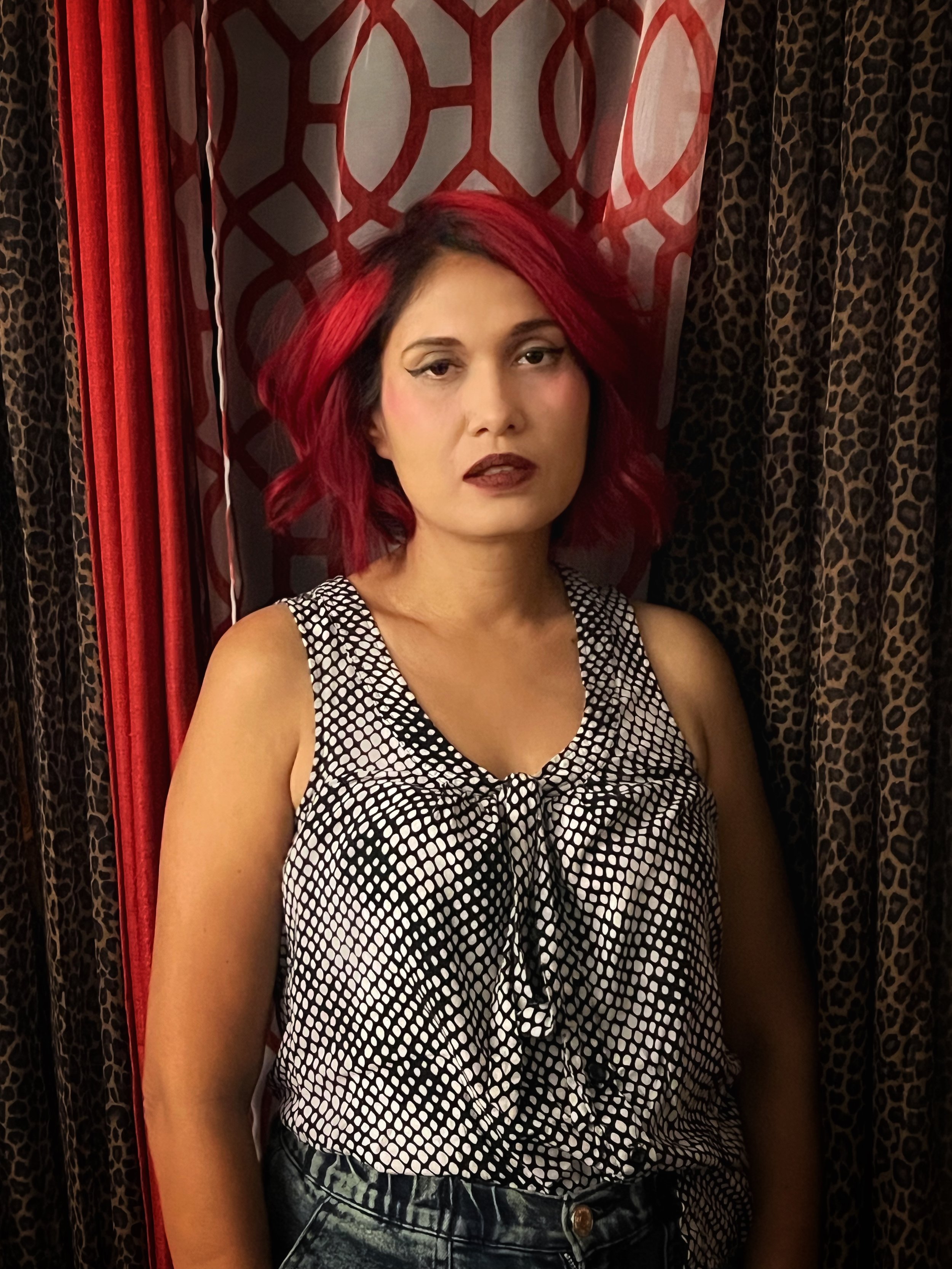
Photo of Monique Quintana
BIO: Monique Quintana (She/Her/Hers) is the author of Cenote City (Clash Books, 2019) and the chapbook, My Favorite Sancho and Other Fairytales/(Sword and Kettle Press). Her work has been supported by Yaddo, The Community of Writers, Sundress Academy for the Arts, the Kimmel Harding Nelson Center, and Storyknife. Her work has appeared in numerous anthologies, such as A Night of Screams: Latino Horror Stories (Arte Público), Até Mais: Latinx Futurisms (Deep Vellum), and Latin American Shared Stories (Flame Tree Press). She is a union organizer and teaches English in Fresno, California.