seventh-grade pretending
by Trelaine Ito
I
“Here. Merry Christmas.”
Tommy hands me a present before taking his seat next to mine. It’s our first day back from winter break and I haven’t seen him in almost a month. The shiny, blue wrapping paper, accented with gold stars and bundled together with three pieces of tape (eschewing a more formal ribbon), encases what is, to me at the time, a material embodiment of my worth to him as his friend—a book: The Golden Compass.
Pleased with himself, Tommy smiles. “I love that book. You have to read it.”
I’d never before received an unprompted Christmas gift (usually gift exchanges were well choreographed, and you knew who was giving whom what, and who, therefore, expected something in return). A slow shame simmers in the pit of my stomach because I have nothing to offer him, because while shopping for gifts he never crosses my mind. I muster a small “thanks” in response.
The Golden Compass is a light book. A picture of the alethiometer—the story’s namesake truth-finder—dwarfs the background image of the protagonist, Lyra, and her companion, an armored bear named Iorek, gazing at the aurora borealis in the Arctic’s forever-twilight. Sitting next to Tommy, the alethiometer points in a cryptic foreshadowing to the hourglass, anchor, and helmet, revealing a truth I can’t escape. That I won’t escape.
Of the many colors of the aurora, I focus on the blue.
After appraising the novel’s exterior, I fan through it in a backwards speed-read and land on page 115.
Eight: Frustration
Lyra had to adjust to her new sense of her own story, and that couldn’t be done in a day.
I imagine Lyra as a heroine waiting at the precipice of her long journey, ready for her next steps but unsure of where they will take her. (At the time, I didn’t know the book was the first in a trilogy and that her journey would upend her world.)
Destiny makes no sudden movements. So, Lyra becomes impatient. She looks to the alethiometer for answers and it, in turn, suggests that she trek toward the northern lights. With a brief glimpse of truth, Lyra starts to run toward her destiny. In her stride, she finds direction. She starts with an exiled bear and his stolen armor.
I close the book, and it seems as if the alethiometer spins its needles, intuiting a subconscious question. The little golden device points to the boy next to me, softly smiling to himself, and I am left to decipher its truth.
II
“Hi, Trelaine.”
Tommy would often greet me with a smile. He liked to smile—an expression that, by no force of its own, induced on my cheeks quiet blushes. On the first day of seventh grade, recognizing me, Tommy sat in the adjacent chair as if it were assigned to him. Surprised by this stranger’s audacity (no one ever sat next to me by choice), I pieced together fragments of my memories to recognize his face. He looked different without goggles. I didn’t think he knew who I was.
Tommy swam with my older brother, Travis (whose swim meets were actually quite boring). Mom brought me along, subconsciously trying to fit me into Travis’s shadow. Sitting in the stands, she cheered on her firstborn, her heir apparent, as he stretched before his race. He dived in, I looked away, and he won. Mom celebrated, as she usually did, with raucous applause. Wearing a giant black coat with the words “Aloha Aquatics” stitched across the back, he cast a long shadow, both great and expectant. As his successes began to consume me, I fostered resentment as a defense. And I stopped attending his meets.
But Tommy is different. I don’t mind that he, like Travis, swims or that he, like Travis, exudes an air of easygoing success. He is nice and smiles, so I forgive him.
By January, sitting next to Tommy is a habit. I like to stare at his wrists, watching as he writes out sentences on a page. They bend in a fluid motion, snapping back to dot an occasional “i,” before curling down to travel on to the next word. He uses a hybrid style of cursive and print, a lazy string of letters looped and speckled as if smiling.
When Tommy is absent, there’s a void. But when he’s present, it feels like there’s something more than just a friend sitting next to me. At first, the feeling is only a little troubling. Transfixed by my table-partner, January sees many wandering thoughts as they weave together Tommy’s gift and my undeniable fascination with his wrists.
III
At times, though, sitting next to Tommy is brutal. Something about puberty and middle school makes adolescents cruel. Our classmate, Caitlin, teases us incessantly, directing her jabs at Tommy but not at me (she knows that to make fun of me is to ask for tears). Tommy, however, is a cool character with a face that communicates little feeling. He oscillates between stoicism, sarcasm—and, of course, his smile.
Caitlin points. “Look! It’s Tommy and his boyfriend.”
Boyfriend? I hate that word. The way it jumbles out, forcing an open mouth, scraping teeth against lips, pounding tongue against palate. Do boys even have boyfriends? To a young mind yes, I am a boy, and yes, I am a friend. But the combination of those two words invokes a different type of connection, something more profound and rarer than either gender or camaraderie alone.
Tommy continues to take notes, unfazed, while I look away, fascinated by his unbroken concentration but not wanting to prove Caitlin’s point. What is he thinking? Caitlin said it loudly enough. With her words, she handed us a puzzle of entangled strings wrapped around Tommy’s lithe wrists and my fidgeting hands.
Am I his boyfriend? I don’t know. (Probably not, though. I assume that status requires some sort of mutual agreement.) But the act of sitting next to Tommy exposes the possibility as a viable option. After all, what could be the culmination of a perfect table-partnership other than a gradual evolution into boyfriendhood? My logic turns on the intimacy of side-by-side chairs.
“Why don’t you sit next to your boyfriend, Tommy?”
Tommy never caves to Caitlin’s words, never takes the bait. As he walks from the classroom door to our table, I, in a bout of failed telepathy, dare him to turn to her and say, “Yes. I will.” But instead, he pulls out his chair, flashes me a welcoming smile, and sits down.
(The summer after graduating from college, I mentioned the seventh grade to Caitlin, but she didn’t remember the teasing. She remembered Tommy but had to squint to see me peeking out from behind my desk, afraid of her abuse.)
IV
At first, I don’t feel uncomfortable about the state of our relationship. Should I ask him about it? Tommy hasn’t noticed anything, so I don’t bring it up. If it is pretend, at least it’s stable. For now, at least.
Per Tommy’s recommendation, I borrow the other books from Phillip Pullman’s trilogy from the library. The Subtle Knife introduces Will. I don’t find him a compelling character at first. Will doesn’t laugh. He likes the quiet. Will never pulls Lyra along, never asks her to follow him. He persists on his separate journey as fate quietly merges their lives together. In the end, when their paths diverge, he doesn’t object. He accepts separation as their doom for the sake of promises kept. Once a year, reliving the moment of their destined parting, he hikes to the north and raises his hand to feel her ghost. A universe apart, he still feels her warmth in the cold.
Lyra and Will, Pullman’s tragic couple, reappears throughout the trilogy in different skins and with different names—Mrs. Coulter and Lord Asriel, John and Juta, Baruch and Balthamos. Each coupled embodies a tragic cycle—love, then separation, then death. They feel beyond what their vessels can handle. Their passions consume them, so they fight, they run, they hunt, they mourn, and they inevitably succumb to the doom of their union. To break this vicious cycle, Lyra and Will remain apart, separated neither by time nor space, but by choice. Different universes protect their love, keeping each piece half-alive and unwhole, tethered together only by an annual trip to the north.
As Tommy starts to resemble Will, his fictional twin, I start adjusting to a new sense of my own developing story.
V
I love him. I felt it when he gave me his book, but I could name it by February.
Love begins with a subtle nagging nestled in my chest cavity. I suffer it whenever I see him, and, somehow, suffer more whenever he leaves. It’s an uncomfortable rising and receding tide, swayed by lunar movements beyond my control. He would walk near, and I’d tense up as the break crashed against the shore. Then he’d walk away and the waves would subside, flowing back out to sea.
Tommy isn’t the same table partner anymore. He conjures up an aura of hidden intentions. His words whisper their own secrets. He walks taller, stretching his shadow further across the table. I try not to stare too much, but his newness, like polished shoes or a fresh haircut, attracts my every glance.
I know that I must hide this feeling, though. I don’t want him to notice. At least, not yet. The school day becomes a complex dance of quick look-aways and paper-fiddling. A heavy sigh relieves the burden at the last bell’s ring. Weighted shoulders slouch down on the bus ride home, finally rid of my table partner.
For a time, he is oblivious, and I try denial because this feeling scares me, the idea of being bound to Tommy, not because of anything extraordinary he does, but simply because of the unique nuances in his routine activities, a newness discovered quite suddenly like a click of understanding while reading hieroglyphs. The static pictures will never mean the same thing again.
Lost in a daily web of smiles and wrists and stares and blue everywhere, Tommy is somehow special now. And as I attach myself to him, he merely drags me along, both unaware and unburdened.
VI
In March, I decide to tell him. The simple act of verbally expressing a feeling—this feeling—would surely compel reciprocity, right? To love is to be loved. (It happens with Lyra and Will, after all.) As the month unfolds, however, the idea remains exactly that. Each night, I conclude with, “Tomorrow. I’ll tell him tomorrow.”
The longer I wait, the more uncomfortable the feeling becomes. Internal questions begin as nuisances—Did he see me staring? Am I standing too close?—until they swell into a constant barrage. The stomach knots are simply unpleasant, their tightness wringing my appetite’s neck until it submits to love’s fasting. And there’s something ridiculous about bashfulness—the unconcealable rush of blood to cheeks, the inability to hide what should be explained and not blurted.
Tomorrow. I’ll tell him tomorrow.
As the emotion grows (and maybe it’s simply literary projection), so too grows a fear of love. At an age where kids are meanest to themselves, to admit openly not only that you love someone, but another boy, carries with it a heavy stigma. What would I do if I ever faced Tommy’s look of disgust? Maybe I shouldn’t tell him. At least not in the seventh grade.
And what if we try love and fail. In failure, I’d rather not relinquish my claim to life, as so many of Pullman’s couples did. Or what if we can’t sustain being boyfriends. Knowing what love felt like, I’d hate to have to endure it again with someone else. It’s an uncomfortable sensation crawling around in some secret crevasse right behind the heart. It pretends to control the flow of blood, but really, every few minutes it crawls up my rib cage and bungee jumps down toward my stomach. With each fall, it pulls me in further.
Or what if this isn’t really love?
My inner conflict projects too many questions for a young mind to bear. I am a boy in the middle of puberty with a penchant for dramatic flair and unnecessary tragedies, losing himself.
“Tomorrow. I’ll tell him tomorrow.”
VII
The attraction is more of a noticing than anything else—the times he makes direct eye contact, the length of his eyelashes, the curl of his thumb around his pencil, the way he makes more close-mouthed grins than teeth-exposing smiles. My obsession with Tommy, the patchwork of daily feelings that envelopes my nascent sexual orientation with his subconscious tics, becomes a blanket to wrap myself in, one that keeps both intruding doubts and the cold of reality at bay.
Tomorrows arise and I allow them all to expire until opportunity slips from my grasp and we enter the eighth grade.
Tommy and I are on different calendars now. To accommodate an influx of new students, our middle school decided to restructure its multi-track system. The change doesn’t faze most of us. It gives everyone fewer school days and more breaks. It lets us choose where to go, which schedule we like best, and, most importantly, with whom we want to learn. I don’t know which track Tommy will pick. I can’t ask him (that, I think, will be too revealing). So, I guess (correctly).
But by accident, I turn in my form late and end up on a different track. Separated, Tommy and I drift apart. I see him occasionally during afterschool orchestra, but we play different instruments and thus sit far apart.
Before I can adjust to this new reality, we’re in high school. We aren’t around each other much then either. Different social circles place him at the round table outside the library and me at the second table from right in the cafeteria’s lanai, some fifty feet away. Still, we are friends, even if in name only.
From a distance, I watch Tommy leave me behind, as if the separation is a choice. A universe away, and I am the only one with my hand held up in the cold. No one waits on the other side.
I couldn’t make sense of what I felt in the seventh grade nor the substantive difference that rang after it. So I pretended it never happened. I stripped love of its name to relinquish its significance. It remained static and waiting, fixated on Tommy, as if to sustain his existence on mere memories. And it ended up hidden, but not extinguished.
VIII
The Golden Compass is one of the oldest books I own. For years, I would pick it up once every summer, just to reacquaint myself with Lyra and Iorek.
Within its pages, a vestige of Seventh-Grade Tommy hides in specific chapters. Under a table with Lyra, both of them are afraid of the Silver Guillotine—the device that severs your physical body from your externalized soul. Lyra already saw a victim succumb to the blade’s violation. She accidentally kicks over a chair and is discovered. But Seventh-Grade Tommy stays motionless and unseen, frozen in place by both air and fear.
For years, Seventh-Grade Tommy, a physical piece of my soul, a shiny blue and gold-starred dæmon, evades detection. He hates the silver device because it seeks to excise him, a punishment for the simple crime of inducing the memory of a feeling that I don’t like but can’t escape. Because I don’t like the way the blue reflects off my recollection of Tommy’s face. So, Seventh-Grade Tommy stays under a table, in the cold, beneath northern lights, in another universe, alone but protected. And the Silver Guillotine forgets about him.
But this isn’t the boy whose wrists are like art. This cold boy is a fiction crafted to appease a seventh-grade denial. He’s a ghost, stagnant as the world around him grows up. He’s the union of love and regret and imagination. Thus, he is as much a part of that particular book as Lyra and Iorek. Each summer, I encounter the cold boy’s specter and feel a rush of nostalgia. Regret then reburies him between sentences as I fan through the pages in an annual summer game of hide-and-seek.
Years pass, but the cold boy and I fail to acknowledge that both of us remain static, neither of us wanting to forget. So, I continue to play pretend with him. Each game estranges the cold boy further from the real Tommy until the two are irreconcilably different. Each planned encounter with Seventh-Grade Tommy is a first step into the snow: soft and delightful, but soon enough the icy wetness seeps in and all I can concentrate on is the discomfort.
IX
I see Tommy at a Starbucks a decade after the seventh grade. And while we’ve both aged (physically and emotionally), I feel myself shrink all the same, back to the meek boy waiting for no one in particular to take a seat next to him.
I didn’t notice Tommy at first, until he called out, “Hi, Trelaine,” complete with his signature smile. (It, like him, grew up rather nicely.) My hand returns a wave with too much enthusiasm. I haven’t encountered a wild Tommy in years, so I try to concentrate on the tiles on the ground while we exchange greetings.
I hastily grab my drink before he can upgrade to small talk. But I need a cup sleeve. Naturally, the dispenser, sensing my frantic state, positions its springs at such an angle that, when I take one sleeve, they all jump out onto the floor. Now, nervousness and embarrassment battle against my hyper-polite disposition to take responsibility and clean up my mess. My fight-or-flight mechanism toggles to Flee! Now!
Tommy looks amused. I mumble an explanation. “Um, so the thing just, like, exploded. Should I…” I make a sweeping motion with my hands.
He smiles an unnecessary apology. “Oh, yeah, you can just leave it there.”
He then begins a conversation (while I, on the other hand, sink further into the ground). We do the small-talk dance—“How are you?” “Well.” “Where are you now?” “D.C., but I’m home for the summer.” “You’re in law school, right?” “No, a master’s program.” “How’s Chelsey?” “Engaged.” “Oh, I think I knew that.”—as I desperately, in that moment, try to teleport away. My answers are vague, and I don’t return any questions. Sensing an exit, I hurl my goodbye back at him and trudge through what is now the swamp of my own embarrassment.
It is, in the end, a laughable experience. But our chance encounter revives my seventh-grade love, not just a memory of a feeling, but the actual feeling itself. For a decade, I had held onto our story like a secret whispered into a clutched hand. Afraid of the twin tragedies of rejection and loneliness, my repression was based on a trust that love unseen was love protected. Safety allowed love to flourish on its own, a budding flower in a sheltered greenhouse. And once it bloomed, it might be ready for display, justifying my years alone.
But as I parse through details of our decades-old story, I find it odd that I would fixate not on the last time I saw him, but rather the day he left me, the day I traded him for a well-kept fiction. My fragmented memories were tailored as their retellings aged. Each piece was carefully placed, like stock photos on the mantel of a home for sale, eliciting from potential buyers the faked memory of happiness. Then, each piece fell into the next, like an accidental décor, a chronological tale of someone else’s life. And what had been staged became the past.
Boyfriend. I still hate that word. Ten years later, The Golden Compass resembles a memoir, containing the story of my developmental failing. Because the seventh grade is my forever-twilight and Tommy is my doom. My own universe is lonely, and it takes some readjustment, to the lack of blue, to the feeling of wholeness accompanied by an acceptance of my half as the only half. I sense my own developing story needs a shift in purpose, a new focus.
But I still remember the finer details of his wrists.
*Originally published in You Might Need to Hear.
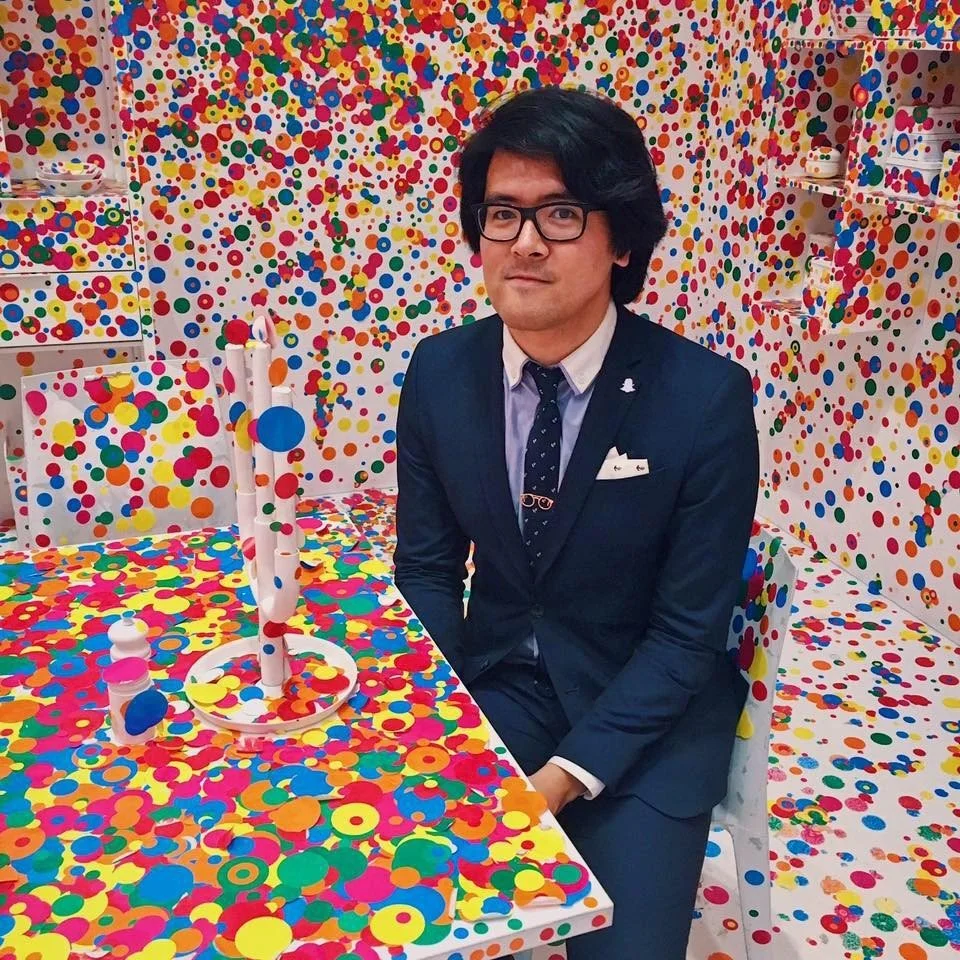
Photo of Trelaine Ito
BIO: Trelaine is originally from Hawaii, but, true to form, he saw the line where the sky meets the sea, and it called him, so he currently lives and works in Washington, D.C. ). He enjoys origami and washing dishes and taking pictures of clouds and sunsets (but never sunrises because he’s not a morning person). His work has appeared in You Might Need To Hear This, The Write Launch, and The Argyle. He can be found at trelaineito.com.