second skin
by Shena Cavallo
One of the last times I saw my husband was a few days after Christmas on that wide avenue in Mexico City, Paseo de la Reforma. It’s funny how, in the end, an entire life, millions of little memories, are eclipsed by a single, relatively mundane moment.
It was late and we went out to walk the dog. Back and forth, we punted the same conversation we had been having for the past two years, or a slightly mutated version of it, in front of a fluorescent pharmacy. Underneath the dog-eared shreds of sadness, frustration, and disappointment was the aftertaste of fatigue, exasperation - how many times could the same lines, the same scene be repeated with fervor and conviction?
Everything felt twisted and faded, but I could still recall what I ate on our first date in a Chinese chain restaurant so many years ago. I remember he had borrowed his friend’s car for the date and I had briefly been thrown off by the “baby on board” sticker on the back bumper.
It’s strange to think you are still the same person, and he is still the same person who sat across from you in the restaurant all those years ago. The cautious optimism, the boundless curiosity are no longer there. Suddenly, you know the other person a little too well.
I had always imagined divorce was something that happened when you are betrayed, when you fight and scream and treat each other poorly . . .I hadn’t considered it was perhaps something that happens when you wake up one day and realize the person next to you, though loved, is not someone who fills you with fire – either sexual or otherwise. There is sometimes no terrible event, no great betrayal or revelation, but an itch that never ceases to irritate you.
I think we had naively hoped his visit to Mexico would somehow revive something between us, but that thing no longer had a pulse . . . if anything, the visit just lay bare how tattered and frayed that thing that connected us had become.
Someone once told me you can’t “stop” loving someone, if there was love once, there will always be love. I’m not really sure. Maybe the love is still there but it transforms, takes up less space, is no longer something that can keep the two of you afloat so a body must be sacrificed.
My decision to marry had perplexed many people. I had recently graduated from college; we had only dated for about 10 months. I had never even been in a relationship before him. I had never really liked anyone before him, not really, not enough to begin to imagine a life together, to see that my definition of home was beginning to include him.
Love stories are mundane to an external observer, and only meaningful for those inside of it. We enjoyed midnight runs to Walmart where we simply would browse the aisles, meandering road trips on windy backroads, and frying turkey bacon at midnight to eat while binging on TV series. He would make me homemade concoctions when I was sick, he never could remember what size I wore, he left me handwritten poems. Everything was effortless in those first years.
Well, almost everything . . .
There was a sound that eventually faded into background noise but would occasionally send me into an existential panic. It was like a mosquito you can hear but you can’t seem to trap.
I could manage desire for men, I even managed love for this man . . .but the kind of love and lust that blinds you, that consumes you . . I had only ever really felt and held for women.
The evidence was there all along, even if I was a child who loved ballet, dresses and dolls and did enjoy the occasional heterosexual fairytale romance. My scrap books were laser focused on female actresses and pop stars with the token headshot of George Clooney in the corner, to throw them off my trail.
I obsessed almost exclusively about female teachers. My cheeks would flush when a teacher I liked scolded me for talking in class . . maybe there was some shame and guilt (I was raised Catholic after all), but there was something warm, bubbly and electric that would surge inside of me too. To this day, the threat of punishment and anxiety often mingles with genuine desire . . .and not in a sexy way, but a rather dysfunctional way, as if my body never knew the difference.
To throw them off my trail, I would select the most inoffensive, shy boy to tell my friends I liked . . . a chubby little Italian boy with a unibrow, another boy who was so shy he could hardly manage eye contact . . . I would dutifully write my name next to the boy’s name, an exercise which felt as mundane and tedious as our cursive writing drills in Catholic school where my clumsy, trembling cursive never looked as elegant as the other girls’. I would even go so far as to write that I liked the boys in my diary, carefully mirroring the words I had heard other girls use.
Later, I found one of these diaries and I thought the 11- or 12-year-old version of myself was pitiful. The words were so empty. . . but I kept writing them. Maybe I hoped over time they would become true. Maybe I believed like all the Hail Marys and Our Fathers recited ad nauseam, these words in my diary would also offer salvation, or at least a way to twist indifference into passion.
But it was no use. Women were who, almost always, made my pulse race. Hundreds of little boys with their compact bodies and fluctuating voices would not fill the void.
I didn’t fake my love or my desire for my ex-husband ... it was there, it was there in the beginning and even for a long time after. But there was still something out of place, something that brute force couldn’t force. . I never could relate when people started falling in love and wanted to spend all their time with that person, when love was something all-consuming that caused other emotions and events to fade, blurry, in the background, when people couldn’t keep their hands off each other in public. I guess I thought I was just fiercely independent, but the reality was, while I didn’t fake the love, there was a part of me still bound up tight. A part of me was observing things take place from a distance.
When I was 12 or 13, I cried on the kitchen floor once as I told my mom I thought I liked women, and it seemed she sort of recoiled that day. I don’t think my mom felt anything homophobic towards me, but I sometimes have felt like I was (and am) too much – too much emotion, too much complexity, too much curiosity, too much enthusiasm.
“I don’t know why you complicate your life so much,” she has told me.
Maybe a part of me married for that reason . . . . maybe a part of me longs to just go along with the crowd, blend in, fade into the background. Maybe if you pretend long enough, you change your form, change your parameters, change your skin. You become someone more easily digestible to the world.
I tried for as long as I could. Until I couldn’t. And at the end of the day, I couldn’t die and not know what it was like to be with a woman, and I don’t even mean in a sexual way, but to build something lasting with a woman, to share the mundane details of life with her, to fall head over heels in that reckless, uncritical way you do when you are young. It’s a terrible feeling when you know day-by-day you are betraying a part of yourself. I was 35 when I asked for a divorce and I knew: whatever skin I had to shed, I would.
Eventually I got what I wanted. I got the divorce.
In those early days, I looked forward to having the bed to myself, to having my own routines. I imagined a life filled with no strings-attached adventurous sex and eventually a happy love story with a woman.
Dutifully, I went to Pride, to queer bars, created profiles on various dating apps, but going through these motions somehow felt forced.
The first time I tried to make a profile on a queer dating site, I realized I had no interest in identifying as bottom, switch or top . . I cringed when I saw things like ‘soft masc’, ‘lipstick lesbian’ . . .I wanted to feel unrestrained and unrestricted . . I wanted to be able to shape shift. It had never occurred to me that the rigidness of roles in your average heterosexual configuration might also translate into queer spaces.
Though I’ve tried on different skins, I’m neither particularly masculine or particularly femme, not in my appearance, nor in my behavior. I’ve tried both extremes and I always feel like I left a part of me outside. And like an anxious dog, it continues to bark. I want to return to it but I can’t remember where I left it.
I’m not interested in replicating versions of the dysfunction that exist in heterosexual paradigms and power relationships with another woman. I look at the social media page of a local queer meet-up and with each image of beer pong, of someone twerking, and swapping Jello shots and saliva, I am increasingly more convinced I will die alone.
I also, if I’m being honest, rarely feel a rush of excitement for women. Turns out my desire is just as selective and limited when it comes to women as it had always been for men. . . or maybe it’s shrunk over time. I make friends easily and have enduring friendships but there is something about me that seems to be a little off, a little stiff when it comes to romance and intimacy . . .It's a defect or quark I mistakenly thought would be rectified by dating women.
I no longer talk to my ex-husband but for a period we did. I wanted to believe we could stay friends. We usually carefully skated around the topic of dating, but once we foolishly, recklessly broached it. He seemed both perplexed and maybe a little bitter when I said there wasn’t one else in my life. . .maybe he wondered why I’d ruined a “good thing” . . .and he became increasingly frustrated when I corrected him when he used male pronouns.
“Why can’t you just be normal? Just date guys, don’t make your life harder,” he said.
I am not ‘normal’ . . .I’m glad I’m not, but I’m also not free. I always have a million thoughts, concerns, anxieties brewing in my head. I hesitate too, plunge into a pit of self-doubt. I also, simply put, don’t like many people . . .not enough to build a life with them, and honestly, not enough to even have a one-night stand with them.
What my ex and others though may not understand is that even if I’m “alone” . . I’m not necessarily sad.
I get it wrong a lot, but the experiences give me clues, insights into myself. That I need to feel the spark, the fire of desire, but I also have to feel safe, I have to feel at home with the other person. It took me years to realize this particular intersection where desire and attraction mingle with familiarity, safety is what I seek and what I rarely can find . . .and without the two things, I find it hard to take the plunge . . .maybe because I also know all the work, the energy that goes into constructing that life together.
I often think back to the responses of my mother, of my ex-husband . . . I’m not sure if I am trying to ‘complicate’ my life or if the life I long for doesn’t fit into neat boxes and standard formats. I refuse to follow a script.
I probably should not be too swayed by anyone’s expectations of me, in the same way that I couldn’t really fit into the heterosexual boxes society set out for me. And I do love the version of myself that wrote those fake words for those little boys. I wish someone had told her that exactly what she felt in the pit of her stomach was exactly what she needed. . . that there was nothing about her that she should be ashamed of . . .that later, other kids would end up living in the same town, married to someone they went to school with. There is nothing inherently bad about that life path, but maybe some of those kids never questioned things . . .they never sought another, more allusive answer.
I could have stayed married. I could have stayed ‘safe’ but I think I always prefer the path of exploration, even if it’s more solitary, more uncertain. It’s filled me with deep angst, but there is also beauty, and I think, potential and pleasure as well.
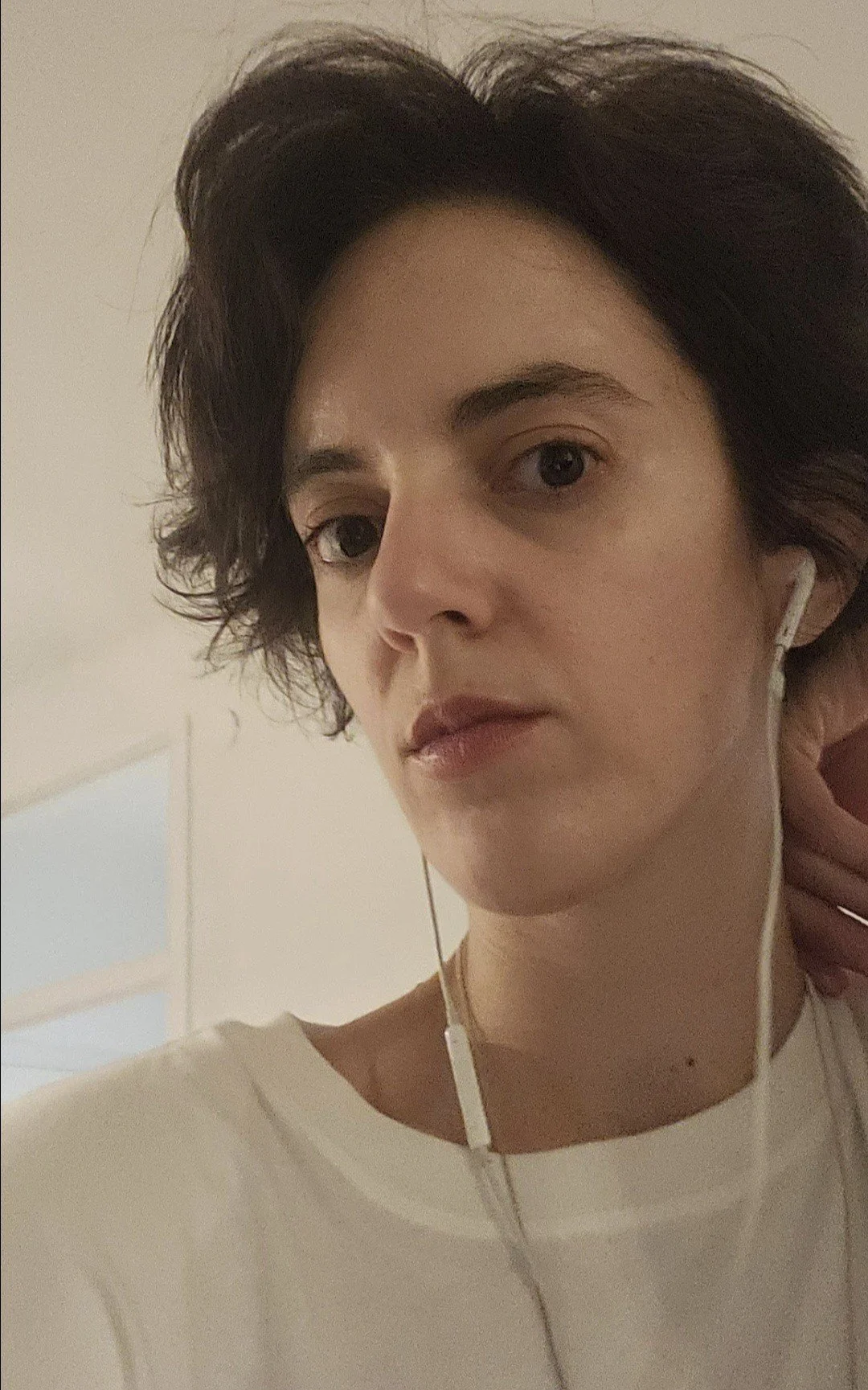
Photo of Shena Cavallo
BIO: Shena (she/they) was born in Oil City, Pennsylvania. For the past fifteen years she has been part of the non-profit industrial complex working in various international non-profit organizations where she has written about human rights, social movements and philanthropy, including for Open Democracy and Inside Philanthropy. Their first creative piece, “Bottomless,” was published last year in the Feminist Food Journal and explores grief, its aftermath, desire and their impacts on the body. Shena has a piece in The Brussels Review’s winter edition, “Junk People”, which illustrates why foraging through other people’s trash makes them feel at home. Saturn-ruled, astrologically speaking, Shena is interested in exploring grief, memory, human connection and making sense of an increasingly dystopian reality. They live in Barcelona with their dog, PJ.