my tlön
by Mohammad Tolouei (trans. Farzaneh Dootsi)
Borges has a story in which a group of encyclopedists gather to write an encyclopedia of a fictional world—complete with its mountains, its seas, and its systems of weight. Then, little by little, that fictional world begins to take shape and come into existence. It makes me wonder whether Tolkien later built the lands, creatures, and languages of The Lord of the Rings with a similar idea in his mind, or whether Borges had any influence on him at all. Each day I sit down at my desk with the urge to build my own Tlön. It is quite likely what first drove me to writing was this idea—of recreating a world from scratch, shaped entirely as I wished. When I create my own Tlön, I become a spirit at peace in Nirvana, yet anxious for the other souls; I watch the characters of my story evolve—from mineral to living being, from animal to human—and I am profoundly unsettled. I know this description sounds somewhat self-important. What I truly mean is not that I’ve reached any real serenity in life, but that I try to inhabit that state while writing—and to do so I’m compelled to invent my own methods of writing as well. An encyclopedist who has to write himself down, too, so that one day he may come into existence. Of course, a personal method of writing is not like customizing software, where one chooses preferences with a few clicks and checkmarks. So whatever I call “my personal method” may well be something I once read somewhere and am simply repeating—or a mixture of the methods of several writers whose way of writing I admired, and afterward convinced myself that I must have written that way from the very beginning.
Building a Sea upon a Sea
People are said to fall into two camps: the watermelon-eaters and the grape-eaters. Or they are further divided in two groups: the athletes and the sedentary. And when it comes to writing, people fall again into two groups: architects and bricklayers. Architects concern themselves with structure and can begin a story anywhere they please; bricklayers build their stories brick by brick, one layer after another. In all these schemes I find myself belonging to both camps at once. I like both watermelon and grapes, and I can never honestly choose between them. Some days I train as though preparing for the Olympic qualifiers; other days I can’t even bring myself to wiggle my little toe. Even on my athletic days, it is hard work. Similarly, I’m an architect who lays my story brick by brick. All year long I’m reading, taking notes, and writing— for the stories I’m working on now, for stories I might write someday, and for stories I may never write at all. I consider a possible plot using these elements, then share my outline—as a five-minute story—with a few people. I select those few people randomly, without prior planning. Beforehand I ensure they’re the kind who will listen to the broad strokes and instinctively spot the narrative’s flaws—people whose minds, at that moment, work purely logically and are grounded in reality.
Each time I retell the story, I revise it, and inevitably I add details to the characters and events. Telling it aloud allows me hear it with my own ears, to sense what is extraneous, and discover the rhythm in which it desires to be told. At this stage the characters themselves don’t matter much; it is their functions that count. In a crime story, the killer could be a sixty-year-old technocrat who has spent years trying and failing to advance, or a thirty-two-year-old man ruined by the stock market. In a love story, the man might be fifty, newly divorced from his second wife, yearning for a relationship with a depressed woman whose daughter died in a car accident; or it could be an aging unmarried woman in love with a man whose daughter drowned in a lake. At this point my characters have neither faces nor genders; it makes no difference whether they studied at the Alliance school or a religious seminary. What matters are their actions and the effect those actions have on moving the story forward. Then, when the story has no more limp spots and everything is in place, I try to forget it. Usually I abandon it for months, sometimes for years. I’m careful not to draw a map of the story anywhere. I keep it only through small hints—like jotting down the name of the scene where the main characters meet, or opening a folder on my laptop. When I finally want to write the story, I remember less of its structure than the reactions people had when I told it aloud—the dinner we were eating that night, the kinds of cigarettes people smoked at that gathering, where each person was standing in the room. Or what scenery we were looking at when I told the story to a friend driving along the Firuzkuh road.² Up to this point I may seem more like the architect type of storyteller; but from here on, I resemble an overzealous environmentalist. The kind who always carry a bag in the mountains or forests to collect stray plastic, and who, wherever someone wants to build a dam, discover an ancient ruin about to be submerged. Because by then my outline no longer resembles a story plan; it’s more like a formless oil slick on the sea, with bits of my notes stuck to it. It’s like pollution I must clean up, and there’s no guarantee I’ll succeed. Often I don’t, and the slick stays in my laptop for years. I’m a kind of environmentalist who creates more pollution than I can save the world from. And even when that slick is finally cleaned away, there’s nothing new in the sea; it’s just that the sea—which was already there—becomes visible again, natural and unastonishing. When the story is finished, I truly think: well, this story must have always been here. And I search through my shelves to make sure I haven’t written it line by line from someone else’s story.
Building a Mountain upon a Mountain
People are said to be divided into two kinds: doves and owls. Doves wake early; owls work at night. Again, I belong to both groups. Some mornings when I wake, I see the mountain opposite my study window, and the sun laying its first morning rays on its ridge. And some nights, when I’ve stayed awake, I see—or rather don’t see—the mountain lost in darkness. I know it’s there, though unseen. It remains in its place. When I have the outline of a story and want to write it, I’m exactly in the same position: facing a mountain that exists— sometimes it is visible, and sometimes is not. Does a writer write more easily when they know the character they’re dealing with, or when they don’t? Each time I’ve asked writer friends, I’ve heard strange answers. Some writers truly rely on their unconscious: when they begin a story, they don’t even know whether the main character is a man or a woman, what they will do—characters behave like wandering pícaros, capable of anything. Others design their characters so meticulously they can tell when the women in their stories have missed a period. Having an idea for a story is one thing; advancing the story with one or more specific characters is something else. From this point on, I become like the bricklayers. The architect who could envision the whole plan disappears. I’ve never been able to write a character from the middle of a story and then go back to design their early traits. Nor can I write a scene first and decide later where it belongs.For me the story unfolds line by line, with the surprises my protagonist creates. As if I’d never known them, or if I had known them, I hadn’t seen them in years—and in the meantime they’ve changed completely, become someone else entirely. So to make sure I truly know my protagonist, I keep going back and rereading the story from the very beginning. When writing a story, I must have reread the first sentence up to wherever I am a thousand times. Because of this, after the book is printed, I can never read my stories from the start again. After publication I open the book somewhere in the middle. I’m afraid that if I begin from the start, I’ll discover the character wants to do something else—and right there I’ll feel compelled to rewrite the story. At this stage I’m like someone who has climbed a mountain several times with a companion, and now that the companion is absent, must imagine where they would place their foot, where they would run out of breath, where they would stop and plant their hands on their hips. Knowing someone well enough to think in their place, walk in their place, breathe in their place—this is truly difficult. That’s why writers turn to behavioral clichés: actions any human might do, regardless of gender or nationality—or, if you believe in life on other planets, regardless of which planet they were born on. The pseudo-science that codifies these clichés is psychology. Psychology tries to classify human behavior, and it’s obvious that when we try to fit the behaviors of all humans into such grids, something crude emerges. Turning to psychology to frame a character’s behavior is as foolish as the old social theorists who classified people by the size of their skulls. Think of people condemned to certain behaviors because of skull measurements—or because of an Oedipus complex. But what should one do? I let my characters choose for themselves. It sounds absurd, but it’s true. They can choose what to wear, how to walk, which university they attended—under two conditions:
(1) They must not explain these traits themselves in the narrative,
(2) Every ability or inability they have must help untie a knot somewhere in the plot.
With these two conditions, any character is free to do anything. In the first third of the story, I enforce the conditions strictly; halfway through, I’m still firm; but in the final third, it becomes clear the conditions constrain the character too much. At that point the character needs an inner monologue, through which one of the most personal moments of their life—something only they could have witnessed—comes to light. Then a hidden phobia shows itself in hysterical behaviors, and by the end the character is constantly revealing themselves. My stories usually end this way: a character realizing that what they are is not what they should be. Like a mountain that gradually emerges, though it wasn’t visible from the start. I can never even imagine writing such a character from the beginning, as if constructing a mountain with all its slopes and grooves already visible. Truly, one of my nightmares is that someone might point to a mountain and tell me: now build one exactly like it—with the same inclines, rocks, and fissures. My work is more like building a path which, once traveled, makes me realize I have passed over a mountain.
Building a Desert upon a Desert
People are said to fall into two groups: either they’re pilots or they’re passengers. Pilots aren’t afraid of responsibility and are willing to make decisions in critical moments; passengers prefer to have someone else be responsible for their lives. When I’m rewriting a story, sometimes I’m a passenger, sometimes I’m a pilot, and sometimes I prefer not to get on the plane at all.
Rewriting is the most important and longest path I walk to write a story—like someone who has deliberately lost himself in a bazaar full of chaos, and only after hours of wandering realizes that he is truly lost. I read the story again and again and keep asking myself: What is it you’re trying to say in this story?
Borges has another story he recast from The Thousand and One Nights:
The king of Greece invites the emir of the desert tribes to his land. He hosts him for ten days and ten nights, and to intimidate him, he takes him to Crete and throws him into the labyrinth of the Minotaur. The emir wanders in the darkness for two days without food or water until he finds the exit. He returns to his oasis full of vengeance. The following year, he invites the Greek king to the desert. He hosts him for ten days and ten nights, then takes him by camel to the heart of the desert.: Here is my labyrinth, he tells the Greek king, Let’s see how you get out of it.
Rewriting, for me, is precisely that desert—where it doesn’t matter whether I’m pilot or passenger; either way I’m lost in it. A labyrinth whose only exit lies in answering the question what were you trying to say?
Not leaving work in the hands of someone else is a virtue. Walking into darkness brings only darkness. Returning to the past is impossible. Revenge won’t make you feel better, but it does salve the wounds of the past.
Usually I find sentences this clichéd and quasi-spiritual scattered through my stories, and I ask myself: Did I really want to say this? Is this seriously what you meant? As if I’d said these lines in a dream, and now, fully awake, I have to decide if I’m ashamed of them. Then I try to rebuild the story around those sentences. Sometimes like a pilot whose engines have failed and is trying to land the plane somewhere less deadly; sometimes like the passenger in that same plane, who has lost hope of surviving. Many times I even rename the story’s file after a famous piece of music or some movie I downloaded from the internet so that even when I search for it, I can’t find it. And then, when I’m looking for that music file, I stumble on the story—left there for months, sometimes years—and once again I’m lost in a desert, and there begins the same cycle of searching for the answer to What were you trying to say?
The best moment of life cannot be kept forever. Loving is nobler than being loved. Joy cannot be given as a gift. Everything in the world has an extension in our thoughts.
The answers I find may be right or may contradict the earlier ones, and they can completely change the course of the story. Once again, the desert in which I’m lost, and the airplane whose pilot and passenger I both am. This continues until I finally convince myself that the story is finished and that nothing more can be done with it. Is this the final point of a story? What if I read it again and realize it’s not what I meant to say? What if I read it ten years later and find that it is exactly what I meant?
I still don’t have a solution for this obsession. Usually at moments like this I comfort myself by saying I have until the age of seventy to rewrite this story, and that publishing it today is merely releasing one version among the thousands of versions I will eventually write. In truth, I convince myself that there is a future—like a mother in a crashing airplane promising her child a place in a prestigious university.
Then, when the rewriting finally ends—usually because of the publisher’s deadlines—the story feels like a desert in which I had been lost.
They say no two deserts are alike, but I can never tell the difference between mine. The second desert is full of footprints of someone who has wandered in every direction, and you can’t even trace the path of how they got lost. Sometimes I feel as if someone put their shoes on backwards and walked through the sand just to keep anyone from following their trail. Honestly, when the rewriting is done, it seems to bear no resemblance to the original story, and one can only say airily: Well, it’s the same desert. When I rewrite, I build one desert upon another.
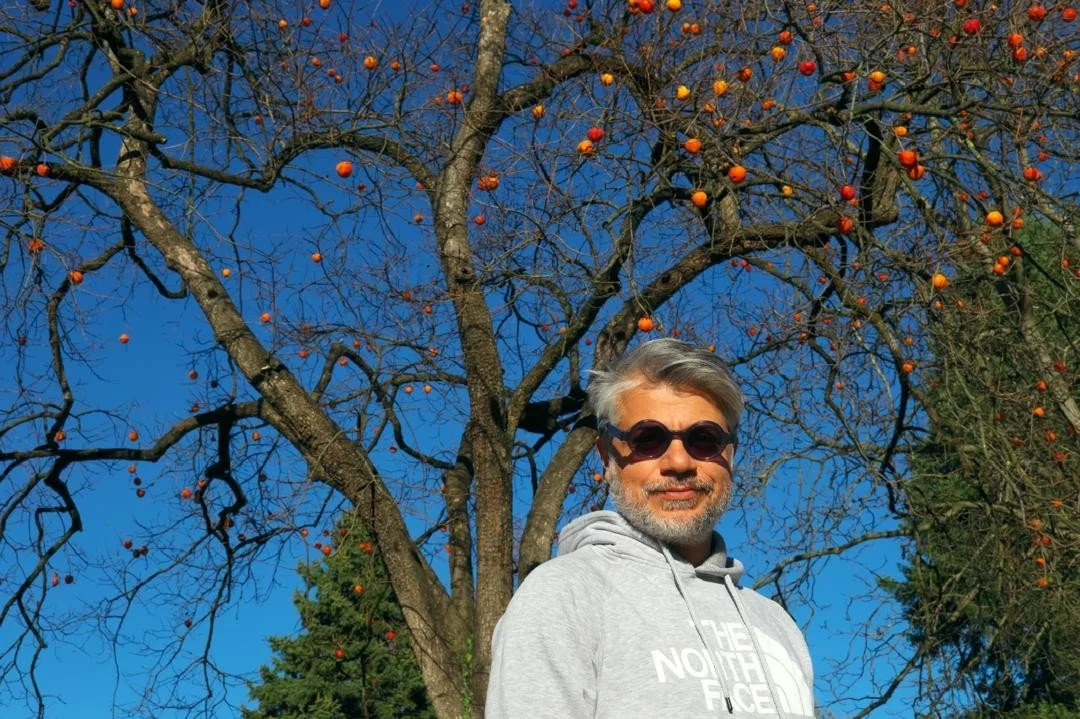
Photo of Mohammad Tolouei
BIO: Mohammad Tolouei, born in Rasht during the 1979 Revolution, is a prominent Iranian novelist, short story writer, and essayist whose works have been bannedby the Ministry of Guidance, yet widely published and celebrated internationally. He began his career in poetry and drama before turning to fiction, with his debut novel Fair Wind’s Prey (2007) winning the Farda Award for Best Technical Novel. Tolouei’s stories have been translated into English, French, and Italian, and appeared in The Guardian, Asymptote Journal, The Columbia Journal, The Massachusetts Review, The Stranger’s Guide, Strange Horizons, The Pesian Literature Review, Internazionale, as well as collections such as The Book of Tehran (Comma Press, 2019) and Iran +100: Stories from a Century after the Coup (Comma Press, 2025). His most recent novel, Encyclopedia dei sogni, was published in Italian by Bompiani (2025). "My Tlon" is translated from original Persian by Farzaneh Doosti with fair use of ai.