by Leslie Lisbona
My mother was at the wheel of her white Caprice Classic Chevrolet. I was seated beside her on the blue velvet seat. She was 66 and I was 30. It was just the two of us this time because my siblings couldn’t come. For the last four years, we had made this two-hour trip weekly to visit my father, but this time was going to be a little different because I had something important I wanted to say to both of my parents. I didn’t think it was going to go well. I fidgeted with my jeans and shifted in my seat.
It was 1994. O.J. Simpson and the Menendez brothers were on trial. Jack Kevorkian and Tonya Harding were in the news. We had recently seen Forrest Gump, which my mother thought was contrived.
I was still living at home, working at a steady job that I didn’t like in order to help my mom with the bills and upkeep of the house. Gone were the acting classes, auditions, and working for next to nothing in Off-Broadway shows. My carefree days of being an actor were over.
The drive felt longer than usual, and I needed to stretch my legs. “We are here,” my mother announced at last as we pulled into the parking lot of the Federal Correction Institution of Otisville, NY. She filed her nails with the emery board that was resting in the ashtray, empty now since she’d quit smoking. She opened the sun visor to check her makeup. “Do I look okay?” she said.
I couldn’t help smiling. “Mom, I only wish I could look as good as you do right now,” I said.
When we got out of the car, my mother adjusted her skirt. “Is it long enough?” she asked. Skirts could be no more than two inches above the knee.
“Perfect,” I said as we stood there.
I left The Bridges of Madison County behind on my seat. My gaze landed on the coiled barbed wire that ran along the top of the tall fence that encircled the prison, and it crossed my mind that we were being watched, even in the lot. “I’m so glad he is going to come home soon,” I said.
Once we were at the entrance, we waited to make sure we were on the approved visiting list to see my father. Each time, I worried that we wouldn’t be admitted or that he had been sent elsewhere, which had happened before.
My dad was convicted of arms dealing, but I knew and believe to this day that he was innocent. I was there in the courtroom when evidence that would have cleared him was not permitted to be part of his trial. I watched as the judge dozed off when my father’s lawyer pleaded his case.
I looked around the waiting room of the one-story prison and saw a child in a stroller. His mother was pouring Coca-Cola into his bottle for him to drink, and I tried not to stare.
I took a deep breath and pressed my lips together, trapping the air in my mouth.
We stepped through some kind of metal detector and then were patted down by an unfriendly officer. My insides were doing something, and I put a hand to my belly. I don’t recall how many security portals we had to get through before we arrived at the visiting room, but it seemed like a lot.
Finally, we were there in a room full of inmates and their families, and my vision narrowed in on my father in his tan one-piece overall, white sneakers on his feet. No ascot or designer jeans, no pipe, Dunhill tobacco pouch as soft as a dog’s ear, or fancy sunglasses.
I should be used to this, I thought. There had been so many of these visits. We had written each other hundreds of letters and read more than a dozen books together. He greeted us with a broad smile.
“Dad,” I said in a gasp.
We were allowed to hug and kiss briefly in front of a guard, which made me feel as if I weren’t hugging or kissing right. I inhaled his skin, searching for something familiar, maybe just the smell of his cigarettes.
“Lozay,” he said with a big grin, holding me by my shoulders.
I stepped aside so he could greet my mother.
“Chérie,” he said, and he folded her into his arms, her short brown hair partially crushed by his embrace.
And then we were flooded with his ritual questions: Was the drive too long? Did we get lost? Were we tired? “I was so worried,” he said.
It wasn’t until we sat down in the hard yellow plastic chairs that I realized how loud the room was. Inmates were animated with their visitors, chairs were scraping along the floor, doors were clanging open and shut, lots of beeps and walkie talkie chatter from the guards.
My parents spoke to each other in a mixture of French and Arabic. Their words were muted and measured. They were immigrants from Beirut, Lebanon. They had lived happily as Jews in an Arab country until they were forced to leave in 1949. My mother wished she could have stayed in Lebanon, but my father wanted to come to America.
While they talked in this noisy room, I wondered why my mother still had such a strong accent and my father had hardly any. As I sat, I examined my father and saw a scab on his bald head.
“How did you get that?” I pointed, making sure not to touch him, interrupting my parents’ conversation.
“I shaved with a cheap razor,” he said, not taking his eyes off my mother.
I tugged at my jeans and leaned back in my chair, waiting for his attention. Waiting for the right moment to say what I wanted to say.
It was understood that I would stay in the house with my mom in Queens until he got home. When I heard that my dad would be released soon, I started thinking of a place of my own. I’d actually seen an apartment in Tudor City, a tree-lined enclave near the United Nations in midtown Manhattan. I didn’t tell anyone, not even my siblings.
There was a lull in my parents’ conversation. Here was my chance.
“Dad,” I began and looked carefully at my mom. “Since you are coming home soon, I was thinking…”.
I’d better just get this out, I thought.
“Dad, I was thinking that since you will be home soon, that maybe I would move out.”
There, I’d said it.
My father’s face fixed on mine; my mother turned away.
What was I doing?
Finally, wiping his eyes, he said, “Did we do something wrong?” His voice sounded uneven. I feared he might cry.
And yet I persisted.
“No Dad, it’s just that …” I couldn’t look at him. “I found a great studio for $800 a month and…” My voice caught. This is it, I thought. How will I ever leave if I don’t say it?
Somehow I continued. “And I make enough money at the bank, and I will be really close to home on the East Side.”
He turned his face from me. My mother was staring at something on the floor, and there was another long silence. I wished she would look at me. She was my heart, my anchor.
“What can we do to keep you?” my father said. “Anything,” he added, and this time his voice was shaking.
I thought, what have I done?
“Dad, Dad, don’t worry, I won’t move, everything is good, I love living with Mom, and I can’t wait for you to be home and we will be together again,” I said. And, “Sorry,” I added.
They took an audible sigh of relief together and left me alone and went to talk in the outdoor area. I sat and thought, I couldn’t have picked a worse time or place to say this, that I will bide my time, and maybe when he gets home, they won’t even care if I move out. I also thought that as awful as my father’s incarceration was, as long as I had my mother, I still had everything.
A little later, our time was up, and everyone was standing, saying their goodbyes. It was extra loud, and I hugged my dad hard. I wondered if I would ever stop fretting about him.
“I will try to call you tonight to make sure you got home safely,” he said, and I smiled at him. Poor Dad, I thought, he longs for our visits and is eaten by worry. “I won’t sleep all night otherwise,” he said.
I watched as my mother hugged my father. This part didn’t get easier, and I looked away.
“Bye, Dad,” I said, pulling my mother along in an embrace of my own.
My mom and I went through security again and got to the car, spent and exhausted. The sky was dark with heavy clouds.
“Put on Patsy,” my mother said. I slipped in my cassette tape of Patsy Cline, and my mother put the car in gear. I had introduced her to Patsy on these long drives.
“Sweet dreams of you,” Patsy sang, and my mother sang along, “every night I go through,” with surprising yearning. The song “Crazy” was slow and like a lullaby; she knew every word. When “Walkin’ After Midnight” played, we sang together about a weeping willow crying on his pillow. “She’s Got You” was the most plaintive one, and my mother and I dug deep and sang with feeling.
Love songs, tragic, like the operas she loved. My mother was ashamed of her singing voice, but not with me.
We didn’t talk much, or maybe we did, but we didn’t discuss my attempt at moving out.
She switched on NPR for “This American Life” as I nodded in and out of sleep, trying in vain to listen. In the end I surrendered until my mother nudged me.
“Thank god,” I said when I opened my eyes and saw a familiar highway.
“You think this is home?” she said.
“When do you think we are home?” I said.
“When we pass LaGuardia Airport,” she said.
And for some reason, this made us laugh.
I spent so much time worrying about my father. He was the focus of my concerns. I should have been paying more attention to my mother though. She died a few days after my father was released. We had gone to the theatre the night before, just the two of us, and she was acting odd, misplacing her keys, not remembering where the car was parked. It was unexpected, an utter and catastrophic shock that to this day, more than thirty years later, is still difficult to comprehend. It was the last time I sobbed with my mouth open. She was my center, and although I wanted that apartment, it didn’t mean that I wanted any less time with her.
I eventually married and moved out, in that order, and it was one of the most hurtful things I ever did to my father.
Looking back, I wanted so much a home of my own. But where was home, I wonder. Was it our old house in Queens? Was it when we passed LaGuardia? Or was it simply being with my mom on all those long drives in our car that felt as big as a living room?
I wish I could be in that car now, with her nail file in the ashtray, near my mother, listening to Patsy, both of us singing, and to hear my mom say, “We are practically home.”
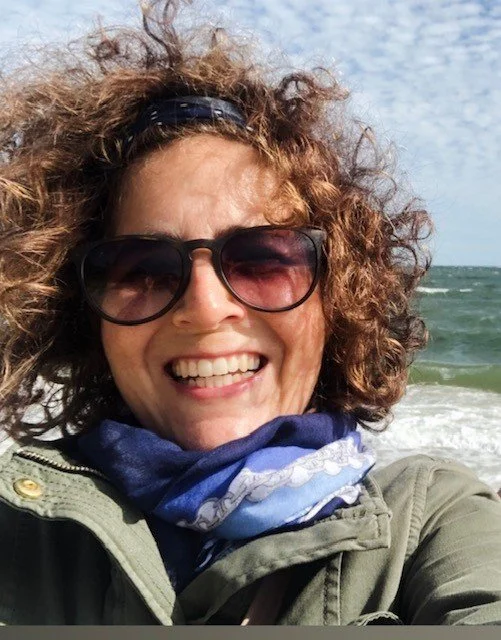
Photo of Leslie Lisbona
BIO: Leslie Lisbona was featured in the Style section of The New York Times. She is the winner of the creative nonfiction prize at Bar Bar Magazine and has been nominated for Sundress Publications Best of the Net. She has been the Author Spotlight for In A Flash. Her work has appeared in numerous journals and magazines such as The Queens Review, Synchronized Chaos, JMWW, Smoky Blue Literary & Arts Magazine, and Welter. https://bebarbar.com/2025-barbes/ She is the child of immigrants from Beirut, Lebanon, and grew up in Queens, NY. You can find her online at https://leslielisbona.substack.com/