growing/dying
by Summer Griffin
The flowers died on Monday. I chose yellow daisies because they remind me of little suns, and I’ve never trusted the real one to stay. I read somewhere that yellow symbolizes hope, and I think some part of me was glad to choose something so uncomplicated. By Tuesday, no one in the house would admit they’d noticed—though something subtle had changed in the air. The vase sat in the center of the table, water gone cloudy, stems bent in quiet surrender. And, every time the front door would open, a few petals would let go and fall onto the floor, nearly blending in with the worn tile.
I kept meaning to throw the flowers out. I kept meaning to do a lot of things. Instead, by Wednesday, I was fishing for the half smooshed pack of Marlboros tucked away in the soup cabinet—smacking the carton against my palms, clumsily grazing over the one flipped in the center. I let my head rest upon the cherry-colored cabinet that frames the kitchen sink, watching the smoke curl toward the ceiling, turning that egg-shell white into a muted yellow. The wilted flowers mocked me from the corner of the room, brown at the edges, patient in the way dead things tend to be.
On Thursday, I changed the water in the vase anyway. I thought that, perhaps if I’d made some attempt at redemption, the once vibrant petals would reanimate. The water smelled faintly of citrus and mold as it poured down the sink—brandishing the rust laden pipes. I wondered if those pipes could separate the bacteria that nourishes from the sort that decays while I scrubbed at the vase’s curved sides, hands gone raw under the water. When I finished, I placed the withered bundle into its fresh home. The stems slowly seeped color into the water, making small reactive bubbles float to the surface, like proof of effort. But, I swear to you—when I squinted my eyes and looked toward that lonely corner, I could see the wilted leaves strain slightly toward the sun.
Friday seemed to curl against my ribs and stay there, like something tender trying to survive the cold. I wonder if this is what grief feels like.
It's strange how much energy goes into keeping something barely alive. My mom told me once, after the death of our family dog, that the only reason I felt so sad was because I had once felt so much love. She did not tell me what to do when the love felt bigger than the body that carried it. I was only a kid then. Kids are easily quelled—and they make magnitudes of the smallest things. Like, when I was a child, I thought the moon would follow me on my drive back home. I made myself believe that if I didn’t tell the moon goodnight, the sun would wake up lonely. Now I stare out the window at night and whisper goodnight anyway. I am not sure where it is supposed to go.
I think there is something so adolescent about how gentle we are with our own wounds. I can imagine that kissing her bruises and pulling out her splinters wouldn’t be so hard for me. But, when it comes time to clean out my own cuts, I can’t help but hesitate—there is a fear of dressing our own hurt. By Friday night, I am convinced that this is what grief feels like.
Come Saturday, the water had gone cloudy again, perhaps a bit darker this time. The stems were nearly black in certain spots, the petals curling inward like tiny hands that might clasp together. Mold spores tainted the water, living but unclean. I should have thrown them away by then. I should have washed the vase and returned it to its cabinet. Instead, I moved the vase behind a wall of unopened junk mail and grocery store coupons.
I moved to the soup cabinet, letting my hands work from memory. My fingers traced the top shelf, searching for the hidden pack. When I opened it, there was only one cigarette left, flipped upside down. I told myself it was especially lucky because it would be my last.
On Sunday morning, I bought a new pack. Without thinking, I smacked it against my palm, tore off the plastic, and pulled two cigarettes free. One settled easily against my lips. The other I flipped upside down and placed back in the carton. Certainly, that one would be the lucky one.
When I got home, the cat had knocked over the flowers. My face flushed hot with anger, the shape of a yell already formed enough to send her skittering away. The water on the floor was thick with decay, cloudy and slow. The vase had shattered. I gathered the broken pieces and carried them to the sink. A few petals clung to the floor behind me. I picked up the flowers and watched them slide into the trash without resistance, as if they had been waiting for permission to be done. When I returned to cleaning the floor, I nicked myself on a tiny glass shard. I rinsed the blood away from my finger and watched it thin into the drain, pink at first, then barely there at all. I winced while I wrapped the wound carefully, measuring my tenderness by the pressure of the bandage.
Tomorrow, I’ll buy new flowers. Tonight, I’ll call my mom and we can say goodnight to the same moon, together. I’ll tell her that I just bought my last pack of cigarettes, and that in the morning, I’ll buy fresh flowers to celebrate.
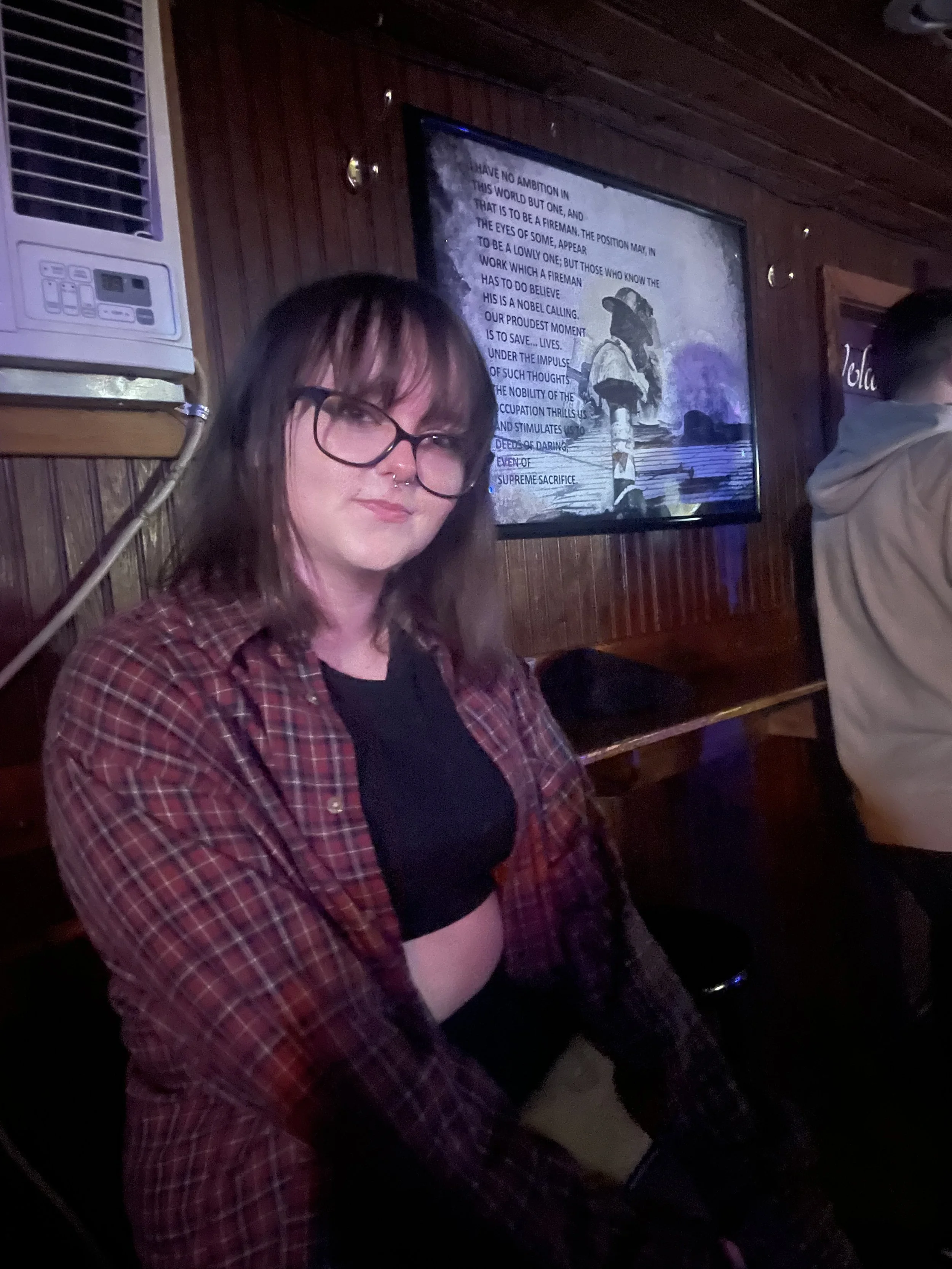
Photo of Summer Griffin
BIO: Summer Griffin is an undergraduate at Seton Hill University, studying creative writing and philosophy. Her work has been published in several print and online editions of the Eye Contact Magazine. She grew up in a small, rural town in Western Pennsylvania, where she spent her youth perplexed by questions of faith and love. She now leads a life in academic pursuit of answers to those questions.