by Bright Aboagye
I was five years old when I made my mother angry. I have replayed that day in my head for years, as a blur punctured by her face, the way her eyes looked fuller than usual, the way her mouth tightened while she held my wrist and pulled me along the road. Only later did I understand that what I mistook for anger was grief, especially since it does not shout or strike and then settles into the body and refuses to leave. She dragged me home as though distance itself had offended her, as though every step away from the school had already been a betrayal.
I do not have a clean picture of what happened before that. Memory gives me distortions and guesses rather than scenes. What I know, and what has never left me, is the knowledge that I had been found kissing Clinton, a boy from my Grade One class, inside the school washroom. There were no adults in the room at the time, but there was enough noise afterward to make the act public. I was the effeminate one and that settled the matter before anyone needed to discuss it. If two boys had done something wrong, then the softer one must have been the cause. I must have started it. I must have led him into it. I must have bewitched him.
This version of the story lasted longer than any other version of my childhood. It was the explanation that followed me into later years, attaching itself to other things I would do and other ways I would move through the world. It explained why people watched me more closely. It explained why corrections came quickly and forgiveness did not.
That afternoon, my mother promised she would not tell my father. She said it in a low voice, as if secrecy itself required careful handling. It would remain between us. No one else needed to know that I had been involved in a kissing game. At five years old, I understood enough to recognize that this promise was not protection so much as containment. Something shameful had occurred, and the task now was to make sure it did not spread.
Promises do not survive contact with family.
By evening, Clinton’s mother had come to our house. She did not stay long, but her visit was enough. My aunties heard about it the same day. News traveled through the family with a speed that suggested readiness, as though everyone had already been waiting for confirmation of something they suspected. My father heard too. I do not remember the exact words he used, but I remember the lesson. Whatever softness I had shown would need to be disciplined out of me. I needed to be corrected into boyhood.
After that, eyes followed me everywhere. They followed the way I walked, the way I spoke, the way I played. School became a place of monitoring rather than learning. Madam Agnes, the teacher who had discovered us, developed a particular interest in my whereabouts. If I stood up to drink water, I could feel her attention. If I joined a game at recess, she watched to see who I stood near. It was as if my body itself had become evidence that required supervision. Her gaze did not relax even when nothing happened, which taught me that innocence was not a state I could return to.
This went on quietly until Grade Three, when Emmanuel decided to name me his wife. It was not a secret arrangement. He held my hand in the open yard. We hugged. We played at being a couple in full view of our classmates. No one intervened. They only watched. I did not yet understand humiliation, but I understood exposure.
Faustina remembers this period clearly. She remembers it better than I do, or at least she remembers it more loudly. She brings it up when it suits her, sometimes with laughter, sometimes with accusation, as though reminding people that I had always been this way. Aunt Martha does the same during family meetings. She does it with the tone of someone contributing to a record, not wounding anyone on purpose, but never questioning whether the record should exist at all. Looking back, I understand why I kept my distance from her. It was not dislike. It was self defense.
After Emmanuel, nothing else happened publicly. If there was a phase, it passed inside me, without language. I learned early that there were things I could not explain, because the words themselves would place me in danger. My body began to feel unfamiliar in ways I could not map onto what adults said about growing up. As a child, I learned to lie on the ground and press myself against the soil, rubbing until something loosened and relief arrived through urine. I did not know what this meant. I only knew that my body sought release in ways that had no audience.
By the time I was thirteen, the sensation had shifted into something recognizably sexual, though still solitary. In my imagination, I took the role of the woman. I searched for men to resemble, though their faces did not stay with me. The details dissolved as soon as the act ended. What remained was the knowledge that this was not how desire was supposed to work. These private rehearsals taught me that attraction did not move toward women. That realization came without drama, and also did not come without consequence.
Church became more important in our household after that, though I am not sure whether the timing was causal or coincidental. My mother attended evening prayers faithfully, and we followed her. Sometimes I fell asleep as she pulled me along the road, my younger sister secured against her back, my elder sister complaining the entire way. On certain days, my body failed me during prayers. When these attacks came, prayer became the first solution offered, and the only one.
I did not need my mother to tell me she suspected something. I knew from the way she watched me, from the reminders she gave about grandchildren, from the concern that mapped itself into her instructions. I spent long hours on the phone with boys from school. My voice softened when I spoke to them. At night, when sleep refused me, I searched the internet in ways I did not understand and even give a name to. None of this was invisible to her.
The word gay arrived formally when I entered senior high school, though its presence had preceded its definition. There were many boys like me there, enough to be noticed but not enough to be safe. We gravitated toward one another loosely, bound more by recognition than by trust. For this, we were labeled. The label was used as a tool. Jesfred pressed my hands during class, telling me it would keep me from becoming too feminine. Thomas sent flowers and called me his wife in front of others, because he wanted me to stop being myself. Teachers participated too. One of them, whose name I never learned, seemed to take pleasure in humiliation. Sick passes did not protect me.
University offered exposure rather than freedom. I learned how queerness functioned in Ghana through gossips and shared secrets. Knowledge moved through suggestion rather than declaration. I listened more than I spoke. I learned about networks, about codes, about men who sought boys and reshaped them into something glamorous and hidden. I learned stories from voices I never saw, including one bisexual man who spoke of Ola, who pleased a pastor while living as a transgender woman. These stories fascinated me and repelled me at once. They promised escape and threatened erasure.
I have never been in a relationship. I know now that I am not gay in the way people expect that word to operate. Attraction arrives for me without the pull toward partnership. I recognize arousal without desire for attachment. Pornography provokes a response, but it does not direct me toward a life. My body reacts. My future remains blank. This is where asexuality enters as an attempt to describe absence honestly.
Even now, my mother remains present in these questions. After my father died, her influence grew rather than receded. She prayed constantly. Her faith organized the household. Protection and vigilance merged. Sometimes it felt as though her prayers hovered over us, jostling against our choices, steering us away from paths she could not follow. When I asked God why I was attracted to men and not women, I also asked why I had been placed in this part of the world, within this particular family, under this particular gaze.
In 2023, answers did not arrive. Desire, such as it was, pressed for expression. I downloaded Grindr, convinced that experience would clarify everything. I walked with anticipation, certain that this would mark the beginning of understanding. Instead, I was kitoed. Men attempted to take my money. Fear overtook curiosity. A pastor intervened and escorted me away. Rescue came from the same institution that had taught me to distrust myself.
When my mother found out, disappointment settled into her expression without spectacle. I tried to defend myself by blaming the men who had promised to buy me books. The explanation sounded weak even as I spoke it. I believed, then and now, that her prayers had driven this outcome, that God had stepped in to shut a door I should not have opened. She sent me to church for hours afterward. She covered the incident, but the warnings were firm. It took time before I recognized myself again.
This is where the idea of the bad child takes root. And certainly, the disappointing one. The child whose existence itself requires constant correction. The child whose desires provoke recriminations without ever becoming acts. I sit now and wonder whether my closeted self, dressed in asexual language, is a truth or a defense. Whether refusing marriage and children is honesty or retreat. Whether faith offers forgiveness or simply another arena for discipline.
I remain Christian. I remain afraid. I believe God sees everything I do not act on and judges me for it. I believe my life has developed the way it has because of these unspoken deviations. I believe suffering follows misalignment. At times, I imagine God urging me to vamoose from myself entirely and begin again as someone simpler.
And nonetheless I stay. I stay with my mother’s devotion, her constant attendance at church, her hope that prayer will realign what she believes has gone wrong. I stay with the knowledge that I have not lived up to the person she imagined. I stay with biliousness that rises when I consider how much of my life has been influenced by avoiding further disappointment.
What I understand now is that disappointment formed slowly, through habit. It learned my figure and configured the spot to sit. By the time I could name it, it had already arranged the furniture of my life.
My mother never said you are a bad child. She did not need to. The language of disappointment works best without accusation. It relies on implication, on prayer requests offered for your benefit, on testimonies that arrive dressed as warnings.
I learned early how to present myself as improved. Improvement became a posture. It required alertness, a constant readiness to adjust tone, gesture, interest. At home, I monitored my speech. At church, I monitored my face. I knew when to bow my head, when to lift my hands, when to keep them still. Faith became choreography. If I performed it well enough, maybe it would stand in for whatever was missing.
The trouble with discipline is that it trains the imagination. Once you accept that something inside you needs correction, you begin to search for it constantly. I watched myself from the outside. I catalogued my impulses. I rehearsed explanations I hoped never to use. Desire did not disappear. It became something I studied, something I argued with, something I tried to outthink. The effort felt like jousting against an opponent who never showed his face.
There were days when I believed I had succeeded. Days when nothing occurred and days when the future appeared manageable, formed around work, faith, restraint. On those days, I imagined myself as someone my mother could trust without worry. Someone whose life would confirm her prayers. Someone who would not require constant intercession.
Those days did not last.
What returned was lust and confusion. Attraction without destination. A body that responded without offering a plan. Language failed me here. Gay felt inaccurate. Straight felt dishonest. Asexual felt partial. Each term solved one problem while creating another. I began to understand that naming myself was about survival. If I could choose a word that asked nothing of anyone else, perhaps I could remain intact.
When I think back to that day when I was five, to the walk home, to her hand on my wrist, I no longer search for the original mistake. I search for the beginning of a role. The child who must not add trouble. The child who learns that love requires management. The child who understands that confession does not guarantee relief.
Everything since then has been an extension of that lesson.
In school, I learned to anticipate correction. In church, I learned to preempt judgment. In adulthood, I learned to regulate possibility. The world responded positively to this version of me. Teachers praised my discipline. Pastors praised my humility. Family praised my seriousness. No one asked what it cost.
This is how I became skilled at silence.
As I write now, I recognize how often my life has been induced by recriminations that never occurred out loud. I anticipated them so thoroughly that they became unnecessary. I corrected myself in advance. I punished myself privately. I offered compliance as proof of gratitude.
If I am honest, part of me still believes that disappointment defines me more accurately than desire. That what I have failed to become matters more than what I have refused to pursue. That my mother’s faith stands as evidence of what I owe the world and have not delivered.
I do not know whether God condemns me. I know that I have learned to do that work myself. I know that faith has given me structure and fear in equal measure. I know that my body has taught me truths my language struggles to accept.
If I am the bad child, it is because I learned early how to hold disappointment without letting it spill. If I have disappointed my mother, it is because I survived long enough to become myself under her prayers.
I do not know what redemption looks like. I know what endurance looks like. I have been practising it since I was five years old.
And I am still here.
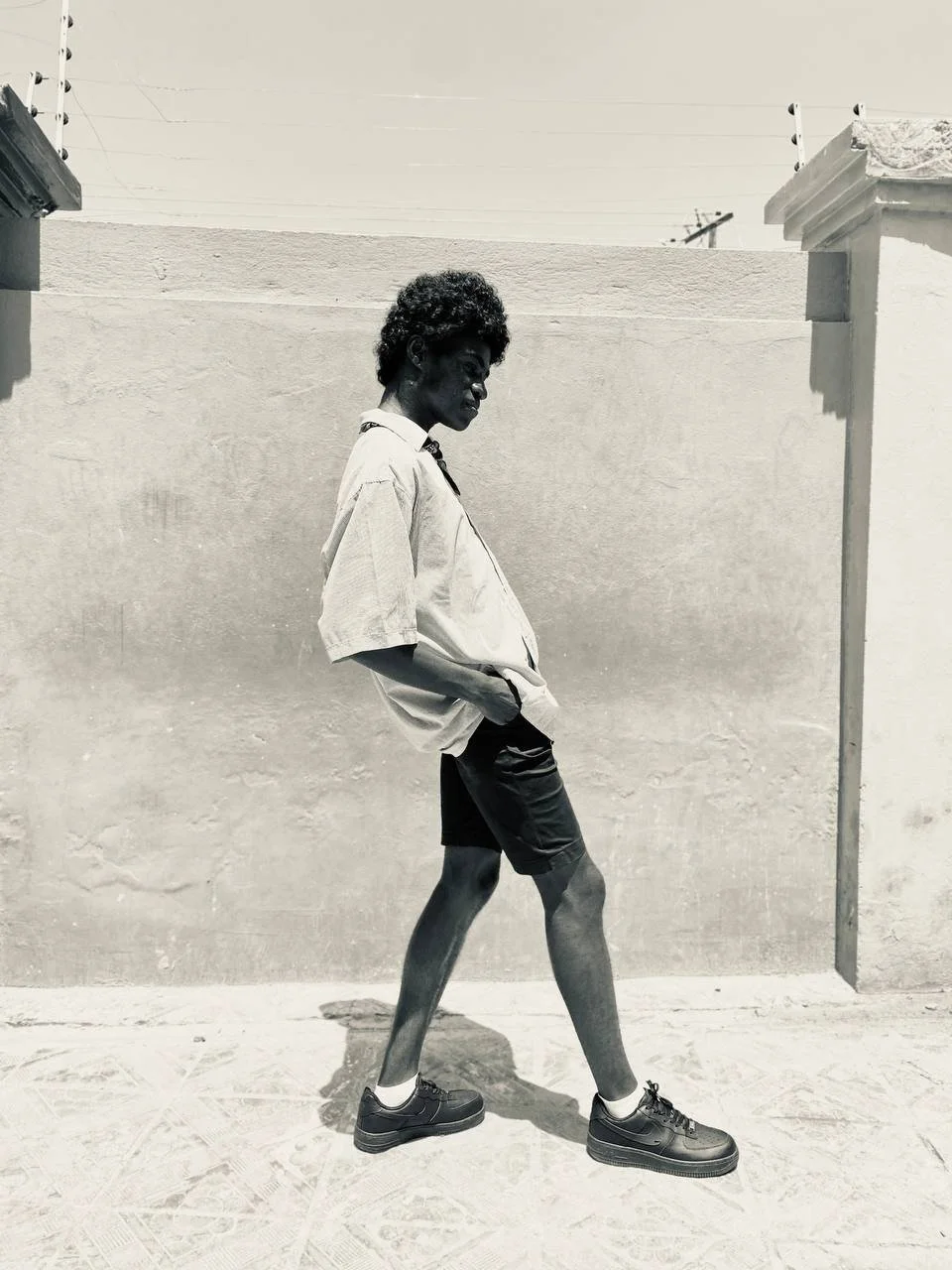
Photo of Bright Aboagye
BIO: Bright Aboagye counts Aja Monet and Akwaeke Emezi amongst his influences. He dreams of becoming a surrealist blues poet, writer, and restaurant entrepreneur. Bright hopes that his work inspires and gives hope to all who engage with it. He can be found: Twitter: Bright_Abo9gye, Medium: https://medium.com/@briswift34, Blog: http://tayyashh1912.blogspot.com/ and LinkedIn: https://www.linkedin.com/in/bright-aboagye-1990552b7