don’t tell god
by Tafara Gava
The first day of boarding school accosted everyone with the haze of fabric softener and the shortcoming rain. I didn’t tumble out of my mother’s little Honda like a doomed hatchling. I was there to assert myself, to live as an academic assassin. My maternal grandmother decided my calling was medicine. She thought having a grandson who worked as a doctor meant free hospital visits. I felt as if I were being forced to wear an ill-fitting tuxedo. Anyhow, I collected what were now all earthly possessions: a black iron trunk, a single pack of bed linen, and a red Toyota backpack stuffed with blank exercise books.
The ease in my step wasn’t stoicism. It was acute cluelessness.
I was yet to realize that I was the hatchling Natural Selection had marked for extinction. I was as hapless as a baby zebra frolicking somewhere in the Serengeti. I was the only child in a house full of women, and the most I’d interacted with males was through National Geographic, watching male giraffes whoop each other down with swaying necks. There was Petros, an occasional neighbourhood bully. He taunted me for never joining a make-shift soccer game. “All he does is dance with girls...” For the most part, my eccentricities amused friends, neighbours, and relations. I’d leave them in fits of laughter. When I was seven I signed up for rugby because I’d confused the r words racket and rugby. I showed up enthusiastically for racket, but there were no starched white shorts and skirts, graceful racket swinging, or the wondrous arc the tennis ball makes as it flies above the net. I learnt two things quickly:
1. Rugby is NOT tennis
2. I make a better rugby ball than a player.
I was the antithesis of a boy. True boys wore bruises from mischief like military decorations. Some were cynical (because their parents were dead or divorcing or drowning in drink). Other boys mistook their arrogant pessimism as wisdom. Being neither the sage sort nor the soldier kind, I was a sister boy.
A sister boy is a boy who acts like a girl.
Sister Boy was a name I’d learnt from watching the movie Tea & Sympathy, a black-and-white Metro-Goldwyn-Meyer film. I found it on TCM one day and was immediately struck by the sister boy’s delicate and brooding handsomeness.
What made me set the TV remote down was how much the Sister Boy resembled Spider-Man actor Toby Maguire. Their faces are both sharply but delicately defined, blue eyes always yearning for someone or something in the distance. My twelve-year-old self lay on the carpet of the living room and turned TCM’s volume up high to find out what the hell Spiderman was doing in a black and white film from 1956.
The Man Who Resembled Spiderman starred as “Sister Boy” (the actor’s name was actually John Kerr).
At any rate, in the movie, the Man Who Resembled Spiderman is sent to an elite boarding school. He does everything but wear a Spiderman suit and, well…be Spiderman. He finds himself surrounded by “soldier boys”, worshippers of a boarding master and American football. Unlike other boys, he doesn’t like American football, rough-housing, or fantasising about women’s genitalia.
So the other boys called him “Sister Boy.”
Sister Boy's father had sent him to a single-sex school to try to rid Sister Boy of his sisterliness. I found my nose against the warmth of the TV screen, palm pressed on the glass in commiseration with Sister Boy. I had just graduated from primary school with distinctions in Mathematics, English, Shona, and Science. Little did I know I was about to walk into the TV to take up Sister Boy’s fate.
At this point, it had been arranged for me to attend Saint George’s School for Boys. Zimbabweans regard it as Zimbabwe’s Eton. Its prestige is vested in a century-old castle converted to classrooms and student halls. It offers multiculturalism and rugby pitches wherever the eye wanders. I was admitted there solely based on academic merit. My favourite aspect of Saint George's was its optional boarding program.
Sister Boy was sent to a horrid boarding school, but my life would largely stay the same.
I’d never leave the side of my mother, or my youngest aunt Madeline, or the house-help, Tendy. I considered Tendy my closest friend. Madeline and I would continue waging wars against each other over Cartoon Network and MTV. Fighting for the remote was how Madeline and I loved each other. Our house, a small bungalow in a highly populated suburb of Harare, was purchased by my father before he died. It would be my boarding house.
One day, Mother came home early from work as an auditor for Zimbabwe’s Reserve Bank. She wore a gloom on her face. Her shadow was heavy with what she could not say. She told me to wash and dress. The Honda waited outside for us to drive somewhere I still didn't understand. She broke the news.
“T., I don’t think we can afford Saint George’s.”
“But I’m not going to a boarding school. We talked about this.”
I pointed out the crimson blazer and orientation packet we’d received. I pointed out that I told all my friends in primary school that by the end of my first year at Saint George’s, I’d have one white and one Asian friend (needless to say, I’d gone to an all-black primary school, so all my friends were Shona-speaking Zimbabwean blacks). I told one boy named Gondo I was going to learn French because Saint George’s offered French. His perfunctory wow belied his annoyance.
I knew my classmates found me annoying.
Either way, they had to know. It was their only option.
Mother knew all these things, and as I pointed them out, her face grew gloomier.
Mother always talked to me like a close friend. If I misbehaved, the softness of a bruised voice sat me down to talk about how it made Mother feel. After all we’d been through together—a car crash, losing Father—the last thing I ever wanted was to see her cry. My philosophy, as far back as I remember, was to do well in school so that all the prizes and scholarships would make Mother forget that Father had died.
“T., I can’t. Do you see how expensive everything keeps getting? Remember the time bread was a million dollars, then by the end of a fortnight it was a billion dollars. My other fear is even if we can just afford the school fees––what about school trips? Saint George’s doesn’t visit Harare City Library or the Africa Unity Square. It visits other countries—museums in the UK or rugby matches in South Africa.”
I swallowed hard.
“T., I don’t want a rich white boy laughing at you because you live in a crowded black neighbourhood or that your mother drives a car from 1995. How can we drive that thing into a Mercedes parking lot?”
She asked her twelve-year-old son to reason with the following:
1. The Zimbabwean economy, the world’s most serious case of hyperinflation since Germany and . ……….Hungary after World War I,
2. Electricity and tap water visiting as infrequently as a down-and-out father
3. Many Zimbabweans waiting in endless lines for a single loaf of bread as a Cholera outbreak razed . ……….them down.
I broke into a keen.
“T., listen, the other thing is you’ve been around women all your life. Me and your aunts are always around you. Don’t you think it best to live with other boys, play with other boys and learn how to be a man?” When she said this, I felt as if all women or anything remotely feminine had betrayed me. Since my father died when I was four, women were all I’d ever known. In new surroundings, a girl invariably came to my lone corner, to ask my name, and what it was I was thinking. Girls always had room for one more guest.
Mother continued that the headmaster of a highly revered mission school had called her earlier that day. The internal reaction was to cry more. Crying itself would be my argument against this sedition. I thought I’d failed this school’s entrance tests the previous year. I’d cursed it for insulting my intellect, and so banished it from memory. As it turned out, this school had put me on a waitlist. Mother impressed on me the significance of a place there. “It’s not fancy like Saint George's, but a lot of doctors, lawyers and politicians studied there. I talked to my friends at work and they said Saint George’s is fast becoming something purely decorative.
Make no mistake: the boys from the new school came from families as affluent as those at Saint George’s. There was, however, something Spartan about this new school. There was a fraction of Zimbabwe’s elite who’d inadvertently made brats out of their sons. The fathers, oligarchs of Robert Mugabe’s oligarchy, wanted discipline flogged into their sons. They wanted their sons to experience the humble beginnings they’d emerged from. Where Saint George’s coddled students like little heirs to thrones, this Catholic Boarding School took its students in like a rancher would a herd of cattle. The priests and sisters ran it like a military school. The school fees were thrice less than the fees of Saint George’s because they didn’t need a castle or a parking lot stocked with BMWs.
Mother said Robert Mugabe had decided this fate for us.
She told me to hurry and wash so we could get all our money back from Saint George’s uniform shop. I bawled all the way, the sky outside blackening with rain. It was December, mid-summer, and soon I’d own a blazer as green as Harare’s albizia, munhondo, and msasas. The Jacarandas showered lavender petals at the Honda’s windows like a wedding party showering matrimony with rice grains.
Saint Build-A-Bear College renowned itself with a 97% pass rate for the Zimbabwean version of England’s GSCEs. It churned out heart and brain surgeons sans relaches. Its seat is a mountain an hour’s drive from Harare, Zimbabwe’s capital. You exit the city via a highway named Enterprise Road (even though nothing enterprising seems to occur the entire duration of this road’s length). All the roadside offers is the ebullient greenery of the richest of Zimbabwe’s sloping backyards. Enterprise Road curves thrice until it passes the Chishawasha gas station. A smaller road offshoots from Enterprise Road, leading into something of a small town. The tar thins to rock and dirt.
I was always unprepared for the jolt of wheels shifting from fine tar to rocky dust.
Dust tailed you down the dirt road winding through the feet of green mountains. Another small dirt road suddenly appears to your left. You abandon the initial dirt road
for this one, leaving the former to wind on towards Santa Dominica, an all-girls Catholic boarding school. The Jesuits have occupied hectares upon hectares of this land since the turn of the 20th century−−building clinics, schools, and seminaries. The last dirt road you take runs up the slope of a mountain so great that it hosts two satellite transmitters. The mountain is shrouded with acacia, bay chestnut, pear and rain trees–shrubbery of pigeon berries, fire bushes and the lantana camara flanking its dust roads. The green grows darker as the trees' umbrella-shaped boughs spread like open hands above it. It’s then that Saint Build-A-Bear’s brick-red walls emerge. Saint Build-A-Bear only permits entry through an iron-mesh gate.
It has this in common with prisons.
Your parents brought you to the gate a sapling. Six years on, they’d take you barrel-chested, deep-voiced, hirsute, towering, knowing more about sex than you ought to—but altogether ready for medical school abroad.
The Sunday afternoon I arrived at Saint Build-A-Bear—all the other hatchlings were in green blazers, too. They moodily trailed their parent’s restless shuffling, offloading school trunks and bed linen. For some reason, we all wore matching green hats with wide floppy brims. It was clear from the scowls on our faces that we’d worn them under duress. I don’t remember anyone ever wearing them again. Should a wind have accosted us, the brilliant shine of our shorn heads (seventy-two in total) would have escaped.
I remember the other hatchlings slumped on newly made beds, a mere breath or blink away from bawling. My eyes weren’t watery or reddened as theirs were. Mothers and their maids explained for the umpteenth time how laundry irons worked. Some of the little boys looked at the laundry iron like a gaming console they’d never heard of.
“This is not a PlayStation, please. The headmaster should never call me with news of arson. We DON’T iron little underwear briefs...” Came harsh whispers.
Most fathers stood outside, leaning against cars, drinking. Some accosted the boarding master to deposit hundreds of dollars in pocket money. “Keep it on his behalf, my little boy will spend all of his money on chocolate in a week…”
I didn’t lower the hat’s stupid brim to betray any sign of weakness. To the end of being an academic assassin, to the end of being a medical doctor—I prompted myself to imagine Saint Build-A-Bear as an adventure: a starring role in a reality show about a black African boy who loved old Hollywood movies and was sent to a Spartan catholic boarding school. Reality shows had only recently been thrust to the forefront of the world’s attention: Being Bobby Brown, The Osbournes, and the one with Paris Hilton are many examples.
I was designated dormitory no.6 and a bed right by the door. Twelve boys occupied this dormitory, as did the ones in dormitory no.5 to no.1. Your bedside was not an end table but a made-in-China PVC bucket for laundry. Twelve boys slept across each other (six against one wall and six against the other). A slab of gleaming red cement divided us like a cathedral aisle. It was called a “locker-top.” Beneath it—brick-built—our individual lockers awaited the dispensation of potato chips, jams, toothpastes, soaps or that ghastly bog green blazer. From the ceiling, off-white and sagging, a speaker-like apparatus hung limply. Worn red and black wires battled gravity to keep it up. No discussion was as heated as the one about the function of this device, its past life. One would swear on their grandmother that it was a broken fire alarm. Someone, bare-topped, would leap onto the locker-top and fiddle with the wires, arguing it looked like something from the 60s. This boy concluded that it was a speaker Jesuits used to read bedtime stories to students in the 60s.
I still feel the weight of abandonment after the dreaded separation. I calmly shut the door of dormitory no. 6, turned around to eleven heartbroken little boys, confused about what to unpack and pack, to sit or to stand.
“Well, boys, it’s time to be men, I suppose,” I said, arms akimbo like a documentarian on National Geographic.
I garnered a few weak smiles.
Smiles all the same, I thought.
We exchanged names and caught the light outside dim to darkness.
Someone said the head boy (another word for school captain, a senior student elected by the powers that be to enforce rules) would summon all the boys shortly.
Mars was his moniker.
Occupants of dormitories no.5 and 6 caught sight of Mars down the corridor. He stood at the doorway of what would be our common room, feet in glinting oxfords set wide apart, one hand in a trouser pocket and the other playing with a jumble of keys. His barrel-chest bulged through his special white blazer. He tended a beard and played rugby. He must have lived the life of the tall, dark, and handsome. Perhaps he’d proved himself something of a war god on the rugby field, much like Mars was in Roman mythology, but only in the sky.
A storm accosted Saint Build-A-Bear the night of our arrival.
Mars, through his eight subsidiaries known as prefects, shuffled all seventy-two boys into Junior House’s common room. Inside, a brass Jesus, nailed to a wooden cross above a TV set, looked down at us pleadingly. There were rows of iron-legged benches, tubular-framed with teak seats and backrests. Stiff was the wood against our buttocks. Only the rain firing window panes, and the shuffling of feet in brogues dared tread the frosty silence. Mars’ eight subsidiaries presently entered the common room.
The prefects stood before us in cream blazers adorned with accolades. They looked like a late 90s boy band ready to break into a ballad about heartbreak. Mars didn’t need a microphone. His was a baritone unperturbed by the thundering outside. He said, "Good evening, gentlemen.”
The address felt like wearing a tuxedo sizes larger than my body.
I’d never imagined myself a gentleman.
Gentlemen were people who’d died on the Titanic—preferably saving women and children. I’d watched the movie ad infinitum since age five.
Mars’s audience was not this. It was only a lot of plump cherubic faces. I decided to keep this technicality to myself. It wasn’t a classroom. Any hand-raising and subsequent opinion voicing seemed highly inappropriate. In the days that followed, I realised we were only ever referred to as gentlemen when we were in a collective, like in a classroom or on a sports field. Individually, we were no more different than the Victorian chimney sweeps in William Blake's poems and Charles Dickens stories. M'fana, a Ndebele or Zulu word meaning "small boy," was often used to summon a student to take up a chore.
Mars said if we were terrified of him and his prefects it meant their work was going swimmingly.
Prefects tolerated no insubordination: speaking out of turn, casual conversing as orders were read out and most importantly, farting. Saint Build-a-Bear was the sub-Saharan version of 18th-century Siberia. My catholic boarding school handled us like little Raskolnikovs or Mitya Karamazovs–––human beings who killed their fathers or frail hags. Mars reiterated there were many a tangle of shrubbery needing pruning, a quadrangle of lawn overdue for slashing.
“That said, gentlemen, here on this land, the people you should fear most are the Japs,” Mars said.
The Japs weren’t at all Japanese.
Jap simply stood for Junior Associate Prefect.
This explained why no one called them Krauts or Toms.
Japs were the most noteworthy nine students in Year 4. The most avaricious for power, they’d campaigned for the post from their first day at Saint Build-A-Bear. They staged campaigns through working up hierarchies of clubs or sports teams, earning dossiers of A+ school reports and sports trophies, and playing sycophants to teachers. Some boys held a conspiracy theory that the wealthiest parents heaped donations into the school so their sons could be Japs. Having worked tirelessly for three years for the post, most Japs ascended to their thrones like sixteen-year-old African dictators, little Robert Mugabes or Idi Amins. Bloodlessly, they sentenced entire classrooms to slash a lot of grass (even if only one student had farted or cracked a joke). They inspected our dormitories with the seriousness of a battalion commander. Uncombed hair and unpressed uniforms were easy prey. Nothing was as satisfying to a Jap as the sight of a mass flogging. The Japs were announced during the first school assembly.
Anticipation and anxiety charged every student on these Mondays.
Mars boomed school rule after school rule. The rain slammed window panes. Boughs wailed and leaned. Mars came to the last commandment with a pregnant pause. “Gentlemen, the most important commandment is not to engage in acts of homosexuality. Simple.”
Homosexuality was when two boys were caught kissing.
Summarily, Mr Gumbo, junior house’s boarding master, was applauded into the common room. He looked like a retired boxer. He was bald and lantern-jawed. He moved his tall frame in long strides. He was a fourth-year mathematics teacher. He flogged his students till each earned an A+ in Cambridge Ordinary Levels. Mr Gumbo walked to Mars like an actor going to receive an award. He introduced himself in a voice much like a deep bark. He asked for names. He didn’t care for your first name, what mummy called you. What was your surname? What was the name your father had given you, as his father before him and his father’s father?
I squealed my last name to the incitement of giggles.
It was the sound of my voice, wasn’t it?
Even Mars broke his composure momentarily.
Mr. Gumbo remained unfazed. “Good and well, gentlemen. Now look around the room.”
There was a sudden scurry of looking. We shifted in our benches.
“Good. Now stop looking! My point is, these are the faces you’ll see from now on. Forget your little primary school chums and little primary school girlfriends. These boys around you shall be your comrades. They’ll be life-long friends or very important connections at the least. If you seek a mother father brother sister it is in the boy next to you.”
Mr Gumbo expressly said we were NOT to find lovers among the other boys.
There was another uneasy silence. It was like a lurid coloured balloon, high on helium, had just floated into the room, and no one knew what to do with it. Mr Gumbo let us simmer in the silence. He spoke of two boys kissing and groping each other in the dark as the symptom of some scourge. He alluded to having presided over junior house long enough to see things a man never should. He was determined to treat outbreaks of homosexuality like a public health crisis. Our private parts were to be masked at all times–even in the communal shower. He spoke of protecting oneself from homosexuality as if it were a variant of the Spanish flu that disfigured testicles.
My eyes widened in horror.
I immediately saw my sexual awakening being less of an “awakening” and more of a “foisting.” It wouldn’t be a private path, an aggregate of time-long thoughts, curiosities, and urges finally ejaculating under a bedsheet in the cover of dark and solitude. The older boys, upon returning from holiday, would probably expect me to be a precocious little pervert. Before boarding school, there never was a sexually desirous bone in my body. When I walked before a mirror or window shop, I caught sight of a scrawny thirteen-year-old who’d never masturbated or clicked the many pop-up images of naked women on the internet.
Was I going to have to know things like Pornhub or what an American rapper named Lil Wayne meant when he rapped about turning someone’s pussy into a fire hydrant? Would my main preoccupation be daydreaming about breasts? Gaze glued to the common room’s cement floor, I thought over these things quickly. Whenever a woman’s name came up in conversation, I’d have to voice my opinion on the shape of her body. I would have to lie that my favourite football team was Chelsea because there was a girl I knew in primary school with the same name.
It’s true that there was a girl named Chelsea in primary school and that she was quite pretty. She was fair-skinned and had a ski-jump nose. The truth is, my desire for her (or any other pretty girl) was not erotic. It was mimetic. I desired Chelsea the same way a Vogue Magazine reader desires Rihanna—a desire neither romantic nor sexual. Mimetic desire is the desire to be Rihanna.
At any rate, Mr Gumbo moved the subject to the routine of a Saint Build-A-Bear week.
The change in subject was met with collective relief. Widened eyes relaxed, dropped jaws picked up. I was the most relieved boy under glaring fluorescent light. As I said in the beginning––there wasn’t a sexually desirous bone in my body at this time. All around were sexless black cherubs, gazes hooded by matching bog green school hats with floppy brims. Even if I were knee-deep in some voyage of sexual self-discovery, none of the boys were, should I say…sexy.
However, I remembered vaguely liking a boy in kindergarten. I remember feeling a light warmth in my chest whenever he was around. Hearing his name called made it hard not to smile. I remember regretting these feelings after he vomited up his lunch one day. After this, I forgot that one could like people in this way all throughout primary school, from age five to twelve. When Mr. Gumbo talked about boys in romantic relationships, I quickly became achingly conscious of this taboo of this part of myself. I buried the taboo like a murderer would a corpse.
Presently, as Mr Gumbo droned on about something or other, Sister Boy flashed in my mind. His beautiful face was tear-soaked and scratched as he ran through a tangle of wood, falling now and again then quickly righting himself to part the brush, to flee a battalion of soldier boys barking for his blood.
This is neither here nor there but the image came to me in black-and-white.
I tied the feet of the sister boy in me to a millstone.
I sank him in the deepest pit of my heart.
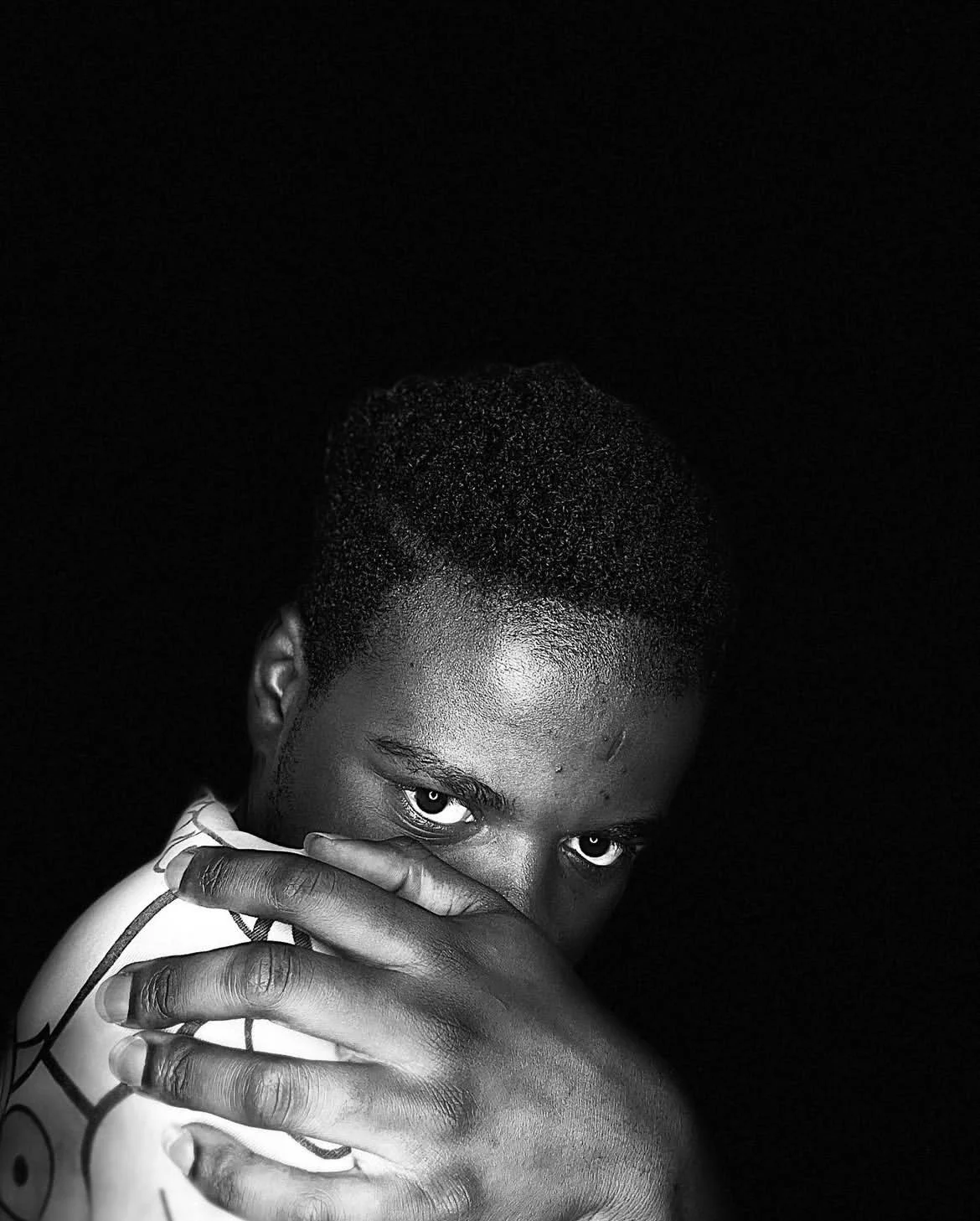
Photo of Tafara Gava
BIO: Tafara Gava is a Zimbabwean-born poet and novelist. His life is divided between his hometown Harare, the Black Forest in Germany, and various East-Coast cities in the U.S. His work has appeared in the Poetry Habitat.