by Tom Stuckey
II
There were many moods in the day, and they changed quick and often. Ted noticed them more now that he was alone and isolated in his lucidity. In the morning, it could be as if the coldest winter had crept into his body during the night and begun to kill off his nerve endings that attached him to life, and by lunch, after exercising and cooking some good oily fish that he had grown to love as a pure source of life whilst at sea, he could feel the joy of false spring returning (with maybe a break in the clouds and some sun falling on to the stone walls of the lighthouse). It was the depths of winter, however, that this hopeful routine became more difficult as the longer periods of despair set in with the lack of sun. On these days, Ted liked to remember some of the things about the mainland that he truly hated and that made him feel so small and hopeless, such as telephone calls to the banks, power and insurance companies, arguments with neighbours over parking. Cities that ran on foul news feeds and produced all the angry people you could never hope to meet. That was enough to make him smirk under his blanket, get up, build the fire, and fight back against the death that hunted him. He had to keep moving, and that was all he needed to know for now. After the fire was going, some hope did return, and he felt powerful, in that he was self-fulfilling—the actions he took were risky, but immediate; he was in the wild of the sea, but he was strong and did not need to answer to any calls anymore in order to live. Ted had not given it much thought that the company had stopped sending aid or reinforcements and maybe this was a part of the surviving that Ted liked the most; over time, this had become his island, and (most of the time) this was ok. He had made connections with some of the fishing boats and arranged for supplies to be brought to him when needed. The VHF radio and a CD player were all the technology he needed. With the small room sufficiently heated, Ted picked out one of the classical anthologies and pressed play on the little CD player then fixed open the receiver on his VHF radio, using an elastic band, and looped it to the speakers; the music flooded into the different rooms of the lighthouse as he began to clear away some of the leftovers and empty glass from the previous night. He slept in the room with the fire, but the kitchen area was above, and he climbed the little spiral staircase automatically. He knew every inch of space that was available to him with amazing accuracy. As he did, he passed a small picture of Helena, which he was sure was different than the one he had hung—the face was sadder and the eyes slightly haunted as she looked out over the railings of the lighthouse’s little catwalk that was under the parapet of the lamp room above; she looked down onto the little pier, where the tender was protected from the main swell.
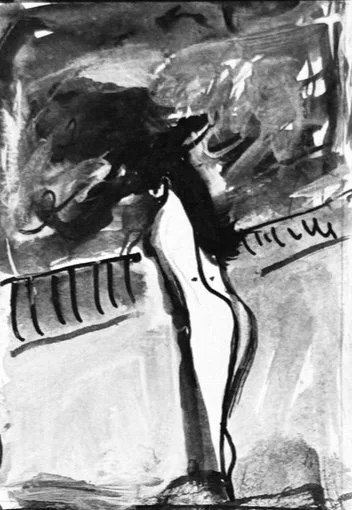
After cooking an egg sandwich with the stalest bread imaginable, but edible only through the melted butters help, he climbed back down the stairs where he glanced at the picture again, and she was smiling, “There. That’s how I remember it,” he said. After he had swallowed the last bite, Ted walked out onto the catwalk but could only stay out there for a short time as the wind was such that it made you believe that it was coming to beat you and snatch you away. Ted checked the tender, which was still safe and was fully anchored and tied, and then had a foreseeing of hope at the prospect of winter breaking into spring—the evenings where he’d be able to sit on the little pier and fish, watching the colours change like a kaleidoscope as the sun went down, but he would stay because it was not too cold. He’d have on his favourite coat, and the fish would surlily take a few more bites so that he would not be alone, for all that was friend and foe moved, but he would be with friends in those pleasant evenings and not the foe of winters winds and waves. Ted looked out through his binoculars and could make out the Odessa, his favourite ship, and decided to try and contact it through the radio.
“Odessa, do you read? Over… Odessa do you read? This is Little Rock Lighthouse. Over.”
“We read you, Little Rock. Over.” The voice was that of its Eastern European captain, and Ted’s only friend, Neno.
“Good to hear you, Neno. How’s the weather, looks bad?” Ted didn’t know any of the technical terms of life on board a big vessel.
“The weather is shit, my friend. We are going to see it out behind St. Marks as you maybe can see.”
“I do see, Neno. You are sitting good there, and hopefully if you get chance before you set off you can make it over here?”
“Yes, my friend, I will try, and I have the things that you wanted.”
“Great!”
“Tomorrow the wind is less, and I will try and get to you by then. Over and out.
Ted had a feeling of warmth deep inside that was not from the heat of the fire, but from the warmth only a good friend could bring after a long period of aloneness. Ted looked at the bookshelf and thought that only a few of these books really knew about being alone, and these where his favourite ones.
The rest of the day passed quickly, as they always did, on the lighthouse. Only the days where there was trouble in the body or mind dragged, the barbs that tore, making everything a slow enemy. Ted liked the evenings the most when the internal waters were calm, and sometimes, like tonight, there would be a brief breaking of the clouds, and the stars would be seen clearly like the big searchlights of all the other vessels that were up there. With this, he went to sleep after not drinking too much, as tomorrow he would see his friend.
*Read Tom Stuckey’s next installment of Of Nurture’s Wildness (Book V) on December 9, 2025, at 6PM CST.

Photo of Tom Stuckey
BIO: Tom is a writer from Devon in England. His work can be found at A Thin Slice of Anxiety, Bristol Noir, Nut House Press, and Pulp Magazine. He is the author of The Canary in the Dream is Dead and The Sun Marches upon Us All. Learn more about Tom Stuckey at www.tomstuckey.com.