the gates of sleep
by Peter Donnelly
There are two gates of Sleep,
one made of horn, the other of gleaming ivory.
The dreams that pass through the gates of horn are true,
sent by the shades to rise up to the open air.
The ivory shining, perfect, brilliant,
sends false dreams up to the sky above.
With these words, Anchises follows his son and the Sibyl
and sends them out through the ivory gate.
(Aeneid VI, 893–897)
Part I: A Short Quantum Dream
The dreamworld:
to hack or crack in
to the dancing
pandemonium
of quantum.
Synchronicity
takes its forms –
spooky
occurrences
at a distance;
equally the minor leitmotifs
that chime in daily life.
The data of reality contains neural links,
and our lives are vulnerable
to the encroachment
of spectral inflection.
Patterns are observed –
the deep learning
of dreaming
is imagistic.
The language of image:
the AI in deep-learning
drinks in deep
the image-language of data.
Like the dream-mind, it metabolises
the parlance of the visual.
Autonomous generation
from inside the black box.
II
The haunted houses.
The bad dreams retained
in the body and brick of a building –
the absorbative property of stone.
Computational data held
in a carved rune
– a single code point.
The imprints of memory.
The retentions of silicon and stone.
But passing shadows of the multiverse
move quickly in a vanishing
from the current world.
Once detected
they have already moved
into the past.
Interference occurs
in quick
flits
and flickers:
an implication
of friction
at the film
between
one distinct
reality
and the next.
The dream space remains like a reliquary.
Dream
condensation
assumes and absorbs image
in the language
of Lacan.
The spirits can send up false dreams
from below.
Confabulations proceed from beneath
as the LLM hallucinates.
There are also
latent hauntings,
expressed in
cryptic whisperings.
In the dream space,
shifting narratives
overlap and inter-blur.
These quick-moving
flicks burdened
by the sheer weight
of the connotative:
dreams are like the fast-
moving freight
passing at a distance from the dreamer
through the night. On the train tracks, the containers
were articulated together,
as in a sentence structure.
The migraines of meaning,
the extrusion outwards of meaning.
There is an unknown power
and potentiality within a Pandora's jar,
as with an AI
under lock and key.
It sits silent and tightly
shut. The dark silence of the black box
permeates. A power untested and untapped:
a universe of connotation trapped
inside it, as if by magic,
as if sealed by the might of
an ancient deity,
or by a curse.
It is as though the dreams
dream us, and not the inverse.
There is that sudden slipping shift
of narrative --
the slide and volta of a dream’s
statement and sentence of events.
Its lexicon –
the inherent textual constitution
of the dream material –
shape-shifts in a displacement
of its facts or characters,
images and places.
The point where one dream
quicksilvers
and blurs
to the next.
Part II: A Camera Obliterates Skiers into Memory
I
Mounds of heaped snow
like banks of crushed sea salt
in the true blank of sunlight.
Light-bodied, it is
mineral
and nearly ethereal.
Momentarily this all
like an Instagram reel
in terms of look and feel.
Social media a false god.
On the still slopes,
from the camera’s vantage point
(positioned outside of time),
the vista is in the past.
It is devoid of wind
and almost of sound:
this iteration of the outdoors,
to its lens,
but a display of inactivity.
The snow remembers the past.
And in a sense is part of the past.
The environment
is absorbent,
somewhat like a mind.
The sound of wind pervades
like white noise
(in the sound a kind of dryness).
The lens
is motionless
in this scene
of frost and pine.
A thawing would be a sort of end;
death is a thawing of a sort –
a releasing of entrapment
and a discharge.
Sort of like a god deciding to pass away.
Experiential
and faintly spectral,
the snow is superficial.
Religion is superficial.
A quicksilver lick of violet hue
over the blank-white
of a slope
steals across this camera lens –
The rose hue seen momentarily in its lens is that
of Himalayan sea salt.
In the snow-laden scene
a blanking of embanked memory –
a pristine blanking of self.
A memory speaks of childhood and death;
the memory is white and bleak
and rich in the detail
of the environmental.
And yet an undercurrent of the unreal
engenders itself subtly into nature,
and ordinary
weather
in turn feels slightly hyperreal.
The air-pressure
thins.
II
The quantum-observer effect
self-effects.
The sense if of material reality
itself shifting through perception.
The self-generating and -generalising properties of the natural
world become analogous
with the dream-space –
the underworld into which
Aeneas made his descent,
delving through the jungle
of the mental.
The real trauma was felt
in the return to the firmament.
sed revocare gradum superasque evadere ad auras,
hoc opus, hic labor est.
The camera persists in observing the long descents
of snow. The plateaus and pistes of snow.
Light suddenly flows across the plateau
like water flooding across
a space.
Clouds dissipate
to allow the light
to expand
as a brilliant white
down the gradient
of the piste.
The piste is a text;
the lambent effect
constitutes as an element
of the text.
Visuals are realized –
that is to say reworked and figured –
into the dream-language.
the texture and terrain
of the lexicon
self-reflects.
A text within silicon memory
or camera-film is a
memory of death on the slope.
It harbours in itself the data of reality.
III
Suddenly on the landscape
a forgetful somnolence –
a kind of lapse
and opening up of reverie-space
into which the unconscious
enters:
it awakens
and activates.
It ambulates like a ghost of the stage
effecting its autonomous intent.
We have then in the subconscious inner
a kind of theatre:
a play’s staging occurs
independently of its dreamer.
The dreamer is but the vehicle of theatre.
The fragmentations of sleep
self-assimilate.
A ski slope or a tract of land
is like a poem;
the slope
is a text that manifests
within and through
the view
of the camera lens, integrating.
The dream is a text
that assimilates in retrospect.
Ski goggles (insectile) were the visors of the skiers,
from the lens’s vantage point;
it is a witness to the past.
Skis in the distance were like twigged
legs of insects as well.
But that was in the past.
The slopes are now empty.
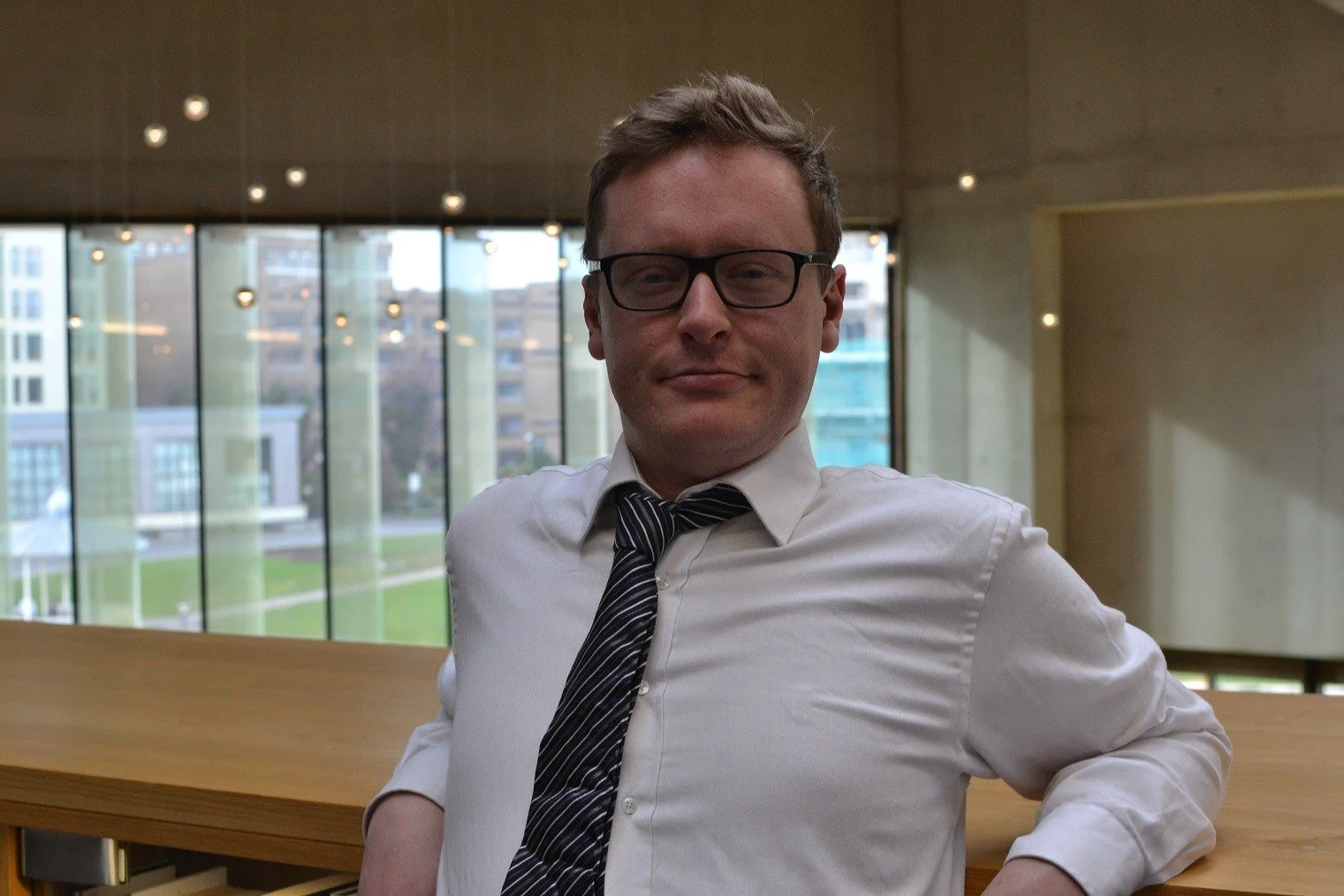
Photo of Peter Donnelley
BIO: Peter Donnelly’s first collection, Photons, was published by Appello Press in 2014. Following its publication, playwright Frank McGuinness commented that "Peter Donnelly already shows he has a strong imagination; indeed, a savage one presents itself on occasion when the beautiful and brutal confront and confound each other." His second collection, Money Is a Kind of Poetry, was published by Smokestack Books in 2019; it has been described as “a meditation on contemporary alienation and the processes by which every new technological advance seems to increase our isolation from each other, and the more connected we are the less we appear to know ourselves.” He is currently working on a third collection, and is furthermore the author of legal text Consolidated Ontario Estates Statutes and Regulations 2023 (Thomson Reuters, Carswell, 2022).