five poems
by Frederick Pollack
Now That April’s Here
I think I have the architecture right:
brown brick, shared walls, no trees
or earth-squares; the latter
grace slightly wealthier districts;
then houses start. On hills above them,
modernism: basements no doubt equipped
for S&M; beyond those the palaces
our television likes. At 9 AM everyone’s
in front of their doors. No expression,
I work on that. Distrust, tempered by
sardonic humor drawing on
ancestral distrust. I check my notes, ask
about pit closures, the idea of
solidarity, atomization, the dole,
alcoholism. Nothing. I put a tear in
one eye, make some heads shake, but a
voice imitating a computer’s (I haven’t even
begun to consider the problem
of accents) says, “All that
happened elsewhere.” Which is a relief:
trees appear, a curving haunted
two-lane lane linking villages, the possibility
of long walks, accessible emotions.
But now the mayor drives up. It takes a while:
I can’t decide if he drives a Jaguar or
a Morris. He wears a gold chain,
asks very respectfully, “Why are you doing this?”
“I’m desperate to break in,” I explain,
“to a very respected journal.
They occasionally take Americans, but mostly it’s
poems that assume knowledge
of little places whose names mean nothing to me.
(I mean, it’s not like me mentioning New York … )
So I’m trying to invent one.” “I see your problem,”
he says. “But you should see mine:
even if you were accepted,
what good would it do us?”
Prospectus
Our impulse is to build the museum
before we’re sure what it commemorates
or mourns. We the Board,
committed as we are
to the great dying liberal
principle of transparency, hold numerous
meetings on this point. (Look what happened
to the Museum of News in DC – a contradiction!)
But the main thing, we decide, is
we have the collection.
The laptops of twelve killer and
twelve suicided kids, playing what they played.
The glasses of a demoralized, contemptuous
late teacher. (These caused argument – we the Board
are on the side of teachers.) The notebooks of
a graphomaniac, to be displayed
open to that one legible
passage. Recorded messages.
A homemade hairshirt, which will require
extensive wall-text as well as
the videos. We don’t know what to call
our passion. The Moment Loneliness
Becomes Something Else won’t work;
though it seems so concrete to us,
there is no one term. But we have the collection,
and ghostly money, and have begun to build.
Not neglecting to contact
institutions we want to liaise with. Like
the Museum of Broken Relationships, in Zagreb.
Gauge
Minutes pass. He describes
a circle some twenty feet
across some hundred feet up,
in an area of sky
unblocked by greening branches …
Posing? Absurd. For whom? No,
there must be a mouse,
perhaps less than a yard from this chair but
invisible to me, though not to
the hawk. And does the mouse know
he’s there? Not seeing him, but through some
more general sense?
If I get out of the way, whose way is it –
the one who dives, the one who runs?
Or have I misunderstood the situation?
Spiraling upwards ...
they can ride thermals at 7000 feet.
Some vultures can fly higher than Everest.
Fleck
I associate that blue
with the year it was painted
and given to my parents,
which preceded much consciousness on my part
though taste was already there.
And the painting was there,
and that blue never
belonged to a football team,
bomber wing
or car, the sleeve of an enemy
in grade school, any sky,
or a girl’s cashmere sweater.
New Waves Remembered
Now the shadow of the cathedral
moves across the square, picking out
kiosks of flower- and fruit-sellers,
vendors of plastic devotional objects,
tourists walking isolated from
the main groups with or without
little flags; it puts, so to speak,
some dark on the situation.
Alone or en bloc, tourists enter
the cathedral. Some in the know concerning
kneeling, holy water etc. follow
their training; others look
at saints, praying heads, vaults and paintings.
If good, as they walk, they imitate ghosts;
if not, they talk. All breathe
the grey air of such places, of which
incense is a small component.
Meanwhile, outside, viewed by tourists
at cafés, a gang of students
enact a movie. They’re dressed as grimy
peasants, inert and starving,
standing around a large cow,
their cult object (papier-maché).
A loudspeaker praises the sacredness
of the cow. Suddenly a peasant,
emerging from fate, yells, “Hey, guys,
meat on the hoof!” and everyone
falls on, tears chunks from
the cow. Red splashes. The voice
screams sacrilege, hellfire, but
in twelve seconds starts to call
“the animal” the bearer of sin and praises
those who combat it. Soon
the whole bloodied company dances
and sings how good the rich, well-marbled,
taste. Unfortunately,
few tourists know Portuguese.
Rain. Most of the tourists take refuge
in museums. Few attend the film festival,
fewer stay. Some enter a gallery showing
the latest cri – great chevrons, targets, flags
of color, revised rainbows! And some of
the tourists would like those bands
to move, on and on, a swift film;
imagine them turning into a wordless
language, directly controlling
emotions, actions, wallets … (Don’t think
the crowd is without fancy, they just keep it
under wraps.) Two young ones hurry
to sit at my table, beneath my awning. Gaze
disconsolately at a forming puddle.
“Don’t worry,” I say, “this city
won’t die by water.” They can’t tell
from my scarf and beret whether I’m
a native; I don’t enlighten them. We discuss
culture; he asks what bands or singers
I like. I don’t, and bore them for ten minutes
(but with smiles that beg forgiveness) with
the Second Vienna School. The girl,
suddenly frightened, says, “I think he’s dead.”
“Only half,” I assure her.
“Plenty of blood, just no pulse.”
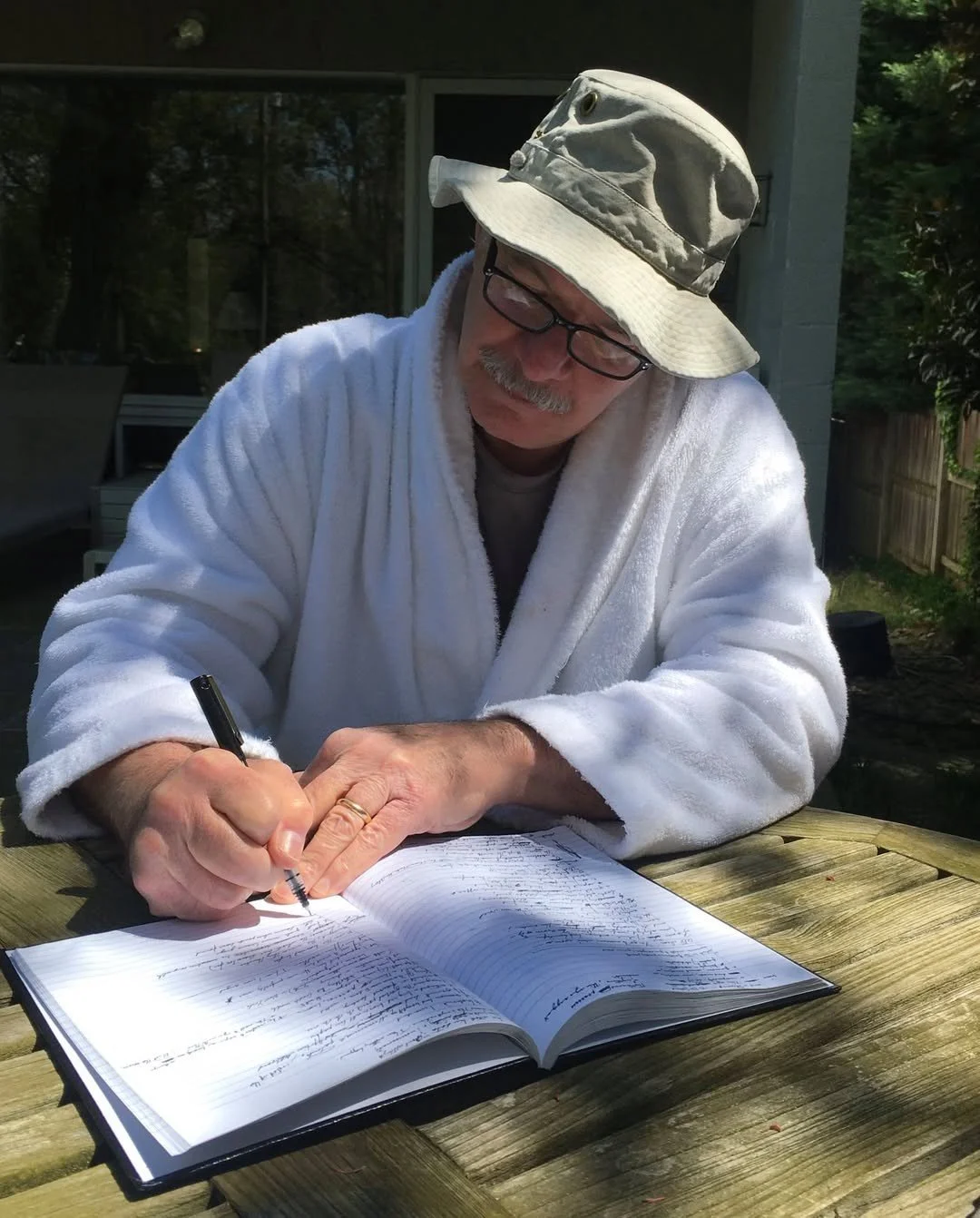
Photo of Frederick Pollack
BIO: Author of two book-length narrative poems: THE ADVENTURE and HAPPINESS (both Story Line Press; the former reissued 2022 by Red Hen Press), and four collections of shorter poems: A POVERTY OF WORDS, (Prolific Press, 2015), LANDSCAPE WITH MUTANT (Smokestack Books, UK, 2018), THE BEAUTIFUL LOSSES (Better Than Starbucks Books, 2023), and THE LIBERATOR (Survision Books, 2024). Pollack has appeared in Poetry Salzburg Review, The Fish Anthology (Ireland), Magma (UK), Bateau, Fulcrum, Chiron Review, Chicago Quarterly Review, etc. Online, poems have appeared in Big Bridge, Hamilton Stone Review, BlazeVox, The New Hampshire Review, Mudlark, Rat’s Ass Review, Faircloth Review, Triggerfish, etc. Website: www.frederickpollack.com.