what is built cannot last
by Aaron F. Schnore
In the summer of 1973, a classified ad ran in the LA Weekly.
WANTED: CONTRACTOR FOR UFO TOWER. PRIVATE PROPERTY. DISCRETION A MUST.
Amelia Sutton—who sometimes went by Ambrosia, a nickname bestowed upon her by the singer Jackson Browne—had placed the ad. She was convinced flying saucers were circling the skies above her Northern California ranch, watching. No one questioned her reasoning. Amelia was the only child of Bernard Sutton, the Muffler King of LA, and the heiress to his fortune. She had enough money to manifest any whim into reality, no matter how outlandish.
The contractor arrived early. I could hear the growl of his Ford pickup laboring up the drive. I watched from the shade of the eucalyptus trees as he climbed out. He was in his mid-twenties, with chestnut-colored hair that fell past the collar of his work shirt. His coral blue eyes were visible from a hundred feet away.
I stepped through the miasma of truck exhaust. “I’m Kenji Nakamura. Ms. Sutton’s groundskeeper.”
“Jesse Valentine.” We shook hands. His palm was rough as sandpaper. He eyed my long sleeves with a puzzled look. It was ninety-five degrees outside.
“Follow me,” I said.
Jesse had the countenance of an outlaw, tool belt slung low on his hips like a holster. I led him to the veranda, where Amelia was enjoying her first gimlet of the day. I closed the door but could hear fragments of conversation as I watered the roses.
“How tall would you like the tower, ma’am?” “Tall enough to see them.”
“Them?”
“UFOs,” Amelia said. “How big is your crew?” “I work alone.”
“When can you start?”
I had been with the Sutton family for over a decade. Bernard Sutton—the Muffler King himself—hired me, praising my botany skills, attention to detail, and ability to keep quiet. After her father died, Amelia kept me around, more out of habit than necessity.
The work suited me. Acres of pasture, citrus groves, and ornamental beds, all requiring constant tending. The days passed without question or consequence. After work, I returned to my bungalow at the edge of the ranch, close enough to the groves to smell the citrus after a storm.
Jesse started early. He unloaded lumber and tools with practiced efficiency and began building Amelia’s tower, board by board, nail by nail.
I disliked him at first. The way he hummed while he worked, tuneless and meandering. The way he left tools and lumber on the lawn. The way he called me “Sir” in a clipped tone. Yet I found my eyes drifting toward Jesse more often than necessary, watching how he lifted beams meant for two men, how sweat darkened his t-shirt, and how he seemed content in solitude.
It was Amelia who suggested we eat together. She appeared in my shed, wearing oversized sunglasses and a silk scarf, to tell me Jesse’s aura was “troubled” and I should spend time with him.
“You have a sea green aura, Kenji,” Amelia said. “Calming.”
Over the next fortnight, I ate lunch with Jesse each day. He had moved to LA to pursue acting after Vietnam, where he served two tours. Jesse didn’t like talking about the war much, so I didn’t ask. One afternoon, over cucumber sandwiches and green tea, Jesse pulled his hair back momentarily, exposing a scar that zigzagged down the side of his neck. I knew something about scars, too.
Amelia’s tower rose quickly. It was a tall, narrow column of cedar and reinforced steel that loomed over the citrus trees. I thought it was hideous until, one evening, I saw the tower backlit against a marbled orange and lavender sky. It had been transformed into a work of art.
One morning, as Jesse burnished the wood in the tower, humming as usual, I was turning over the mounds of soil that surrounded Amelia’s lemon trees. When the tip of my shovel struck an underground nest, a colony of yellowjackets suddenly swarmed out in a buzzing cloud. I screamed and covered my head. They stung my arms, neck, and face. I curled up into a ball. My body burned in a familiar way. Then, blackness.
When I woke, I was in the cab of Jesse’s pickup, my body bulleted with angry red welts.
“You’re alive,” Jesse said.
“Yes,” I said. My tongue was like a tennis ball in my mouth. “Where are we going?” “Hospital.”
“No.” I shook my head. “Take me home.”
“The graveyard’s full of heroes, Mr. Nakamura.”
“I hate hospitals.” I jerked my thumb. “Turn around.”
Back at the Sutton ranch, Jesse helped me into the bungalow. Perhaps he noticed the pairs of identical dark glasses folded on my nightstand, or the many bottles of sunscreen lined on the sink, but he said nothing. Instead, Jesse lowered me onto the bed. He noticed I was shaking.
“Desert’s always cold at night,” Jesse said.
I pointed. “There’s a blanket in the closet.”
When Jesse opened the wardrobe door, he spotted it immediately: a tweed jacket deliberately pushed apart from the rest of my clothing. The garment was expensive—one could even call it “professorial”—with its brown buttons and leather patches sewn to the elbows.
“It’s beautiful,” Jesse whispered, transfixed.
“That old hand-me-down?” I replied. “It belonged to Mr. Sutton. Amelia’s father. It doesn’t fit me.”
Jesse brought me a wool Afghan from the closet, then returned to admire the tweed jacket. He removed it from the closet and raised it high, admiring it like an archaeologist holding a relic from the Middle Ages.
Jesse turned to me. “Can I borrow it?” he asked. “I’ve got an audition tomorrow and this is perfect.”
“Have it,” I said. “Otherwise it goes to the Goodwill.”
Jesse put on the jacket. It fit him better than it ever had me. I smiled, nodded.
Jesse noticed a framed photo on my dresser: a faded, sepia-toned image of a Japanese boy, his eyes obscured by bangs, standing between two proud, beaming adults.
“That’s you?” Jesse asked.
“Yes,” I said. “With my mother and father on my tenth birthday.”
Jesse picked up the photo. “Where was this taken?”
I answered quietly. “Nagasaki.”
Jesse looked at me, but said nothing. He set the photograph down carefully. As he passed me, Jesse reached out and squeezed my arm. I winced, still sore from the bee stings.
“Oops,” said Jesse with a laugh. “Sorry.”
We said goodbye. When Jesse was gone, I slowly removed my shirt and applied calamine lotion to the dozens of welts on my arms and chest. The mirror reflected skin that never quite healed, grafted, shiny like chewed bubblegum. Crisscrossed with scars. My own body was unrecognizable, even to myself, so many years later.
On the Fourth of July, the fireworks started early. I’d watched Jesse climb the tower earlier that morning, but something was wrong. He had been up there too long. It was too quiet. Absent were the sounds of Jesse hammering, sawing, and his infernal humming.
“Jesse!” I shouted. “Are you okay?”
No answer.
I was terrified of heights—I got vertigo standing on a step ladder—but I had to go up. As I climbed the tower, the mantra Don’t look down echoed in my mind.
At the top of the tower, Jesse was curled against the railing, knees pulled to his chest. One hand covered his neck.
“What’s wrong?”
Jesse swallowed. “I can’t feel my legs, Mr. Nakamura.”
“You are afraid.”
A firework burst, red tendrils pinwheeling, then dissolving, in the smog-blanketed sky.
“The goddamn war,” Jesse whispered.
“I know,” I heard myself say.
Another firework flared across the sky and exploded. Jesse closed his eyes. “Will you stay?”
“Yes,” I said. “We’ll watch for UFOs.”
For the next hour, we sat in the tower as fireworks strobed and flashed above. When the display ended, we slowly descended. On the ground, neither of us spoke for several minutes.
“Thank you,” Jesse said, finally. In one sudden movement, he kissed me on the lips. I did not resist.
When the kiss broke, Jesse whispered, “I’m sorry, I never…” His voice trailed off.
“It’s okay.”
Jesse’s hand moved to unbutton my shirt. I pushed it away.
“I can’t let you see me.”
“It’s okay.”
I stepped away. “Please, go.”
Jesse turned and disappeared into the purple shadows, the unasked question answered.
But when Jesse didn’t come to work for the next three days, I panicked. I could barely eat, sleep, or work. Where was he? I replayed every word, every silence, from our last conversation, searching for answers.
When Jesse finally did return, knocking on the door of my shed, the old tweed jacket was draped over his muscular arm.
“I thought you were abducted by a UFO,” I joked, putting down my clippers.
Jesse smiled. “No. I was in New York.”
Jesse had gotten the part. It was a small role, he said, on a new daytime soap called Thorns and Ivy. He was going to play Dr. Henry Pruitt, a young history professor…with a secret.
“Congratulations,” I said. My voice was strained.
Jesse held out the tweed jacket. “This helped me get into character. Thank you.”
“Please,” I said. “It’s yours.”
“You sure?”
I said yes. We hugged goodbye. He climbed back inside his Ford pickup, and, in a plume of gravel dust, he rumbled off.
That was the last time I ever saw Jesse.
Amelia sold her ranch in 1977 and moved to Ireland with her guru to raise sheep. I went to San Francisco and found work at the Botanical Garden. I found love, as well. Arthur, a pediatrician. I trusted him. We had thirty good years together. He died in 2010.
Jesse used to send me a card every Christmas. Just him at first. In the Eighties, a wife appeared. Then children—four, over time—in matching holiday sweaters. Their heights changed, but their smiles remained fixed. I kept the cards in a shoebox, until they stopped coming.
Today I live at Whispering Oaks, a retirement community outside Oakland. There’s a TV in the common room and every resident and staff member knows that, on weekdays from noon to one, the remote control is mine. That’s when Thorns and Ivy is on. I watched every day for the first seven years when Jesse was a cast member. He wore his signature tweed jacket with quiet confidence. After the character Dr. Pruitt died in a plane crash—Jesse, the actor, left the show in 1980—I was hooked. I am an unapologetic Thorns and Ivy fanatic to this day.
Jesse’s career flourished. After the soap, he co-starred in a primetime sitcom that ran five seasons. Movie roles followed. Commercials. Eventually, the stage beckoned. I cried when Jesse won a Tony for his Willy Loman.
In a Playboy interview, May 1985, Jesse was asked whatever became of his signature tweed jacket.
“I still have it,” Jesse responded. “It was a hand-me-down from someone I knew early in my career. Someone special.”
One week after Jesse Valentine died, his oldest daughter Margaret came to see me. She carried a cardboard box. “He wanted you to have this back,” she said.
Inside was the tweed jacket.
“No,” I said. “This belongs with family. Not in an old man’s closet.”
“This is what Dad wanted.”
Margaret helped me put on the jacket. With my body so emaciated, it finally fit. The fabric smelled faintly of dust, cigar smoke, citrus, and sweat. It smelled like Jesse.
Every Independence Day, I put on the tweed jacket—the twice-worn hand-me-down, returned to me half a century later. I roll my wheelchair onto the grass, and I look up. When the fireworks are done, and the sky is still, and after everyone has gone inside, I savor the silence and solitude. I like to watch the stars and blinking lights as I wait for something. I don’t know what exactly. A sign from Jesse, perhaps, hidden beyond the opaque curtain of California sky.
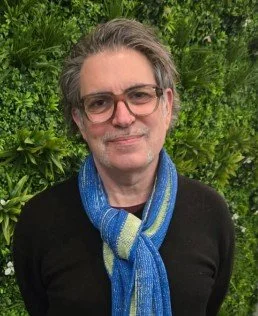
Photo of Aaron F. Schnore
BIO: Aaron F. Schnore is a Brooklyn, New York-based writer, filmmaker, and musician. His work has appeared in The William & Mary Review, 365 Tomorrows, BULL, and The Gorko Gazette. He recently completed his debut novel Let the Stricken Deer Weep.