the time machines
by Mahen Nadesan
“Ya know how this works?” the older man asked, oddly precocious-looking for his advanced age.
“Yeah, I know, I know,” the boy replied.
The old man smiled a broad smile. A chipped tooth.
“Jus, ya look so young an’ all. So clean. Bet ye’re new to all this, eh?” the older man continued. He seemed pleasant now.
The boy just nodded. Guess there’s a –
“There’s a time machine born every secon’ I reckon. So I‘ve seen. So ‘owmuch you want? Ha, who am I kiddin’ – ‘owmuch you need kid?” he smirked. He’d moved into mockery so smoothly.
The boy held up open hands, palms facing forward, balled them into a quick fist, then opened them up again.
“That much eh? You havin’ a party?”
He seemed to want a genuine answer, a mercurial concern now on his face. The boy nodded again, this time with a smile. The tired-looking drug dealer looked around a bit, nodded, and took the cash proffered by the boy with a neat gesture.
“Gimme a few minutes time traveler,” he said. Smile back on. Then he quickly disappeared behind the non-functional turnstile in front of the mall’s public toilets.
The boy, who was in truth older than he looked, had been hooked on time for a few years now. He had recently reached an incontrovertible conclusion about his romance with the drug: it was killing him, and when it wasn’t killing him, it was distorting his perception of what life he had left to the point that he may as well be dead. Sometimes, for days after dosing, he’d feel a sort of mental nauseousness, like laboriously swimming in a viscous pool but not being able to slow down when the viscosity evaporated; things went far, far too quickly. Other times he’d feel like he wasn’t coming down at all, that the slowness of time persisted entirely too long, till he was spending days in a sort of perpetual temporal event horizon, with only the analog sound of his internal monologue passing tests of reality. Cogito ergo something.
He walked to the café across from the toilets to wait. Keep an eye out for old man time. He avoided the cashier’s gaze and decided not to go inside.
He stood under the wide arch in front of the café and looked upon the mall. He’d been here before tugging on dad’s sleeves skipping up the stairs asking for the toy truck, a handful of times with the girl with the temporary tattoos too cool for her age asking to hold hands, each time a small fragmented representation of the whole of that time looking for drugs to score near the lavatories.
He looked at the mini-grand piano in the middle of the walking space and marveled that he’d never actually seen anyone play someone play someone play I’ve got a few minutes before he gets back can I go over there and would I hit a white key or a black or three keys who is that? He’d not noticed the old man walking toward the piano till he was a few meters from it and then only because of his elongated gait. The old man seemed arthritic but slid onto the worn seat in front of the piano with a smooth movement that demonstrated a practiced tolerance of pain. He held his hands above the keyboard. Then, slowly, almost like an implied hesitation, his long fingers were on the keyboard.
At first he heard no sound, the fingers on the old man’s left hand seeming to glide up and down but there it is in a spider-like repeating pattern, his right hand tense above some keys to his right come down come down and then unexpectedly a single oh high note gone too quickly, swallowed up in a slow procession of ascending notes, some held longer, shorter, then down the scale till it was just phrase after melancholic phrase lightly airing in a continuity where you couldn’t tell what came before or what would come after as the rapture of an unheard but deeply known sorrow slowed time, all still serene and evenly paced but capturing a fall hitherto unexperienced. Still the slow rhythm of the old man’s left hand, moving attentively as it now led harmonies of deep yearning, a slight change in color and tone for a moment before a trill formed a herald for a softer, quieter bridging to nowhere, back to the start as if time could repeat infinitely in only the mass of black and white keys, yellow crescendos of their sides being pulled in like some tide on some heavenly beach with no moon to direct them, only the memory of dim light aching to fulfil the old pianist’s coursing through melodies in which the boy could feel aspects of his life being experienced by someone else, someone who could have written something so beautiful about something so incomplete.
The music seemed to be settling somewhere, a repeated phrase taking the boy outside himself until he could hear the motif so clearly in the person he was, just as it was ready to expand into something, to vary its song, to make the journey of small changes that led it back to itself.
Two mall guards, one burly, the other smaller but strong-looking, had come along and been waiting patiently, the former with his hands clasped in front of his midriff, the latter with his arms folded across his chest. A woman whose name tag said ‘Alice’ had moved next to the boy. She spoke softly, so her conspiratorial tone carried to him and him alone:
“’e’s been doin’ this for years. Comes in, plays for five minutes, gets escorted out. ‘e knows you ain’t allow’d. The guards they always wait till he finishes this one bit. Somethin’ by some Choppin’ fella, ahn-dante spinney-ato I think. Soun’s like a pasta dish, don’t it?”
She laughed, but stopped when she saw the boy’s eyes well up. She seemed to know well enough to leave him to his grief. As she walked away, the boy felt the last pins and needles of a long-approaching heaviness pierce the little space left on his pin-cushioned heart.
There was a rushing, a flow of sounds towards some expected but inconceivable end, and then no not a brief pause as the old man started a figure that felt like the acceptance of an end; a beginning where beauty relinquishes its influence, encircling the spheres of countless tiny universes before fragmenting – never to be known again or pulled into a whole; its shards to be encountered unexpectedly in this world, as in others, throwing itself into sharp relief as reflections of something that may have once existed in toto. After a repeat of the figure the boy, transfixed, knew it must return have to return, and awaited it – sounds falling over each other, each a harbinger to its wandering siblings, the old man’s arthritic hands reflected on ebony board as dexterous white limbs of a blue-veined spider spinning an ethereal web for only the boy, suspending raw globules gleaned off a spent emotional life like dotted notes across his score, little inked shells hiding tiny things that would corrode him – and when it came he still felt unprepared and felt that he would always feel that way. Like the old man at the piano who was now being gently lifted off the seat and led away to an old woman with sad eyes. Stop. No more.
The drug dealer emerged as the boy composed himself. The man, solemn now, looked like he wanted to say something, something serious. But then he turned and beckoned for the boy to follow. As they walked in step, leaving the mall, the old man discreetly slipped him a handful of sachets of liquid time and when those were securely stowed away in the boy’s jacket, a few containers of pills. Unexpectedly, the old man stopped and put his hands on the boy’s shoulders.
“You be safe, ye?” he said, searching the boy’s eyes. The boy shrugged and grinned, not sure how to come across. The man seemed satisfied, but bleakly so. He turned around and walked away. The boy unwrapped himself from the moment and began to walk across the parking lot toward the road.
He had one last stop to make, and wanted to make it before dusk. The bus ride to his destination was long, and despite not having made the trip in a while, the bus driver nodded in recognition when he stepped on. He smiled back weakly, fingering the sachets of time in his jacket, not halfway through ruminating on the vague unease he had been nurturing. The bus was half empty late, doing its final run for a Friday. He’d once overslept all the way to the depot, nineteen years old and going through things. He’d woken up and trudged two and a half hours almost all the way home, before a friendly neighbor picked him up two streets away from his destination and got him the rest of the way. This time he tried not to fall asleep, but fell into a pattern of careful dozing, the shudder of the braking bus at every designated stop always rousing him from some half-dream contiguously pieced together like a final movie shown for him alone before the cinema was torn down. Getting off the bus he spliced the last memories of his drowsiness onto real objects and sealed them away forever I think as he walked to the street corner he’d picked for his wait.
It wasn’t quite dark when he saw the old lady go slowly along the pavement. Standing still and watching her, he felt like he was being held within an experience that was static, unmoving, unmoved. He felt all too suddenly trapped, without limbs to call upon, but in a moment striding toward her – even before he felt sensation in his legs, aware enough to wonder if he would tap her on the shoulder before he discovered his arms, wanting to slowly drift himself down his neck on a dark red time-course till he split at every juncture and waded and welled in every terminal his body would give up, forgetting his spirit and becoming the parts till no one and no narrative could force them to commit to a broader unity. But he had already gotten behind her and spoken.
“Mom,” he had said.
When the pale, wrinkled woman turned Mom they both remembered the last time they had seen each other and both beheld in some small way some beginning to an end: for her, his exile, for him, everything. They each waited for the other to speak, lips apart, streams of thoughts not being realized, building patience for the other whilst losing it for oneself: long-lost strangers waiting for the other.
Simon.
He wasn’t sure if she’d said it. He’d heard it and felt that Simon says after all these years of not hearing her voice he couldn’t remember it – she had just put it in his head but it was her voice in the way she had said it when I was 5 and Dad looked mad the dog barking birthday cake all over his nose like a king on the carpet and so he said again Mom and she dropped the heavy bags of cheap groceries and the feel of being squashed by her body made up for so many things if only for now before things get really bad they’re really bad it’s too late to be better bitter butter in the batter.
She said, “I missed you so much, oh my –“ interspersed with kisses as she started and ended an abridged Lord’s prayer but Simon, beyond any recollection of his own ability to speak still heard himself mousily say things tinged with affection, just trying to capture the minutiae of the moment in little sensory scrapbooks – the smell of dish soap and talc hours too long in the sun, fuzzy cheek on his couldn’t grow a beard where’s your hair at occasionally brushed by the firm strands of old wool on her coat, weathered and washed many times over, the sensation in his body of being held make it always sing Mom, scalp cooling with the dew and sun settling like a wash of painted evening – all to be forgotten if not now when I’m gone living nowhere what does she feel too? She was holding him not quite at arms’ length, studying his face bit by bit, and he felt the slow creep of anxiety we need to talk as he knew they’d walk and she’d wait till they were in the warm little house home and the sun had set night and the tea had been made home and maybe she’d ask in the kitchen or maybe she’d ask after she’d brought the tea into the sitting room but she’d ask before he could say we need to talk Mom. He picked up a bag of groceries and made sure to walk on the inside of the sidewalk so she wouldn’t try to hold his hand, but she held his arm; it was a dance and they were partners just for now, again after all these years and soon everything will be over anyway he told himself.
The thought of talking to her right now was flitting around, never leaving him till he noticed she was looking at him while they walked and he started the sentence he had dared in his plans, “We…” but her expectant smile was too much and he finished with, “used to walk this street a lot, I remember.” He’d started looking down at the pavement, as he used to as a child, and remembering was all he seemed able to do; each sudden glimpse of a past that belonged to him, frayed and fragmented as they came, demanding attention even as it bled into another without a discernable rationale and he was left daydreaming a stream of dispossessed images as his gaze moved from pavement to mother, mother to pavement.
By the time they reached home it was dark and the smell of his childhood flooded in like so much contrast – somehow everything out in the world looked and sounded and felt the same from outside place to place. But inside the smell of his old house with his room that was once oppressive outside but was now cozy inside like someone had marked it and said this will be the place you love the most and no one can take the inside away the world is contained herein to forever be opposed to what you must face outside. There were furtive looks between them then, each building up tension in their separate enclaves, measured so that when groceries had found homes in cupboards amongst idle chatter and teabags had been steeped and places had been taken for the final ceremony, they knew the only thing left was the unburdening.
“Simon,” she began after a few moments, slowly relieving herself of the name that meant so much.
“Mom, I…,” trailing off till it was picked up again by her taking his hand and placing it in hers.
Withdrawals began for Simon bad addict and he realized that he would quite quickly be lost in time, his planned confession to stay put in his burdened brain as he lost the ability to comprehend his reality.
“…don’t know,” Simon finished.
Details of objects in the room had begun to swim between vagueness and sharpness, no longer grounded as things themselves felt like they stopped adhering to the passage of time. The old china of the cups glared at him, the painted butterfly shifting in space with hurried movements that followed his hand, blurring but leaving the white of the cups in place, intact and brilliant in the soft light of the room.
“Dad woulda been sixty tomorrow. I always miss him on his birthday more,” she said.
“I know Mom,” said Simon.
Then a torrent of words: “Why are things so hard Mom? Things are – it’s not like when you’re small and people know what’s best for you and then nothing’s your fault everything is because you’re just listening to everyone before you can be a grownup. But there’s a line you cross, no one tells you when, and if you can’t do it you can’t tell anyone. And, and the world feels too big but I’m not small anymore and it’s all wrong and I’m all wrong, and – and I just don’t know anymore.” Slow down old man.
Midway through this his mother’s hand, the one holding her teacup, began to tremble, as if she had to read her son’s future in missing tea leaves before he got to the end of what he had to say.
“Is it the time, Simon? Are you still on that? You said –” she said, her face having lost its composure when Simon wasn’t looking.
“–Of course, of course not Mom, it’s not the time.” Simon struggled, still not sure if he’d said things. His mother’s face appeared to be floating in front of him, painted on at the neck to her body by some crafty artist, but not really attached. Not Mom, at all.
He needed an out, but this felt too quick. Go home. He said, “Can I go to my room for a bit?”
Stella knew better than to ask. Most of her life spent as the one keeping the peace, not asking the questions she sought answers to, vigilantly watching for clues to reasons that would not be spelt out to her. The habit was so well turned out that even as the weight spread along the pit of her stomach, even as the dull fabric of a grief-laden tapestry rolled out before her mind’s eye in a maladaptive daydream of a future without her son, she let him be, and nodded in assent before closing her eyes to damn and seal her arisen tears to her insides. Simon got up, leaving his tea on the table, and walked to his old room. Easier to lose him later than ask him if he’s already lost, she thought. She turned and picked up an old pocket bible with tiny writing and clutched it to herself. “Lord, save this family”, she said to herself.
The smell of home was even stronger in his old bedroom. There was dust on things, not much, not enough to obscure the smell of the old bedding. His mother obviously still cleaned this room, he wondered if it was still on Saturdays like when he was a child. He turned on the bedside lamp, and with its soft yellow glow upon him, fell face-down onto the bed. He twisted and wriggled himself up till his head was on the pillow. He was too long for the bed now, feet dangling off the edge. He inhaled Mom and thought again of his mother. Once this was a spaceship, flying me away, then it was a car, racing for the day. What else? Now I am too long, feet over the bed, but still the pillows are just a place for my head. A poem for a child. When last did I sleep here? He rolled over and looked at the ceiling. It looked the same as ever, empty screen with cracks waiting for me to project a movie that no one will see. And what if they could see? Every canvas the same, what’s it like to be the thing projected on, all the reels gone. Pulling thoughts from me. Higher ceilings would be worse at pulling your thoughts, and people with high ceilings got to keep their dreams and fantasies inside themselves so they could live life better and not have to feel like this. This is a low ceiling for low people.
Lost in time, things were muddled up. He got up and sat at the end of the bed, and didn’t notice his mother standing in the doorway. She waited a long time, watching him sit there, looking ahead, playing with his hands, walking his finger-person down his leg. She knew he was an addict and she didn’t know how to help him. She wondered if that was her failing, or his, or someone else’s. It was someone’s fault, she was sure. Then she watched him get up and walk to the dark window. He looked out, then touched the glass, then traced the panes, then tried to open the window. It had been painted shut from the outside, and he stopped pushing for fear of breaking something. Stella wished she could see through his eyes as he looked out. He stared out into the light for a long time, still unaware that he was being watched. Stella wondered what he was thinking about, but she had known even when he was little that there was no door that could be opened to those things. Finally he turned around and gave a bleak smile.
“I think I have to go,” he said.
“Will you finish your tea?” she asked.
They walked to the front room again, him behind her, wanting to put his hand in hers. He gulped his tea down and looked at his mother.
“Give us a hug then,” she smiled. Lips wide, no dancing eyes, crow’s feet in a tiny puddle.
He held her tightly, arms around her waist, nose on her shoulder, a quick peck on the cheek to follow, and allowed himself one last look into her sad eyes, and, pretending not to notice or know anything about anything, he said, “Bye Mom,” and left. Stella locked the door after him, but then reconsidered and unlocked it. She thought that maybe he’d want to come back.
That night Simon sat alone on his bed in the room share with his stash spread out on the bedspread. He made primitive little shadow men and shapes using the light from a small lamp on the bedside table. When the impulse had first appeared to go to his end, he had given some thought to who might find him first. In the dreamy, fevered, time-dilated days that had followed, he had focused on finding enough of a stash of time to be sure things would end. Faced with the reality of his reckoning, time spread out before him, he wondered again who would find him. He felt like saying a little prayer for that unfortunate soul, and reluctantly stopped himself from imagining that soul was his mother. He wanted to leave a note, not that he wanted to explain, but more like a final epistolary gesture, Ye who have known me. But he had nothing to say. What is a life? I could say. Stalling. Quit it. As if quitting it were so easy. If I could’ve quit…
An urgent sadness had begun to grip him since leaving his mother’s house, and as its tendrils grew into the veins of his heart, he knew that he had birthed a panic that had nowhere to go but back inside him, Now, to feed upon his profound dread, this seepage of dross overrunning the circuits of his veins. Now. While he could still manage it, he drew the contents of each sachet into the syringe until the time was locked inside: a spent-looking hourglass, waiting for the fine sand to finally drain from its bottom. The glass of water was at hand and he tipped out all the pills onto the bedsheet, ready to be scooped up once the liquid time hit his veins. He’d first calculated enough stuff to get high, then enough to overdose, then enough to assure death, then more, then –
Right hand shaking, veins on his left arm crawling just below the surface of his skin like so many snakes waiting to burst out, blue in a wash of red, purple when the light hits just right, the tip of the needle piercing flesh quickly, a ripple of blood, thumb on the hammer, go go go, and it was done. Almost there as he scooped up most of the pills and greedily shoved them into his mouth, coaxing his lips to seal against the cupped hand whilst his flailing left arm, already losing feeling, swayed with syringe, finally falling out to reach for the glass of water and deliver it too quickly to his mouth, glass on teeth as water flooded his mouth again slow down and he felt things drop inside him in clumps; sets of rare death expending themselves amongst themselves. He coughed and one came up, slightly slick, onto the bedsheet, and his frenzied hand just forced it back inside himself.
All done. All done. Soon.
He had enough in him to compose himself in bed, to situate head on greasy pillow and arms at sides and body horizontal. Lights out. Just about waiting now will it hurt it must hurt right? And then it came. Ready. A slow, steady thrum in his ears. Far away. He closed his eyes and waited for dim light to coalesce against his lids, fluid blobs of almost color dancing through the black background that belonged only to the time before sleep and dreams. Funny shapes funny sounds everything smoothed till a distorted wail, still far away, reached a station inside his brain, itching till he felt the need to reach into the tunnels of his ears and scratch these arms were someone else’s and the screeching had been going on for ages. Deep breaths.
Blood now racing in a surge from his feet, rippling and stretching veins and arteries till the sound of dying is it hit something unknown and black-red and clogged, and the screeching was being curved into duller notes barely audible against the background noise of a universe as big as his head but as large as his life, plink plonk dropping against the keys of the mall piano.
Men coming to take me away have to be taken to slowly round up the frail old man playing something so beautiful that he could not even hear it. Things stopped in the middle as the men paused and then walked backwards getting smaller and younger and stopped to play in a playground filthy he called me once where someone was holding his hand and. No more. No more. Till he forgot what Simon sounded like. Soon he could hear a voice and it wasn’t his; soft and round and warmed till he zoomed in and heard the rough edges – something familiar, something familial, I put my voice in your head she said. He caught himself as he was falling and began to see a brightness that should have emerged and loomed but instantly supplanted consciousness whole till the once-bleeding seed of his self was a shell that hadn’t yet been watered.
All his senses were beginning to swim in the growing luminosity of the unknown light. He could see nothing in its awesome glare, hyper-present; soft, warm ozone the smell of its pure radiation, its hot taste coalescing on his tongue through new impressions from moment to moment. Enveloped in dazzling heat, his skin sloughing off its coolth to superheat him. Till, quiet. The dead sound of heat, a missing inertia as light withdrew, crisping the edges of vision with powder-blue sky as the sun shrunk, pulling with its faraway gravity the world outside till he was looking at it through an open window in his old room, curtains drawn, the world let in. His world zoomed out as far as his eyes could bear, the last vestige of a retreated self holding on by dint of a still photograph of a summer past. He was young, there was shouting from the other room, and only the hazy glimmer of the pulsing Sol to know his vision was alive. He knew what he was waiting for. Everything had hung on serendipity, each cascade of the faraway star’s light the counter on which to hinge this, his final future. He was aware now that he was drugged, that time had been pulled and strained and cut and sieved, that this present had made a gift of the past, and he marveled at knowing what was about to happen.
He remembered that a breeze had been blowing that afternoon and realized that he could not feel it and that the things that were crucial to the essence of his time were not the things that existed but the things that he had accounted. Too slowly he knew that what he had been waiting for had already begun: a movement to his right, the lightest of touches making the lightest of entrances. The butterfly seemed to do more than fly, it wafted in on a breeze that it had commanded, deliberate, as it too knew what it was like to take an accounting of its world. The memory had ceased to be itself, he was standing again, seven years old, at the window, looking out and waiting for the butterfly to land on his arm. He fought an urge at every slow beat of its wings to pluck it from the air and damage the grace whereby things seek their own natural ends. He knew time was almost up. He felt it alight though it was still inches away from him arm, and he held back on giving up. When its delicate limbs arrived, twitching a small pattern of insignificance on his arm, his heart felt like it would burst. He held on to the moments that followed, knowing the child he was then was the man he was now, smiling at the beauty of being chosen by something so fragile. It was sudden when the butterfly lifted up, and as he merged with his final passage of time, the child and he closed their eyes and never saw the butterfly again.
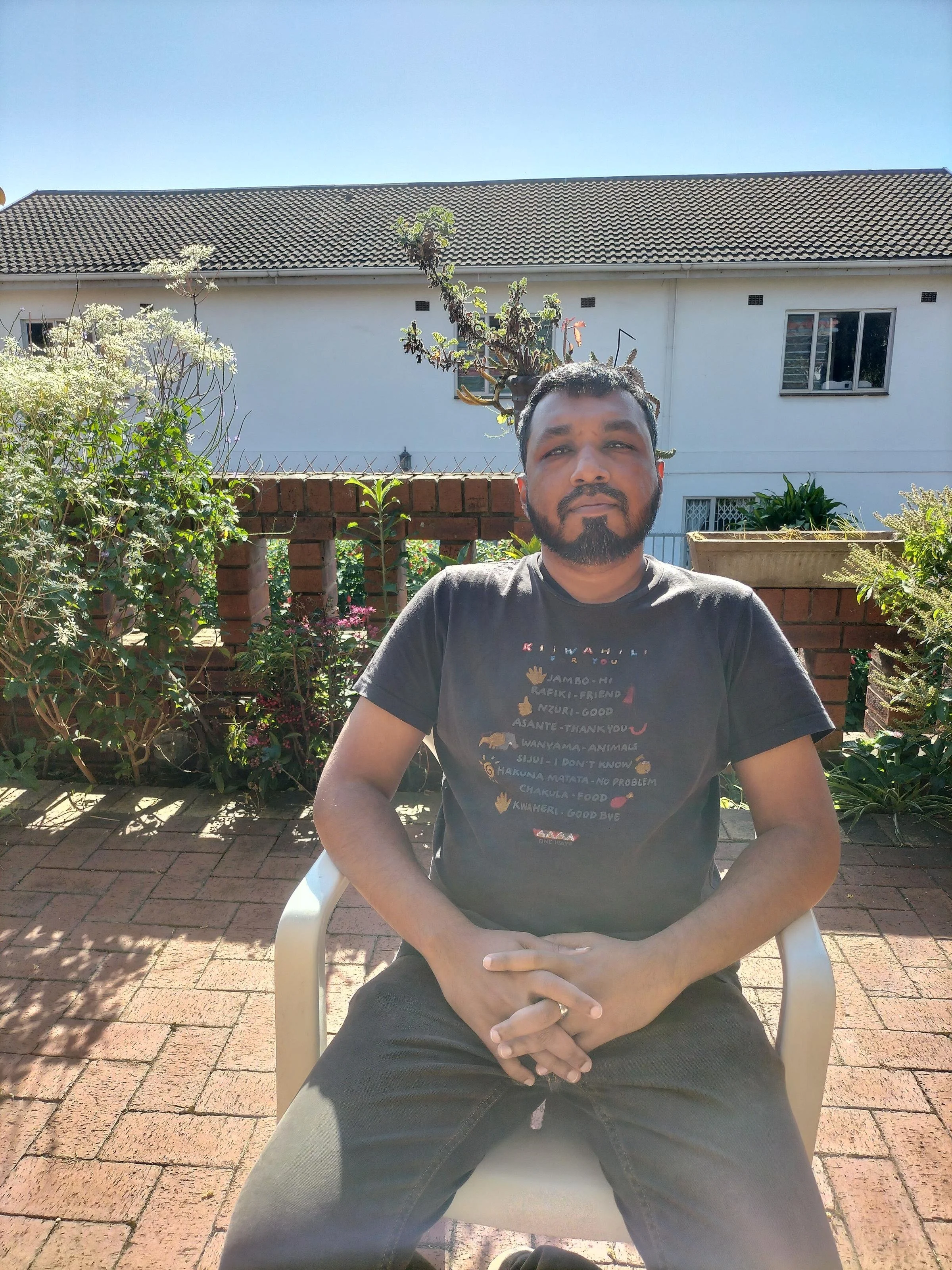
Photo of Mahen Nadesan
BIO: Mahen Nadesan is a software engineer, musician, and writer from Durban, South Africa. He hopes to explore small parts of the human condition in his writing, and to one day publish a collection of limericks.