the shop
by Saee Motling
I ran away from home when I was thirteen or fourteen. I can’t recall the year, but I do recall that it was the same night I got into the selling business. I stole this and that, sold this and that, and it went on for years. My folks never tried to find me. I know because they would have found me easily had they tried. I had even dropped clues—some nights, I slept on the streets near my house, and some days, I walked around my folks’ workplaces—but they never saw me, and I never saw them. It was as if I wanted to go home but didn’t want to be home, and they wanted me home but didn’t want me to be home. But it wasn’t their fault. They had brought me into this world, hoping the world would become a better place. It never was and never will. It wasn’t my fault either. They left early, came home late, working day and night, with no days off. I don’t even remember seeing them in the sunlight. So, I had plenty of unsupervised time and empty pockets. It didn’t take me long to realise that time flies with filled pockets. So, I started with my father’s pockets, then my mother’s, and then I saw that the world was filled with much bigger things than pockets. But I don’t blame my folks for becoming robots. They had no will to will. But I had, and if I were to be a robot, I would be a robot by choice.
I was around nineteen when I started this business. That same year, I believe, I went on for weeks without thinking about home. Hell, I had seen so many faces pass by every day over the years that I couldn’t even remember what my folks looked like. I never particularly missed them or home. Sometimes, though, I missed my childhood when I didn’t understand that two and two make four.
Anyway, my new business. I had a small shop, and the stuff I sold there wasn’t something most people would call ethical. Yes, it was illegal, and no, it wasn’t drugs. It was just something private. That’s why I never discussed it with anyone—not even with my clients. They would come into a dimly lit back room, ask for what they wanted, I would give it to them, and then they would leave. And because it was illegal, it was better that I didn’t see them and they didn’t see me. I implemented this low-involvement policy after my first week. A week was enough to teach me the lesson. There was no control over the information the customers shared with you. All my customers came in desperate and vulnerable conditions. You give a little push, out swings their gate and then comes the flood. The flood was already brushing my chin; I couldn’t afford any rise in its level.
I sold emotions. More precisely, I sold two emotions: Love and Happiness. There were other emotions too—Inspiration, Confidence, Hope, Peace—but I chose these two. Now when I think about it, I think I chose them because, I guess, I never had them. Also, the market had a high demand for them, and the other emotions were nothing but side effects of these two. So, multiple birds with one stone.
The emotions came in liquid form from the manufacturer, and I injected them into my customer’s veins. Now you might wonder: is there any real difference between Love and Happiness? Hell, I don’t know. I have spent years debating it with myself and never reached a conclusion. But I will tell you one thing for sure, young folks never came for Love, and old folks never came for Happiness.
And no. I never used them. Not even once.
I ran the shop for five years. The front was a tattoo parlour; the back was where the emotions were sold and injected. I had tried different businesses before finally settling down into this one. And when I did, I left my stealing days behind. I built everything in there with my own hands or bought it with the money I needed for food, keeping my stomach growling for days. Every little thing was connected with memories—the sofa in the corner I slept on for months, the walls I painted with my friends, those boom boxes everyone borrowed for parties, my second or probably third hand bike that I loved and crashed and got an ugly scar below my ear, the pricey tattoo machine that starved me the most, that espresso machine gifted by my girlfriend, and the walls nailed with pictures of happy customers after getting the tattoo.
Anyway, like every good thing must end, one day I also decided to end this happy era and close the shop. I was going to be a father. Though the world still wasn’t a better place, I wanted to be one for my child. I started telling my customers in my last month there, and they went nuts. They thought they would never feel happy or loved again. With moderate efforts, I could have found out who else sold emotions and shared their whereabouts with my customers, but I didn’t. Making them feel happy and loved was a good thing, but it wasn’t the solution. I couldn’t tell whether it was contributing toward making the world a better place, and around that time, I had stopped choosing if I couldn’t choose.
The end was near, and I didn’t know what it would bring, but I was ready. I had a feeling that the sticky, stubborn, bad phase of my life was also, finally, nearing an end. I could have kept the tattoo parlour running, but I wanted to leave it all behind. So, I sold everything—from the sofa to the frames on the walls—leaving only the espresso machine. I couldn’t part with it. It had been pure from the moment my girlfriend had gifted it to me.
So, on my last evening there, I pressed the button and watched that dark, steaming liquid pour into my black mug that had a small crack at the bottom, and sat on the sofa staring out the glass door. It had darkened outside, and the air was chilly with a dash of raindrops. The sky had turned red and black, matching the cars passing below. I sat with an empty mind, and just as I raised my hand to take a sip, a shadow moved before the door, and the tiny bell above tinkled.
“I’m sorry,” I said, squinting at the man standing in the dim light, “We’re closed.”
He hesitated and glanced back at the door. “But the sign says you are open,” he replied. I recognised the voice. It belonged to one of my oldest customers. He was an old man, around sixty, with a worn-out face and a head covered in grey-black hair. But I didn’t know his name. I didn’t know most of my customers’ names.
I stood up. His sudden appearance had confused me. He came on the first of every month to get Love, but that day wasn’t the first. It was the last. I remembered informing him about the closing, but it was clear he was worried about the day after, when he would habitually step out of the house and realise that there was nowhere to go and nothing good left to feel. He had been coming to the shop, I guess, for the past three years. He had a wife and had become so pleased with the emotion that after a year of taking it, he had tattooed his wife’s name on his right forearm inside a heart.
“You are a day early,” I said.
“Oh, yes, yes,” he stammered, looking lost, “I was just passing by and thought I would see if anyone was still here.”
“Oh,” I said and looked at him. He looked back. We both didn’t know what to say after.
“Well,” he said, “I-I’ll leave then. Good luck for your future,” he waved awkwardly, “And goodbye.”
When he said that, I realised I had never seen him clearly from the front. I suddenly felt like I should have known his name. He waited for a moment or two, maybe for me to say goodbye back, or at least a wave of the hand, but I was stuck under some unfathomable weight and couldn’t move. Seeing this, he turned to leave. He pulled the door, the bell tinkled once again, and a hand shoved inside my ribcage and squeezed my heart. I was leaving the shop, but he was leaving me. And that hurt. All that time, it was only about what I was feeling, but then I understood what the shop might have been feeling. I was scared, lost, and excited, and I wondered if the shop was feeling the same.
“I just made coffee,” I said before he could step outside, “And I have two mugs.”
He stopped and looked back with hesitation. Then he looked up at the red sky, and a chilly breeze rushed inside through the open door. He closed it. “I hope it’s still hot,” he said.
I handed him the mug as he sat in the corner of the sofa, maybe it was his usual place. I pulled a stool and sat in front of him. The shop was filled with the smell of the first rain and coffee.
“You won’t be doing the tattoos too?” he asked.
I nodded. “Someone else will continue it.”
“Are you moving someplace else to start a new business?”
“No.”
Silence fell, and we both took a sip.
“I’m getting married in three months,” I said. I have no idea why I shared that, considering the low-involvement policy. Maybe because it was the second-best thing that had happened to me in an eternity.
The man smiled, “Congratulations.”
Another round of silence and sips.
“I’m really grateful,” he said, “For what you did here for the people like us.”
Hundreds of questions had swarmed in my head over the years that I had never asked, but it was my last day there, and I thought, hell with the policy. “Don’t mind me asking,” I said, “But why did you start taking the emotion?”
He looked at me in amusement as if I had asked why the leaves are green or the sky is blue. Then he smiled, as if I knew all of his secrets and it was silly to hide anything from me. “My wife,” he pulled back the sleeve of his jacket showing the tattoo, “She is beautiful. Always has been.” He neatened the sleeve back, “I couldn’t give her the only thing she wanted. To be a mother. She wanted to be a full-time mom, with two, three, God knows how many kids. And I couldn’t even feed one.” He sighed, “You know how it was with jobs back then. Fewer jobs with less money. We needed the money, so I forced her to work. ‘Next month,’ I used to tell her, ‘Next month you quit, let’s just pay this month’s bills.’ But the month never came. When I look back now, I know we could’ve managed on a single person’s salary. We would’ve been poorer, but she would’ve been happier.” He sighed again, “But we were young, and things happened,” he squinted, looking at an invisible spot, “We fought, things happened, and they just sucked all the emotions out of me. I just couldn’t love her anymore. I became cold, thought I didn’t need anyone, but I’m getting old, and I know I need her, and she needs me. And I can’t give her anything if I don’t have it first. That’s why I need Love.”
I wasn’t expecting the man to pour out his heart. But now that he had, I couldn’t help but get involved and ask, “But don’t you ever feel like you’re forcing the relationship? That it’s not natural?”
He shrugged, “Not at all. We’re in love again. We’re happy again. I just hope that we’ll continue like this even without, you know-,” he paused, “We have only each other and memories that are not good.”
“I’m sure you both will,” I meant it, “Love is a basic human emotion. I’m sure that if you try, you’ll find it back inside.”
He didn’t look convinced. “So, someone’s taking over the tattoo business,” he took a sip and said, “Is anyone taking over the other business too?”
A smile came on my face, “No, I’m sorry.”
“Do you know anyone who-?
I shook my head.
“But if you ever do get to know, would you let me know?”
“You’ll be the first person I’m contacting.”
He took the last sip, got up, kept his mug on the table, took a card out of his wallet, and handed it to me. “It has my name and contact details,” he said, and suddenly frowned, “No, not just for that. Well,” he sighed, “I’m too old for you to call me a friend, but give me a call if you ever feel like talking to an old friend.” He smiled and stared at me for a moment that felt much longer, “If I had a son, he would’ve been of your age,” he said and got lost in some thought, then he moved quickly, “I should leave now. My wife must be waiting for me,” He picked up the grocery bag he had kept on the floor. “She gets furious if she doesn’t get things on time,” he said with a smile. He opened the door. The bell tinkled. “Thanks for the coffee,” he said, “And again, congratulations and good luck for your future.”
I nodded with a smile.
He gave a nod back, “Goodbye.”
“Goodbye, sir.”
And the bell tinkled once again behind his back.
Yet again, I was alone. I walked and stood before the door, peering at the dark sky above the buildings as the birds returned to their homes. My insides burned as I thought that I was leaving my home. I have no idea how long I stood there, gazing outside. I knew it was time, but I just couldn’t bring myself to turn off the lights and lock the door. It hurt thinking that it would be the last time. I took a deep breath, and turned to make the last cup of coffee, then pack the machine, and finally, leave.
I was about to fill my mug when the bell tinkled.
“Excuse me,” came a nervous voice.
I turned and saw a middle-aged woman standing at the door. I recognised her. She was one of my customers.
She stepped inside with haste, “I’m sorry to come in like this. I know you’re closing, but I really need Happiness.”
I had opened my mouth to refuse, but she spoke, “Please. I really need it. Anything, even a drop, would be fine.”
She looked so anxious that I opened the packed box and began looking for Happiness. All the glass vials were empty but not dried to the bone.
“So, Happiness is it this time?” I said as she waited uneasily at the door. She took different emotion every time and was pretty irregular.
“Yes, thank you so much,” she said, took a few steps inside, and began glancing around. “So, someone else will be running the tattoo parlour?”
“Yes,” I said, picking up one vial after another to check if anything was remaining in them. Then, with a realisation, I added, “But just the tattoo thing, not this.”
She nodded with a smile. “My husband got a tattoo from here, you know.”
“He did?” I said, raising a tiny bottle to the lamp. It was empty. I picked another.
“Yeah. A couple of years ago.”
“What was it?”
She smiled as she spoke. I could hear it in her voice. “He tattooed my name on his right hand, inside a heart.”
I froze.
“May I know your name?” I asked. She told me, and my heart exploded. This was the wife, and the man who was there several minutes ago was the husband. That was the one thing I realised that evening, and the other was that I was completely out of Happiness to give to her.
I stepped aside slowly, taking a good look at her. Something about her had always felt familiar. I could never tell what and never tried to find out either. I only knew that my mother would have looked like her when she grew older.
“Looks like your husband is madly in love with you,” I said.
She blushed. “It’s because of you and the emotions. They give me confidence.” She took a few steps, stood very close before me, and said, “We made many mistakes when we were young,” her eyes bored into mine. I noticed that she was smothering the urge to hold my hand. She continued, “Neither of us knew what we were doing, and time hadn’t always been easier.” Her voice trembled, and she paused to control it. “Our son ran away when he was thirteen. I don’t blame him. I only wish that I could tell him I still love him just the same, and wherever he is in life, I am extremely proud of him.”
I felt like my knees would break and I would fall. The absolute helplessness of life rammed so hard on my shoulders that I forgot where I was, who I was, and what I was doing. My body shrank into that twelve-year-old boy who had felt the same before stepping out of the house one night, not knowing it would be the last time. I felt hot air coming in and out of my lungs as my heart pounded.
“I see a ring on your finger,” she said, “Good news?”
I looked up and stared at her for a moment. The question reminded me of my girlfriend and baby, and it pulled me back into the present. “Yeah,” I said controlling the crack of my voice, “And I’m going to be a father too.”
And I had never seen anyone so happy and calm in my life ever. But she didn’t say anything. She didn’t have to.
I took out a vial and showed it to her. “The last one,” I said. It wasn’t the last one. It was a vial of a neutral solution I used to dilute the emotions as per different doses. I filled an injection with it and took a step toward her. She sat on the stool and pulled up her sleeve.
“It’s a very strong dose made of pure happiness,” I said, “It will last for at least a year.”
She smiled, knowing it wouldn’t.
“Will it last forever?” she asked as I was disposing of the used syringe.
The image of the old man who had just had coffee with me flashed in my mind. Then came a flood of all the faces whose smiles I had seen getting brighter and brighter because of the emotions as weeks, months, and years passed. Had I helped them by being or was I helping by leaving, I didn’t know. But somehow, I felt in my heart that I had helped both myself and my folks by leaving that night. I smiled, “If you let it, it will last forever,” I answered.
Her eyes wrinkled as she smiled, and I understood that she was going to.
“Goodbye, son,” she said, opened the door, and walked quickly outside.
“Goodbye, mum,” I said, feeling warm tears running down my face.
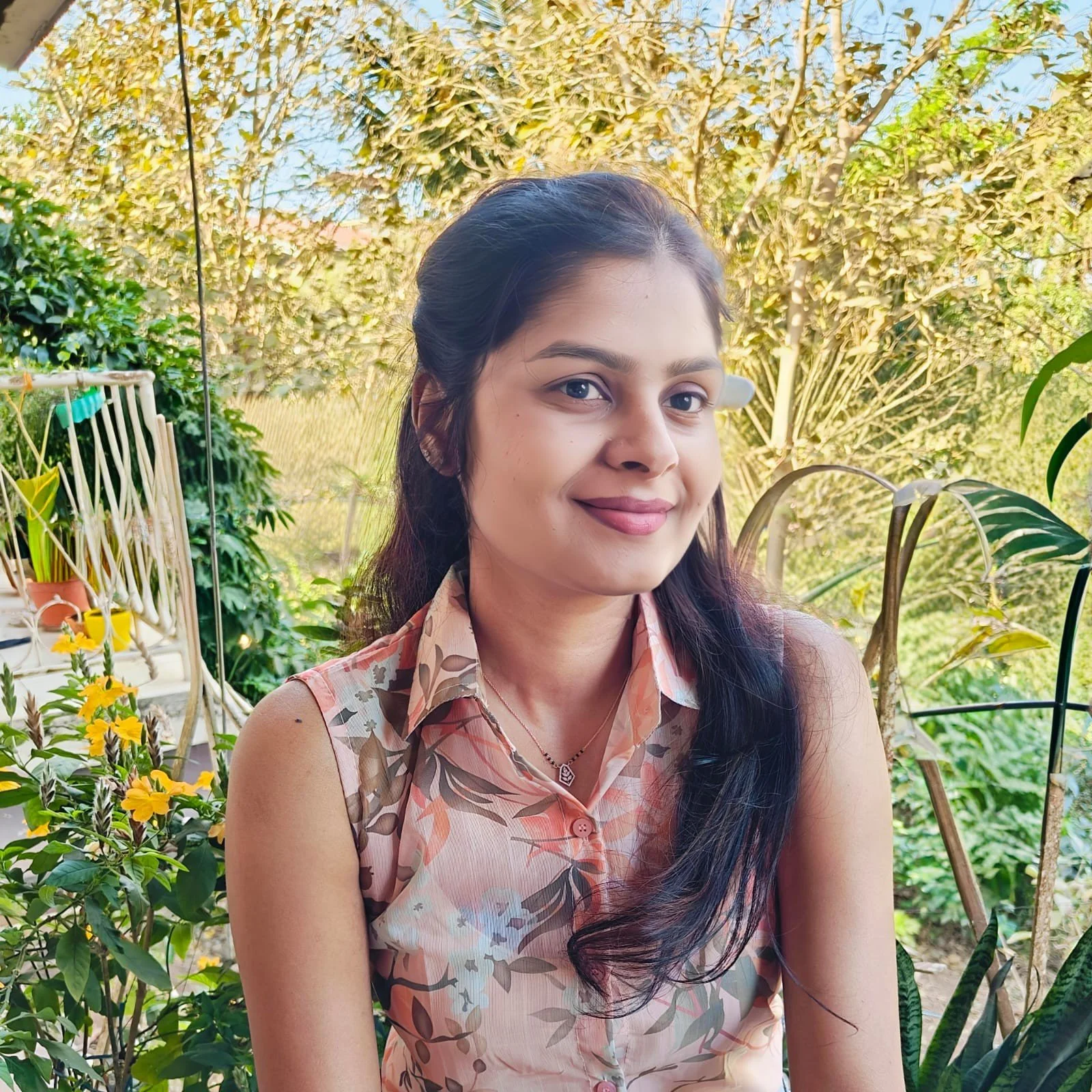
Photo of Saee Motling
BIO: Saee Motling is from Goa, India, a beautiful coastal state, and works as an undergraduate professor. She lives with her husband and their orange cat, Bobby.