the self-checkout lane
by Rick Taliaferro
Harris Reeves, the renowned teenage poet, tried out various soulful expressions in the rearview mirror of his car, determining which face would look best on the cover of his eventual chapbook or during a tv interview or podcast. While posing, he noticed a nondescript sedan near the back of the Sav-Wa Faire building, gray exhaust seeping out the tailpipe. A gaunt young woman with stringy bleached hair sat in the driver’s seat in a haze of cigarette smoke. She looked toward Harris, scowled against the sinking sun, and rolled up the driver’s window which was held together by a diagonal of masking tape.
Harris figured that her boyfriend or husband or children were foraging the bountiful dumpsters in the back of the grocery store; there’d been local television news reports about an increase in scavenging in the suburbs. He locked his car and went to start his shift.
The Sav-Wa Faire Employee Code of Conduct obligated him to notify management about suspicious activity, but as the glass doors slid open and the air-conditioned air chilled him, he decided against telling on the woman. No reason for food to go to waste; she was just harvesting what got thrown away. Regardless, there was the chip on his shoulder about his employer, put there by a micromanaging assistant manager. Talk about a petty officer. Who did he think he was?
Besides, the poet had more important matters on his mind than a dumpster-diver or an obnoxious assistant manager. Like the reaction paper for English, on which he had procrastinated the past two weeks. Suddenly, it was due the next morning. Five paragraphs on “A Refusal to Mourn the Death, by Fire, of a Child in London.” He could whip that out after watching The NiteCast…if he knew what the poem was about. It vexed him, a poet, that the poem puzzled him. He could grab something from EZ-SA Online, but preferred to not cheat. He had a copy of the poem in his shirt pocket to study during the odd lulls at the self-checkout lane. One thing that bothered him was the title: it couldn’t have been a refusal to mourn if Dylan Thomas had written such a tribute to a dead child.
Harris walked along the meat and seafood displays to the breakroom to clock in. The raw smell was heavier than usual, slightly off-putting. He liked cheeseburgers, but cringed whenever he imaginatively peeked behind the cardboard display of a big happy family enjoying prime rib to see the slaughterhouse and what must be the animals’ terror, the sound and the smell. He put on his green Sav-Wa Faire jacket and affixed his ID badge upside down to annoy his tormentor, the assistant manager.
At the self-checkout station, the previous attendant told Harris that register 1 was acting up and left. Harris had a good ten minutes before the assistant manager said in his ear, “I haven’t received your signed interim appraisal, Harris.”
“Hey, Mr. Gellen.” Harris’ eyes were level with a Habsburg lip accented by a sparse black moustache. “Well, I signed and submitted it.”
“When?”
“Right before I came to work.” Harris congratulated himself when Mr. Gellen frowned and opened his tablet. “Maybe it’s floating around in the ethernet.”
“No, it’s here. Finally. Next time, don’t wait until the last minute.” Though no customer had ever complained about Harris, Mr. Gellen had enumerated several improvements that Harris needed to make in his attitude, posture, even his personality. “You left the employee’s response blank.”
“Isn’t that optional?”
“Yes, but don’t you have anything to say or ask about my progress profile of you?” Mr. Gellen seemed offended that Harris hadn’t read his golden words. He held up the tablet for effect. “Either you know yourself or you don’t. This is Harris Reeves, right?”
Although Harris didn’t want to give Mr. Gellen any credit, it was a good question. Some of Harris’ poetic attempts had the motif of identity, a la Who am I? At least he had learned to recognize and delete his overwrought cliches without a second thought. That was a big first step. But, Mr. Gellen’s profile would never be the Harris Reeves whom Harris sought. “Your words not mine, right.”
“Your signature signifies agreement.”
Harris shrugged.
Mr. Gellen smiled as if he had tripped him up. “See, you just proved my assessment of you.”
“I couldn’t submit it without signing it.”
“You think I’m hassling you, don’t you? That I don’t have better things to do.”
“Not at all.” Only to the point of quitting. “You’re like…my coach, Mr. Gellen.”
He was pleased with the analogy. “I really am a coach to you, and all the great talent on Team Sav-Wa Faire.” He squared his shoulders as if posing for news cameras in the locker room after a victory. He had some glory-days as an athlete in college. Or was it high school? “And I’ve set some goals for you that I think you can achieve.”
Harris struggled not to snicker at the low-hanging fruit. He had heard the coach bit from Mr. Gellen at least twice. The way people saw themselves! Either you know yourself or you don’t. “Well,” he said with the right enthusiasm, “I better get busy and score some points with those improvements.”
“Now that’s playing heads-up ball, Reeves.” He looked at Harris’ jacket. “But how many times have I told you to keep it buttoned? Wear the Sav-Wa Faire uniform with pride.”
“I was so eager to start work, I forgot.” Harris started to button the jacket from the bottom.
“Wait just a minute.” Mr. Gellen pulled the jacket away to expose Harris’ shirt pocket. “What is that?”
“Just some notes.” Harris pulled the jacket back. “Kind of a to-do list.”
Mr. Gellen snatched the folded sheet.
“That’s really private property,” Harris said. “Personal.”
“Not when it’s on company property on company time.” Mr. Gellen unfolded and looked at it. “Oh, right, you want to be a poet when you grow up.”
“You should put that in my profile. May I have it back now?”
Mr. Gellen lip-read a few lines. “You wrote this?”
“No, it’s a copy. For English class.”
“English? It’s Greek to me.”
Harris didn’t want to agree with him that it was hard to understand.
Mr. Gellen read aloud Harris’ handwritten notes at the bottom. “Argue points: Thomas is unclear. Obscure images? Outdated words? And WTF -- there are many deaths after the first one. I’d ask what this means, but I’m busy.” He handed it back. “I’ll monitor your station while you go put that in your locker. And fix your ID.”
*****
An hour later, after a swarm of self-checkout customers dissipated, Harris refilled the plastic bag dispensers and wiped the counters with a caustic blue sanitizer. He discreetly ogled the bikini-clad fitness models as he straightened the magazine rack. There were several special-issue publications of popular bands. Alison Cobbler’s gaunt, unadorned face with a thousand-yard stare adorned the cover of his commemorative zine, Sans Makeup! Monster Hits Live at The Luxor! Harris smiled and whispered a refrain from Cobbler’s song, "Eighteen Years and a Dozen Assholes:"
So many things I can't articulate
So many times my mind's just a blank slate
Eighteen years and a dozen assholes
“Har-ris!” Mr. Gellen called from the customer service counter. He beckoned him with a flicking finger.
“I’m glad that you’re presenting a smile, but as per our appraisal, you need to always be on the lookout for opportunities to help.”
Our appraisal. “I was tidying up the self-checkout area.”
“That can wait when there are carts to be gathered and trash to be picked up. You need to guarantee that Sav-Wa Faire makes a good first impression, and that occurs in the parking lot. Now get out there and tackle those carts, then report back to me.”
Though Harris was still on probationary status as a cashier, recently promoted from bagger, he doubted that gathering carts was in his purview, even in a non-union store. He was about to challenge Mr. Gellen when a customer called from the self-checkout lane.
“Yoo-hoo.” A gray man held up a green bottle of the Yadkin Select Merlot that was on special. “Would someone verify my age?”
“Harris, you should have noticed that the customer was approaching.”
“I’d like to drink this before I die.”
Harris started to the register, but Mr. Gellen ordered him to retrieve carts, and bustled from behind the counter to the customer. “I apologize for the delay. He’s still learning.”
“That Harris, he’s a good learner,” the customer said as Harris walked by. “I’d be home sipping this by now if he was working the lane.”
“You have excellent taste in wine, sir.”
“Just verify my age, would you? Or do you need to see a photo ID?”
Harris smirked and trudged into the muggy evening, glad to be away from Mr. Gellen and to have some alone time. The constellations shone faintly in the black sky above the light pollution. Much brighter, a meteor shower of headlights and taillights streamed by on Falls of Neuse Boulevard. The pondering poet was grateful for the light breeze that had developed. He took off his jacket and slung it over his shoulder.
As he gathered carts in the broad parking lot, he tried to think of his English assignment, but couldn’t without the text of the poem; he could have read it under the glaring parking lot lights. Instead, he assumed an introspective expression and mused about his poetry. His English teacher encouraged his efforts, commended some of the turns of phrase. She criticized his most recent piece as too vague with abstraction and suggested that he make it concrete with specific imagery. He agreed, but didn’t think it was worth further effort and aborted it. It was as shapeless as a lot of pop music, Christian rock, perhaps the result of his own shapelessness.
The cart train grew heavier, and weak and weary, he couldn’t ponder on poetry for thinking of the mundane Mr. Gellen. Coach. The beleaguered poet had become his target among the younger employees. He could talk to the general manager, but she probably would support Mr. Gellen, even if she were sympathetic.
The car with the taped window was gone. He was glad that he hadn’t informed on the woman and hoped that she had found plenty of food.
He needed something to distract him from Mr. Gellen, to startle him into an idea for a poem, maybe a shock of some kind, pleasant or unpleasant. He gazed at the sky again and adjusted his eyes wistfully as he emoted “A Man Said to the Universe.” He felt insignificant, too, but at least he didn’t go in for talking universes. …gazing up at the dark sky spangled with its signs and stars, for the first time, the first, I laid my heart open to the benign indifference of the universe… Yeah, pretty much the same sentiment, but that was more to his liking.
Feeling suitably elegiac, he began moving the carts from the parking lot pens to the store. He parked some of the carts in the corral just inside the sliding doors, and the others in the corral on the sidewalk.
After he cleared the parking lot, he walked the long sidewalk with his fists on his hips to ensure that he hadn’t left any carts. He didn’t want to give Mr. Gellen an excuse. Satisfied, he started to put on his jacket under a warning sign:
Pedestrians Only!
No Skateboarding
No Rollerblading
He stopped and cursed. At the adjacent barren lot that was being prepped for a U-Mart, a shopping cart sat on a mound of dirt under a light pole. Construction workers must’ve left it there. Harris went to retrieve it. He’d better check the back of the building, too. As he gripped the cart, a sudden gust blew grit from the U-Mart lot into his eyes. They teared up, imparting a mirage-like effect to the surroundings. In the back of the building near the watery green dumpster by the loading dock, there was a shimmering cart. Harris rubbed his eyes, speculating whether Mr. Gellen had known it was there, or had planted it. Was he now spying out the heavy black vinyl curtains of the loading dock? Good thing that Harris was checking. He donned a serious face and pushed the first cart to the second cart, a dark wall of kudzu-entwined pine trees on his left.
In the second cart was a lump of something in a plastic Sav-Wa Faire bag, garishly lighted by the security lamp above the loading dock. The contents didn’t smell, though there was a hint of rusty iron. Would Mr. Gellen have put it there? He was probably testing Harris to see how he’d handle it. What a joke he was.
But Harris kept his serious face on as he gingerly lifted and opened the bag. For a second, a whole fryer chicken. The next second, a tuft of dark hair, squinted eyes, blue lips parted. He recoiled as he dropped the baby. After he regained his breath, he put a tremulous hand inside the bag, averting his eyes as he felt the cool, creepy skin for a pulse. There was none. Harris shook it gently, then forcibly as if it could be revived. Whimpering, he pushed the cart ahead with sweaty hands to report to Mr. Gellen. He moved by leaden inches.
At the automatic sliding glass doors, the apparition of the cart and him disappeared as the two panels split open to the dizzying array of store lights and colorful packages and Muzak. When a customer exited past him, he remembered where he was and what was in the cart. He pushed it in.
At the Guaranteed Customer Satisfaction counter, the lead rep was reading a flat-panel screen but stopped to look at him. “Lost?”
“Is Mr. Gellen around?” His tight voice sounded as it did before puberty.
“Right over there.” She pointed to the self-checkout lane where Mr. Gellen investigated a problem with register 1. She looked quizzically at the plastic bag in the cart. “Is there an issue here?”
He swallowed the metallic taste on the back of his dry tongue and winced. From a distance, he realized that he was having disconnected thoughts. How to express his find to her? “Yes.”
“Well, let’s make it right. I could use a break from the weekly stats.”
“We can’t make this right.”
She looked askance at him and stepped from behind the counter to the cart. “Let’s see what in the world this is about.” She opened the bag. Seconds later, her eyes widened and she put her hand over her mouth. “Good God.”
“Wrong.”
“Stay right where you are.” She bolted into the glassed-in office as though to vomit but picked up a phone.
“Wrong again.” He wheeled the cart to the back of the faulty self-checkout register. The computerized voice recording was stuck in a loop, and Mr. Gellen’s head bobbed like a squint-eyed puppet as he pressed screen icons to try to stop the digital voice, so sultry, so concrete:
Swipe your Sav-Wa PIN
Sav-Wa PIN is not valid
Wait for attendant
Swipe your Sav-Wa PIN
Sav-Wa PIN is not valid
Wait for attendant
⋮
A few customers lined up to use the other three registers and idly watched the attempted repair.
“Score!” Mr. Gellen exclaimed when he stopped the recording. He looked up smugly but grew stern.
“Harris, what are you—do you feel alright?”
He was surprised at the sympathetic shift in Mr. Gellen’s tone. “I’m reporting to you, like you ordered.”
“Well,” Mr. Gellen said, trying to remain strict, “put that cart away and help me out here.” He lifted the cover of the register to expose the morass of wiring and circuit boards.
“But there’s something you should see.”
Mr. Gellen glowered. “Not now.” He bent over and looked into the guts of the machine as though he knew what he was doing.
The approaching siren of an emergency vehicle galvanized Harris. He wheeled the cart around and stopped a few feet from Mr. Gellen.
He looked sideways at it. “Get rid of that trash and put the cart away,” he enunciated.
“It’s not trash!” Harris shouted, alarming Mr. Gellen into a timorous expression.
He stood. “You’re not acting like the improved Harris, Harris. What has got into you?”
Harris had never seen Mr. Gellen all skittish and regretted startling him. Mr. Gellen didn’t know what was in the bag, and couldn’t be blamed for an offensive comment. Harris pushed the cart forward. “Let me show you.”
Mr. Gellen recovered and braced his hands on the front of the cart to stop it but wouldn’t look down. “Let me show you.”
Their eyes cleaved to each other as if in a staring contest. Joined by the cart pressing against their navels, Harris was surprised that he equaled Mr. Gellen’s strength. More surprised when he realized that he was unconsciously jutting out his lower lip, like Mr. Gellen. Like a couple of twins tussling over a toy. Harris stopped resisting.
“Why won’t you look? Coach.”
Mr. Gellen gloated over his win.
Harris sneered. “You don’t even know when you’re being kidded.”
“You were kidding me? I hadn’t noticed. But at least I don’t kid myself. Poet.”
Maybe he didn’t, but Harris did. He indulged himself as a poet as much as Mr. Gellen indulged himself as a coach.
There was jangling equipment as a group of paramedics and a police officer jogged into the store. The customer satisfaction rep frantically pointed toward the self-checkout lane.
Mr. Gellen looked at them, then open-mouthed at Harris as if demanding an explanation.
“They’re here about this.” Harris tore the plastic bag apart.
A nosey customer gasped.
Mr. Gellen’s face contorted in dismay and he stumbled backward into the gaping maw of the faulty self-checkout register.
The paramedics pushed Harris aside and gathered round the baby. A police officer helped Mr. Gellen up. The older police officer took Harris aside and regarded his face to ascertain his condition. He read his ID badge.
“Last name?” the officer asked.
“Reeves.” It sounded like someone else.
When asked if he’d noticed any suspicious persons, Harris told of the nervous young woman hours earlier. He tried to remember details of her car, her face, but could see only a smoky scowl. He couldn’t identify her any more than he could the poor baby. Any more than he could himself. He’d wanted a shock.
The paramedics moved the baby onto a child’s gurney, covered it with a sheet, and left among a few gawking customers.
“The baby wasn’t the only thing that I found,” Harris absently said.
“Yes? What else?”
“I’m not going to write an essay.”
“O-kaay,” the officer said tolerantly.
“I’m going to turn in a poem, instead.”
“I think I’ve got what I need.”
“And it won’t be a refusal to mourn. Who’d he think he was?”
“You need to ask your boss for the rest of the night off, sonny.” The officer joined his colleague who was completing the interview with Mr. Gellen.
Harris was wondering whether he still had a job when a shuffling senior citizen arrived at the self-checkout lane with a meager basket and several coupons pinched between gnarled fingers. She muttered about all the upheaval. Harris was about to guide her to a working register but stopped. Mr. Gellen was looking at him. He raised his eyebrows stagily and pointed at the customer as if asking Harris what he was waiting for, but dropped the expression to encourage him with resolute lips and a smart nod.
*****
After his shift ended, Harris sat in his car under a security light to note the snippet of verse that had begun to form after things had settled down at the self-checkout lane. He thought “The Self-Checkout Lane” would make a good title, but discarded it as too obvious and irrelevant. He wrote on the back of the copy of the assigned poem, and resigned himself to long hours to make something of the untitled piece:
A ghastly brief life in a black-topped waste
Emanates beyond all property lines
From this center obscured by the lot lights,
With no voice to cry to us commuters
Oblivious to its plight in our haste…
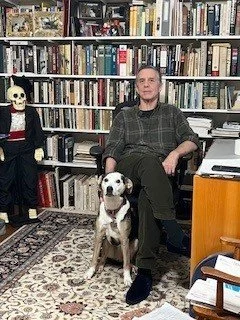
Photo of Rick Taliaferro
BIO: Rick Taliaferro is a technical writer who pursues creative writing in his spare time. Besides short stories, he’s had a YA novel (CASCADES) published. Journal experience includes eight years as an associate editor at Bartleby Snopes, and from December 2023 to March 2025, he was an associate editor at Fiction on the Web. Recent short story publications: “Shock Corridor,” Maudlin House, July 30; “Karjaque,” CafeLit, September 19; “A Lake Monster,” Ivo Review, Issue Two, December 20; “The Miracle of the Clogged Toilet,” After/Thought Literary, January 2026.