the girl who faded away
by Katherine Liljestrand
Casting is always such an anxiety-inducing process. No matter whether good or bad, it still affects everyone. Its repercussions can have long-lasting effects, including but not limited to lasting physical, mental, emotional, psychological, and social effects. And when you deal with casting choices several times within a single season, well, no wonder ballet dancers are sometimes deemed insane.
Insane we must be. Camille stood by my side while we both looked at the rehearsal board. She was called to all three hours of rehearsal today. I was only called to the two hours of rehearsal for the Balanchine piece. Camille has also been called to the director’s rehearsals as well. The third piece, currently getting choreographed, has a rotating cast of dancers called. I haven’t been called yet, but it looks like I’ll be joining the group rehearsal tomorrow.
I’ve stopped being surprised after all of these years. Here’s the thing: I crave dancing more. But I’ve come to realize and accept that maybe I just won’t be dancing here as much as I want. After all, in my first two years here, I had less rehearsal time than anyone else in the whole company. It’s not a large company, but for a company of twelve to fourteen people, that’s still a feat.
Remember two years ago when Kloey and I would go grab brunch cocktails after class because we weren’t called to any rehearsals that day? By that point, I’d already grown accustomed to being called less, but I was still angry, frustrated, or upset over it. Fortunately, I’ve gotten to dance more in recent years. I’ve grown to accept that it just depends. I can fade into the background as easily as a wallflower, despite the fact that I’ve always done my best to be one of the brightest botanicals around. Maybe that’s a bad description, but maybe botanical is a good way to describe growth as a dancer. And goodness knows I’ve been suffering from a lack of growing space or proper nutrients.
The dancers around me all subtly morph in color and pattern, depending on what rehearsals they have and what roles they’ll be working on. We’re all chameleons, changing from one role to another. Sometimes our skins stay the same for longer periods of time, especially when we’re working on a story ballet. I was nothing but red and black and pale white for months leading up to our October horror ballet. And Leslie, Lara, and Mina were all blue for that one partnered piece last year for a month.
I look over at Camille. The prismatic shifts of her skin and clothes are shifting like an octopus’ mimicry. The patterns hinting at Japanese history are coming through a little more boldly. Camille’s getting ready for the director’s piece later today.
None of us know how this psychedelic effect started or why, as a general rule, it only seems to affect dancers and other artist types. The records show that this effect, for dancers at least, was occurring throughout the 1900s, but one can guess that it was affecting dancers and performers for far longer than that. History doesn’t really discuss it, for it’s considered something of an open secret: never to be mentioned, never put down in writing. It’s almost like Fight Club; the first rule of being a dancer is, “Don’t talk about how being a dancer has changed you.”
Ballet changes you in fundamental ways, both healthy and unhealthy. We become even more obsessed with physical appearance than the average layperson and check first thing on Monday morning to make sure that we haven’t gained even the littlest bit of belly over the weekend. We want our feet to be perfect, our legs to look lean and long and - ideally - hyperextended, our waists to be tiny, our abs to be a proper six pack, our hair doing what we want it to do, our fingers long, our necks unstressed, and the rest of our bodies nothing more and nothing less than the perfect ballet body. Those who actually fit this mold are few and far between, as in… actually, I can’t think of any dancers who aren’t insecure about some physical feature. Nonetheless, the rest of us are left trying to sculpt perfection from the imperfection of humanity.
Alas, being human can be a dreadful thing.
I guess the question becomes: are we even human anymore?
Psychologically, we’re just as human as everyone else as well, or at least so we like to think. In my experience, dancers tend to be one of the groups more susceptible to gaslighting and more vulnerable to being taken advantage of. Personally, I have a hard time thinking of other professions that mold you from the time you’re but a child to accept orders without question. Some of us liken it to being a member of a cult, but then again, maybe ballet is just more militaristic than I thought.
I worry for the younger ones who have known nothing but ballet. I had the good fortune to go to college for subjects unrelated to dancing and then have whole jobs and small careers in a few other professions. Because of that, I see things that most of the other dancers might not see. I see potential Stockholm Syndrome in some of my colleagues. After all, when there’s 500 other dancers lined up to take your job, you don’t have room to question whether you actually want this or not.
I suppose that’s part of the problem for me. I don’t know if I still want to do this anymore.
It turns out I’m not in the choreographer’s piece, merely understudying our principal dancer’s spot. It’s not the first or second or even third time I’ve been in this position.
Don’t get me wrong, I’m not complaining. Four years in and I finally understand the status quo. I’m not a principal dancer. I’m not a corps de ballet dancer. I’m a tall soloist. A specialist, as it were. And specialists aren’t often used, only when needed.
I was red and pink and all shades of readiness for Valentine’s Day during ballet class today. My hues matched my leotard, skirt, and legwarmers. Class does allow us to choose our own palette a little more consciously. I suppose that makes us fortunate, at least more fortunate than the students.
Once rehearsal started, though, and my spot was pointed out, my reds and pinks faded to something barely discernible. It’s been happening more often lately and seems to be connected to my mood. If I’m feeling on more solid footing, the colors stay more vibrant. But when I feel like I’m floundering, desperately trying to stay afloat in an environment that sometimes seems more than happy to drown me, the colors bleed out.
They say self-care is important. I believe them, but how do you do self-care when the powers that be say self-care is the opposite of what they want? We want thin dancers, starved, too lacking in calories to think for themselves, unless it’s to pick up new choreography quickly. We don’t want them to stand up for themselves. We want them quiet, disciplined, focused, and ready to drink in our every word without question. After all, questions can be dangerous.
Questions can be a mind game. Say I ask about a particular port de bras for Concerto Barocco. Am I asking about the arms, or am I subtly saying that the Associate Artistic Director didn’t teach it properly? Am I making sure we’re all on the same page, or am I pitting the dancers against artistic?
The professional ballet world, at its core, is politicking. While I’ve always known this, I didn’t consciously become aware of it until the last few years. That explains why I rose to the top and placed myself on a golden pedestal for others to follow as an example back at my school and company of my early years. People - and dancers are people - need role models, people to emulate, follow, look up to. I’ve always striven to place myself in that spot. I guess that’s part of the reason my haunches are slightly raised over many of the casting choices over the last several years. Lack of a lead role is lack of power.
The back corner of the studio smells of tiger balm. One of the other dancers was laying the Chinese topical on her ankle pretty heavily during our five-minute break. The music for the newest section is playing, and everyone involved is working through the newest choreography. In the back, I feel myself starting to fade.
I don’t know if it’s the lack of water - I ran out of water almost an hour ago - or lack of food, but I don’t feel all there. Maybe it’s the tiger balm still in the air. But I feel weak through my muscles and bones as a type of lethargy settles over me.
I pull on a knit sweater when the music pauses, thinking the warmth might help. It’s hard to stay warm when you’re not actually dancing and relegated to maybe a few square feet of space at best; everyone in the cast is constantly entering and exiting from all sides of stage, so there isn’t any extra room to do anything more than mark arms in the back.
We’re still thirty minutes from the end of the rehearsal day. I glance down at my arm; it’s pale. There’s almost no color, almost as if the color has leached away. How strange.
I’m so distracted by my arm - or is it that my mind is just not here? - that I almost miss the announcement about no rehearsal tomorrow. We have a snow day up ahead. This city doesn’t have the infrastructure to deal with snow. Nonetheless, we all desperately need a snow day. I haven’t felt myself in a little while now, and a reset would be very welcome.
By the time rehearsal ends, I’ve gained some color back. Hopeful shades of light blue dance under my skin, reminiscent of snow. There’s excitement in the air. Some of the other dancers are also showing signs of the imminent weather forecast for tomorrow. Would that I could get this excited about the work we’re currently doing.
Last year, I got taken out of a role with my husband that I had danced with him previously. I turned black as black could be, and I’m sure that injured my future prospects. Of course, that put me in the best position to play dark roles later on in the season, and that I did. I got to dance Dark Angel for Balanchine’s Serenade and then Lucy for Dracula. You can’t get much darker than those roles.
We haven’t had any dark roles this season yet. Maybe that’s why I haven’t been cast in much. Time will tell, but that’s what happens to specialty dancers.
Our mixed rep show is just around the corner, and we’ve been rehearsing nonstop. I love running Concerto Barocco and feeling the sweat just dripping down my back. Luckily, my stamina’s good enough that I enjoy the dancing; the same can’t be said for some of my fellow dancers.
The choreographer’s piece is nearing completion. I have a sneaking suspicion that there’s only one more section to create, but the principal dancer I’m covering has already been given all of her choreography. The rest of the cast is continually entering and exiting stage in a myriad of overwhelmingly complex steps, patterns, and rhythms. I haven’t had much to learn in the last week.
I find myself fading into the background more with each passing day. The white from Concerto Barocco - the costumes are literally pink tights and white leotards with small white skirts - probably isn’t helping. I transition from white while we’re running the neoclassical ballet into something amorphously nonexistent. Does this mean I’m becoming less of a dancer?
Everyone knows the stories of dancers fading - literally - into obscurity. They stand in direct contrast to those rising stars whose fame does nothing but grow with age, such as Nureyev, Barishnikov, or even Marianela Nuñez. Their colors and artistry grow with each passing year, each passing dance.
So, what happens to those of us stunted in our growth, unable to grow, unable to dance? Do I just fade off into obscurity too? I’ve worked my whole life for this in one form or another. I was never able to give it up, and my passion burned just as bright as my fellow cohort when we all began. But the opportunities passed along have generally gone to the shorter girls, the skinnier ones, the ones who are so fiery and charismatic that they’ve had no choice to succeed in a company led by fiery dramatic dancers. The more subtle artistry of the serious dancer with a quieter presence, a focus on simply how one’s foot places on the ground, isn’t appreciated here. In fact, one of the directors told me last year how surprised she was that I could perform a role that way when she had pictured it as nothing but fiery and flashy. I don’t think one is ever too old to learn to appreciate new things.
Everywhere else I’ve ever danced has loved me. As such, maybe I’m biased. I haven’t understood why the qualities that so behooved me at other places curse me here.
But I’m at an impasse. I can’t simply get up and leave now. I have a house and a life I’ve built in this city. My options are simple. I stay here and fight for some color back, or I fade off into obscurity. The funny thing is, I don’t think they’ll even notice if I fade away.
It’s the Thursday before our performances. We’ve been rehearsing extra hard all week to make up for the snow days we had last week. I’ve been putting my all into class, rehearsals, just being a dancer in general. I’ve been religiously counting my calories, doing cardio (and some weightlifting) at the gym, and applying myself extra hard in class to just trying things, but still staying within the religious variety of techniques that this company tries so hard to enforce.
Will it be enough? I’m not sure. I look down; I’m fully clothed in revealing white and pink, which reveals each and every muscle and curve of my body. Has the work been enough? My skin also dazzles in white, so much so that it’s practically blinding.
I glance up in the studio mirror. I’m surrounded by my fellow dancers, most of whom are also clad in white like me. I don’t have the ribs showing that many of them do. I have the breasts and curves that they don’t necessarily have. I look more closely at myself. Does this make me less than them? I don’t think so, and neither does my husband, but I think it does in the eyes of my director. Certainly, I’d be un-hirable by those places that hire no one but lithe nymphs not even close to the edge of pubescence.
As these thoughts enter my head, the white fades a little, almost as if it’s tarnishing. Alas. I do my best to stay focused on the upcoming piece.
We’re in the middle of a studio dress rehearsal for the whole program. For the first two pieces, including the piece I’m covering, I stayed in the back, quiet and muted. My colors had muted too, from the greens and blacks of class into a dull beige that might be closer to skin tone. But we’re two minutes away from starting our run of Barocco and I’m letting the white run rampant.
These colors: did they come before or after the dancing, I wonder? Does every child start this bright upon their first dance classes? Or do we curate them, nurture them, continually work on their growth, as we continue to nurture our love for dance, whatever form that takes? I don’t have the answers, even though I wish I did. Maybe in my next career, I should study these phenomena as an academic. Goodness knows there aren’t enough academics interested in pursuing dance as an academic research topic. There’s no money in it.
We line up, ready for places. The girls in front of me pass along a hand clap until it makes its way back to me. Everyone does this before every run. It’s part of the good luck charm, the ritual, a way to tell ourselves that what we’re doing is bigger than us. I guess this is some of how they find something to believe in.
And what do I believe in anymore? I’m not certain I know the answer. I glance down. The whites are kaleidoscoping under my skin, more mixed and less certain than before.
We find our fifth positions with our feet and our arms en bas. The music starts. The dancing begins.
Within moments, the music binds us together as one. We move as one unit, one entity. We blind with the light of a single, multi-limbed organism. Individual breaths no longer exist while the violins play, orchestra behind them. The rush of muscles and sweat and feelings and technique and precision and exhaustion and pride all usher us through the next twenty minutes straight of dancing, up through the end.
Twenty minutes after the music starts, we end as one, all bathed in the same color as our leotards.
It’s a stark contrast to the first piece, where everyone’s costumes are zany, unmatching, and vibrantly loud. In that piece, everyone’s skin took up the banners of their individual costumes; that is to say, everyone was together in their differentness, and it was glorious. To be honest, I feel a little envious of that bright color and individuality right now.
It’s wonderful to feel a part of something. I readily admit that. But when the time comes and you’re separated out from the crowd, it feels like the world is ending and the sky is falling all around you, leaving you alone and apart forever.
I wish I could stop that feeling, but I don’t know how.
Notes follow quickly. They are few for those of us in Barocco. We get to go home early, since we have tech and dress in the theatre tomorrow and a set of double shows on Saturday. Extra rest is in full order right now.
Tech and dress rehearsals were everything we expected them to be: organized chaos. In theatres, tech and dress always are. Fortunately, since this is a mixed rep show with no sets and minimal lighting and music cues, the chaos is limited, contained.
I feel ready for the performances, even if not everyone feels that way. It certainly helps to feel calm and contained when you’re repeating a piece that you’ve performed recently and that piece is the only dancing on your plate. Everyone else is a little more stressed.
Camille has her own set of nerves. “I’m ready to be done with this show, Beth,” she confides in me during intermission. She’s wearing a leotard with cutouts on it and her kimono, part of the piece, is hanging behind her. “I’m just ready to get onto some real dancing.”
“But you are dancing,” I tell her.
“I know. I’m very fortunate. But all this bending and balancing doesn’t feel like real dancing to me.” She laughs. “You know I like big jumps and lots of allegro.”
I laugh with her. To me, the adagio work she’s doing now is some of the dancing that makes me feel most alive and what I’ve been trained to do best. There aren’t many opportunities for that type of dancing in this company, which makes me feel disproportionately useless as a company member.
We get through the first performance without a major hitch. Our two-hour break before the half-hour call goes by all too quickly and all too slowly. I feel withdrawn and untalkative, despite the exhausted babble happening all around me in the dressing room.
Several of the girls are discussing which upcoming company auditions they will be attending and which companies have already rejected them. Others, like Camille, chime in with their own knowledge about auditions more generally but hold their own plans close to their chest. A lot of dancers are looking to leave this company. The actual turnover rate this year will depend on a lot of factors, including luck and timing. I know what the dancers leaving are looking for: somewhere not here. Somewhere where they will be treated like actual people and not expendable resources or golden trinkets.
I envy them, to some degree. The chance for freedom and escape. I don’t have that chance. My freedom and escape lie in other directions, away from dance. I don’t have it in me to leave quite yet, but soon, I will.
The stage manager calls half an hour until places and the bustle of readying for the last performance begins. I touch up my makeup and hairspray any wisps of hair that have escaped since the top of the last show. There’s little for me to do and almost an hour before I need to be on stage.
When I finally do step on stage during the second intermission, it takes me a few moments on stage to readjust to the reality of dancing in pointe shoes on stage for a live performance. The second performance of the day is always the most discombobulating.
After several minutes, once everyone in Concerto Barocco is on stage, the stage manager calls places. We take our places: standing in two lines in fifth position with arms en bas, heads straight out to the upper balcony.
The curtains open almost silently. The stage manager whispers, “Go!” from the side of stage. We plié in preparation for the music to start. The first note sounds and simultaneously we all scoop up to sous-sus, arms high fifth, and begin to dance.
The rest goes by like a dream. This is why I’m still here.
From the side of stage, Camille watches the other girls in the company and some of the trainees perform their last Barocco of the season. Collectively, their skin all lights up in the characteristic way of all the Balanchine ballets. He made his dances as streamlined as possible; the dancers and their skin are one with the music and there is no separating the disparate pieces out.
She’s standing close enough in the wings that she can see the beads of sweat running down Beth’s back when the whole corps de ballet makes their final push. Beth looks as calm and in control as always. Camille worries about her friend. She’s seemed so unhappy as of late.
The girls all finish the last few seconds of astounding physicality before settling to their knees on the last note. The theatre is silent for less than a breath before thunderous applause breaks out. Camille claps hard in the wings.
In the blackout, the eight dancers of the corps all stand up in b-plus. The lights come on and the principal dancers - the first violin, the second violin, and the first violin man - run on stage for their bows. From where Camille is watching, everyone is glowing with the same light. She watches her friends with pride.
As Camille watches the principals receive their roses, she’s distracted by something not matching. She looks for the source of this dissonance and sees Beth, still standing the same as everyone. But her skin is fading from the white of their leotards. This fading is similar to what Camille has noticed about Beth in the studio these past few weeks. But this time, Camille can only watch as Beth fades completely away.
When the curtain closes for the last time, instead of the eleven dancers there should be on stage, Camille can only count ten.
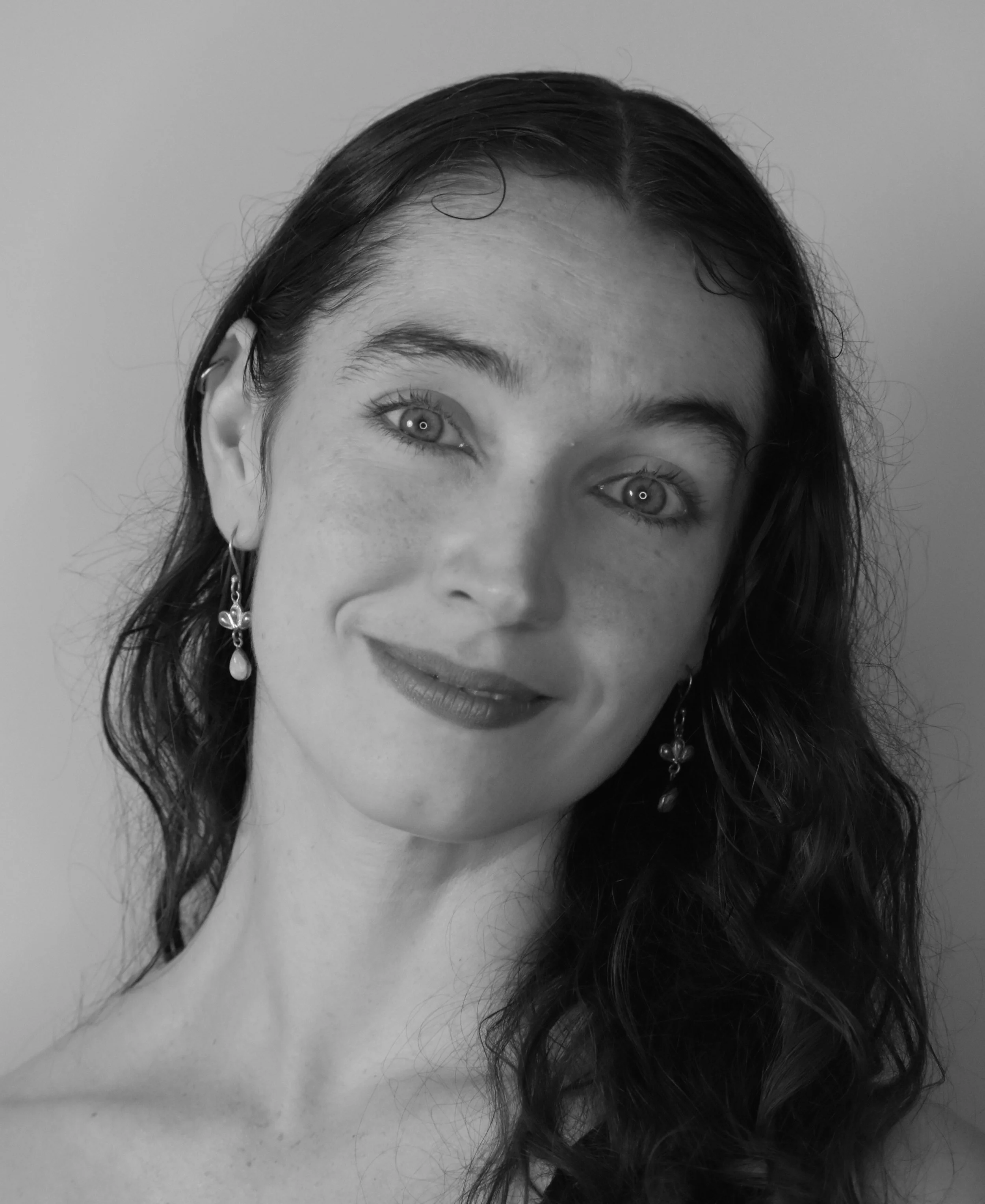
Photo of Katherine Liljestrand
BIO: Katherine Liljestrand is a writer, professional ballet dancer, and former environmental lawyer. She holds bachelor degrees in biology and English from the University of New Mexico, a J.D. from Georgetown University, and an M.A. in Arts Administration from the University of New Orleans. Katherine has previously been published in Neon Origami, Half and One, Panorama, and Georgetown Environmental Law Review. Her first book, Preeminent, will be published in 2026. Katherine lives in New Orleans with her husband and their five dogs. Follow her @katherine.elena.hanson on Instagram.