by Faith Murri
I don’t exist.
You might have seen me around, driving my car, sleeping in my bed, staring into the camera as it click-click-clicks away, capturing evidence of me in light and shadow. You might think this is me if you’ve seen that photo or if you sat beside me in class, borrowed a pen once and forgot to return it, and you find the pen at the bottom of your backpack, and you wonder where it came from. I am there, in your periphery, and you know my name, but you do not know if I am me, not really. If you were to pass me in a city a thousand miles away, you would not think, I know her. You would not think anything, you would walk on by.
In a way, I am grateful for my doppelgänger, who sits in my chair and stares out of my eyes, because she keeps the secret of me so well. She is an expert actress; she can make anyone believe that I’m doing well, how are you and Things are great at home when those are no more true than I am. She is a shadow, a blur, a spot on film you don’t see until you develop in dark red.
I do not exist, but she does. She flits past the threshold of the schoolhouse, past the rusted gate where the bone-dry tumbleweeds are stacked. In the parking lot, the old sedan waits for her, its keys still in her pocket, but she moves down the paved asphalt on foot. Catchweed, tall as a toddler, tugs on her jeans as enormous clouds build overhead. The entire sky is a giant cloud, swallowing everything except for the sun and the rundown barn and the pale wood powerlines. There is only sky and the pastureland under it—and my doppelgänger. Straps loosen, then fall; the backpack is abandoned among the blowing grass. If they find anything that proves she was real, it will be this bag and the half-done schoolwork within, name scribbled in top corners in messy black ink. But they will not find it. They will not even look.
Asphalt ends in a pothole, and now gravel crunches beneath worn soles. Each step kicks up rusted dust as she drifts onward. She passes through an old small town heralded by a corn silo. The burned-out husk of the chapel still stands, its windows, once stained glass, now shattered and boarded up with rotted ply planks. A whistle of wind from the church blows through her hair as she passes it. Beside this corpse of a church house sits another, newer, with a single spire and a painted sign listing meeting times. Beyond these, a rundown truck rusts in the ditch, tall purple grass bursting from its exposed engine. A bird nests in the cracked leather headrest, the letters U.S.A. painted in peeling blue on the gray and orange door.
I wonder about the people who live in this town, and whose car that was, and whether they or their descendent painted those letters, and if they ever left this town as she does now, only a blink and she’s gone, and they’ll never know her, and I’ll never know them, and we are as invisible and meaningless to each other as the wind that whips hair into her eyes.
I wonder how it feels to exist, to be rooted, for your absence or presence to be noted, recorded, remembered.
She steps into a field of corn. She can disappear into the corn, unveil herself, reveal me. The stalks tower above her, rough leaves shading her from the harsh sun, covering her, clothing her, embracing her, snagging on her sleeves, pulling fibers, unclothing her. In the corn, I can exist if just a little. A flickering, hazy thing.
I venture deeper. The field extends forever, it seems. I can walk for hours and never find its end. I can be me here. I can be free.
They will never find me. I was never here.
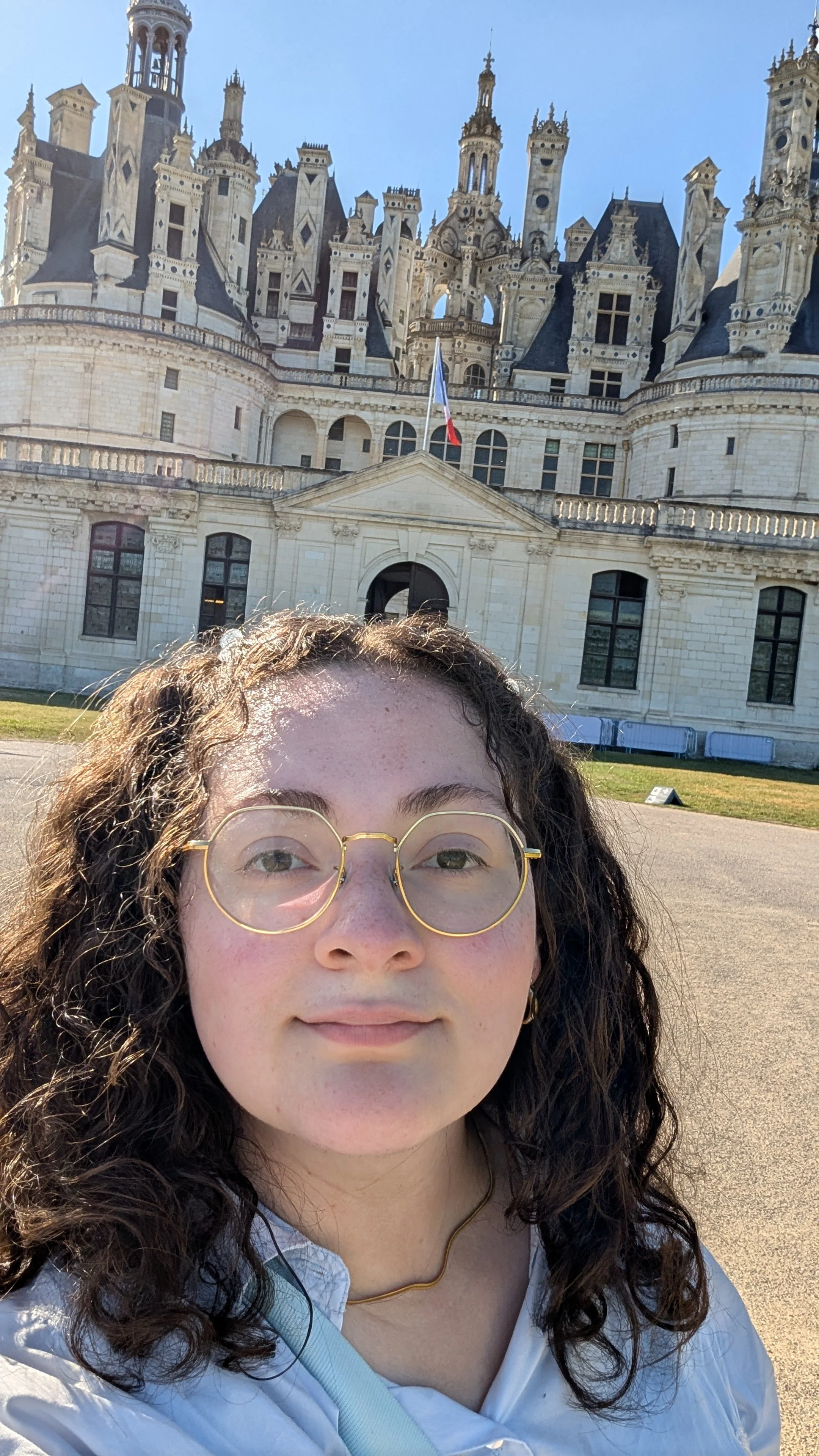
Photo of Faith Murri
BIO: Faith Murri is the daughter of a Chilean poet and an American software engineer. Currently an English major at Brigham Young University, her work explores themes of memory, identity, and the quiet strangeness of everyday life. Her writing is largely drawn from my experiences growing up in the Pacific Northwest, living in the Midwest for a short time, and having Latin American roots. @faith__trust__pixiedust. Previously published work: https://bridgeink.org/meeting-in-the-middle/