the easiest job i ever had
by Melvin Sterne
The man sitting across the table from me is named Steve Taylor. He’s 37, black, trim, and dressed in a light gray linen suit. Dark gray shirt. A light blue tie which he has unfastened so it hangs loosely around his neck. He is calm, well-spoken, clear-eyed and sober, all of which he should be, for Steve has been a field agent for the FBI for nearly six years. The only sign of anxiety is in the way he digs his elbows into the desk and clasps his hands together as if in prayer as he leans in towards me. He’s nearing the end of a remarkable story and he either wants desperately to convince me of the lie or is pleading with me to believe the unbelievable. My job, the easiest job I’ve ever had, is to listen to him, to reassure him, and then make a determination.
We are talking in a small room just off the cafeteria. The room, the table, the benches we sit on, the cafeteria itself, are all unremarkable. They could be on any college campus or high school in America, or many factories or offices, for that matter, though there’s no way they match the opulence of the big tech companies with their fountains and espresso machines and sushi chefs and so on (if the legends are to be believed). The walls are concrete block and painted a flat, industrial white. The table is Formica, light gray. The lights are LED, newly-converted from the old-style fluorescent tubes, the floor is of industrial brown tile (the long-lasting mottled kind that masks scuffs and stains). Our light-green plastic trays are pushed to one side, the stainless-steel forks and knives resting in the middle of the empty white plastic plates. Steve and I both had the fried chicken with spinach and rice. There was also an offering of pork chops with red beans and rice, and a pasta dish. Not great, but not bad, either. He took his coffee black while I drank a soda because, these days, caffeine makes me too nervous and distracts me from my work.
My job is to pay attention and note details like the simple gold wedding band on the fourth digit of his left hand, the silver Sternglas watch with the worn leather band on his left wrist (a gift, I surmise, from his father or grandfather), the bit of chicken wedged between the bottom right incisor and cuspid that Steve keeps picking at. His teeth are crowded there, the lower jaw small, the effect giving Steve a narrow, birdlike face that makes him look a bit smaller and frailer than he actually is. I deduce from this that he was not popular in high school or especially good at sports – all traits that channel people into police work like here at the agency.
I have let Steve talk uninterrupted for nearly fifteen minutes. Now he has fallen silent and leans forward, resting his elbows on the table. He’s calm but searching my face for some sign of belief, disbelief, anything really. Some affirmation of his existence. Perhaps some reassurance.
I nod and smile. “So let me see if I got this straight,” I say. “You were driving in Connecticut?”
“Yes.”
“To Terryville?”
“Towards Terryville. US 6. But I was actually headed to Pequabuck, so I turned off 6 and was driving down 72.”
“Pequabuck? Can you spell that for me?”
“P.E.Q.U.A.B.U.C.K”
“For an interview?”
“Yes.”
“But you never got to the interview?”
“We got there. We were just a bit late. Perhaps fifteen minutes.”
I look at him.
“It was mostly due to traffic.”
“I see. But there was a silver disc?”
“Yes, and it settled right down over my car, slightly in front where I could see it. It was maybe five or six feet across and about a foot deep. Thicker in the center than on the edge.”
“And there was no means of propulsion?”
“Well, there must have been something, but there was nothing obvious, nothing visible.”
“Might it have been a drone?”
“It could have been. But I’ve never seen one like it.”
“Was it spinning?”
“Not that I could tell?’
“And you stopped?”
“I pulled over.”
“And the disc stopped?”
“Just momentarily.”
“And then it just flew away?”
Steve made a spitting sound and flicked his right hand. “Straight up. Like it was jerked on a string. Gone. In an instant.”
“And there were other people around?”
“My partner riding shotgun.”
“Other cars?”
Steve shrugged. “I suppose.”
“Did they see this disc?”
“If they did, they didn’t stop.”
“Or report it?”
“Not that I know of.”
“And your partner – agent Sloan – he didn’t see this disc?”
“Nope.” Steve’s looking straight at me, clear-eyed and steady. There’s a cleaning woman with a wide mop eyeing us from the doorway. She’s Hispanic. Maybe sixty. Probably a widow. No ring. My guess is she’s staying with family. Perhaps a daughter and son-in-law. Their children and her grandkids. They’d be getting out of school in a few hours. The cafeteria’s emptying and she’s likely debating whether to interrupt us to collect our trays or move on. She wants to finish and go home, I suppose.
“Did he say anything?” I ask.
“Are you all right?”
“I’m fine,” I say. “The chicken was a little salty. I shouldn’t have drank that Sprite. The fizz upsets my digestion.”
“I mean, my partner asked if I was alright.”
“Of course. And you replied?”
“I said, ‘Did you see that?’ and he said, ‘What?’ And then I said, ‘Nothing’ and he asked again if I was all right and I said that I was.”
“And were you ‘all right’?”
Steve leans back and looks up at the ceiling. I shoe away a fly and count silently to four before he looks down and says, “Actually, I was. I was all right. It felt almost… comforting.”
So far, Steve’s recitation matched perfectly what he told me over lunch. “Had you been drinking?”
“No.”
“On any medication?”
“No.”
“Any history of Epilepsy? Cognitive seizures?”
“No.”
“Déjà vu? Jamais vu?”
“No and no.”
“Are you religious?”
Steve leans back and tilts his head slightly to his right. I take it my question threw him off-balance. “Not especially,” he says. “Though I have to admit…”
When he doesn’t say what he has to admit I say, “But you’re thinking about it now?”
“It’s gives one pause,” he says. “Especially after…”
“So, you were in New York?”
“California,” Steve says. “I went home to New York, and then on assignment to California. I was driving up the coast just south of Anchor Bay.”
“And that’s when they came?”
“Yes. Two of them.”
“But you can’t describe them?”
“No.”
“You can’t or you won’t?”
“I can’t. I mean, I can tell you what I saw, but it wasn’t much of a description. It was like looking at someone through a shower curtain. They were like shadows. There was like a light. A curtain of light. They were like shadows behind that curtain.”
I smile at his metaphor – to look at someone through shower curtains. It was a long-running joke with my wife that I would peel back the shower curtains and peek in and she would squeal in mock outrage. “But they were shimmering, you said?”
“No. It’s like the light itself was shimmering. The curtain was shimmering. They were just shadows.”
“What do you think they were?”
“I don’t know.”
“One was tall and the other short.”
“That’s right. And thin. They were thin. Very thin.”
“And what did they say again?”
“There was a voice. I suppose it came from them, but it’s not like I could see anyone speaking.”
“The voice spoke in English?”
Steve’s eyebrows bend. He’s thinking about my question. “There wasn’t so much a sound as the words appearing in my brain. I understood the words in English, so yes, At least I could say that I heard the voice in English.”
“And the voice said?”
“‘It’s time. If you don’t change, it’s going to destroy you.’”
The cleaning woman comes back and takes our trays, but not before I grab what’s left of my Sprite and Steve takes what’s left of his coffee. She shuffles off and Steve continues, “But it’s not like they were talking to me.”
“But they were talking to you,” I say.
“But not about me,” he says. “They were talking to me, but this was about us. All of us.” Steve opens his arms wide and gestures all around with his hands. “It’s not about me personally. It was a message for everybody. For all of us.”
“And how do you know this?” I asked. “How can you come in here and tell me that this is about all mankind when you’re the only one whose had this experience?”
Steve was about to stand up, but then he relaxed and sagged back onto the bench. He looked straight at me. “Because I’m not the only one,” he said. “It’s not about me. And they have contacted others.”
“And they told you this?”
“No,” he says. “Some things you just know.”
“By the way you felt.”
“By the way I felt.”
“And how did you feel?”
Steve looks up at the ceiling again and takes a deep breath. I look up and feel the air con switch on, just a gentle stirring in the air. From somewhere comes the faint odor of tobacco even though smoking is strictly forbidden in the building. Somewhere, in some back corner or stairwell or storage or boiler room, somebody has lit a cigarette. I look out the door and take in the kitchen behind the serving line. One of the staff is scrubbing a pot. Another is removing the pans with the leftovers. At least five people work in the kitchen. One of them is probably in the back goofing off someplace. Details. My job is to ferret out the details. I look back at Steve looking at me.
“It’s like everything is going to turn out all right,” Steve says. “Even if I die. Even if the world as we know it ends. It’s going to be all right. It’s not like any of us are that important.”
“And yet, strangely, somebody cares,” I say.
“Exactly,” Steve replies. Then he relaxes and smiles like he’s the one conducting the interview. And, no doubt, he’s conducted hundreds of them by now. I’ve read his files. Cornell class of 2012. Four years with Bank of America. Two years at the FBI academy. He’s an expert at bank fraud, wire fraud, money laundering, white collar crime. Married. Two children. Really, a classy guy. Reliable. Votes Republican. Golfs. Swims.
“And that’s why you came to Florida?”
“Sort of,” he says. “I resigned in Washington, but they sent me here for the exit interview.”
“The optimist says: ‘Adversity can be a good thing,’” I say. “‘It builds character.’ Do you know what the pessimist says?”
Steve shakes his head.
“The pessimist says: ‘These hard times might, with some luck, help us to survive the even harder times that are certain to follow.’”
There’s a rap on the door and Susan is standing there. She’s my boss. Tall. Trim. Blue-eyed. Vegetarian. Dyes her gray hair gold. Plays tennis or pickle ball three times a week. Works out at the gym. Twice divorced. No kids. BA at Yale. MA Oxford. PhD Stanford. She’s wearing a blue pants suit she bought last winter on a ski vacation in Switzerland. She also dives. Polynesia. Indonesia. Philippines. She interviewed Steve yesterday. My job is to confirm what he told her and then to put Steve at ease. Reassure him. Help him relax. He doesn’t need to be nervous. Nerves won’t help. He’s got to be calm. Precise. Poised. She gestures and leads Steve off, ostensibly for another consultation, but I know he’s going to meet the machine.
After they’re gone, I get up and walk to the serving line and refill my glass. I count the kitchen staff. There are five of them, now, not including the cleaning woman. I don’t smell smoke, but I’m pretty sure I know which one is the culprit. There’s a young fellow hauling those big, green hefty trash cans out the back door. He’s tall and thin and has shifty eyes. He could be African, but he might also be Caribbean, or even Indian. He carries the trashcans one in each hand, almost effortlessly. The cans are nearly full. They’ve got to be heavy – there are at least a hundred of us taking our meals here. So, he’s plenty strong. Basketball? Baseball? Definitely not a footballer. So, why’s he hauling out trash in a cafeteria? He’s either an immigrant or he flunked school. Likely into music. Video games. Got himself a shit job in a cafeteria. Lonely. Out of place. He’s probably the smoker.
Susan comes back and stands for a minute, hands behind her back. That was quick. They’ve put Steve on the machine. It’s not a lie detector. We are the lie detectors. And there’s none better at that than the FBI. They tell you that the machine is to scan the brain for abnormalities. But actually, it’s a big electronic eraser. It hurts like hell for a minute – just a moment, really – but then the shock sets in. After that, it’s not so bad. Just kind of numb. Like waking up from a dream when you don’t know who you are and where you are, or really, what time it even is.
She’s waiting for me to say something. Something about Steve. His story. Our conversation. I take a long, cool sip of Sprite and then set down the glass and nod my affirmation. “It’s real,” I say. “The disc. The shadow people. The feeling. The message. He’s just like the others. It’s just like my…”
Susan looks at me. Her eyes are both cold and sad at the same time. She’s the consummate professional. It’s not personal. It’s her job. A pair of burly orderlies in light blue nursing garb come up behind her. She’s been waiting for them.
“Don’t,” I say. My hands begin to tremble. “I’ve forgot most of it. It’s fading. It’s almost gone. It’s like one of those dreams when you wake up and it all, and it all, and it all… I don’t remember. I forgot. Most of it, anyway.
“You’re up,” she says. She turns to the orderlies and adds, “This won’t take long.”
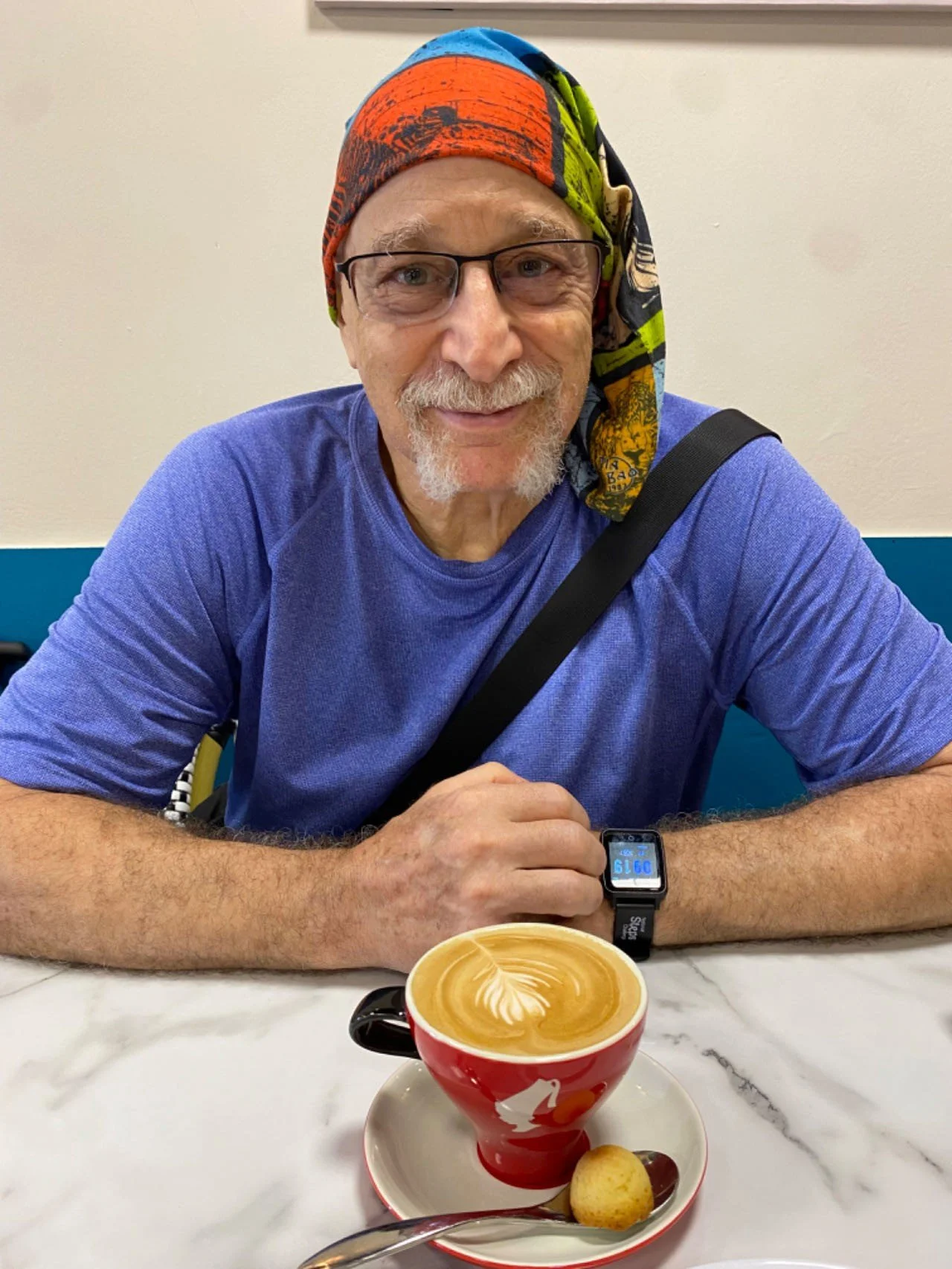
Photo of Melvin Sterne
BIO: Melvin Sterne earned his PhD (Fiction Writing) at Florida State University. He has published 2 novels and 2 short story collections, with more than 40 stories individually published. He currently writes and resides in Singapore.