the ballad of father christmas
by Peter Sipe
Before the service, Bill’s buddies had been passing around a newspaper. His obituary had a whopper of a misprint, and this produced equal measures of mirth and scorn. There were a lot of jokes about Bill doing a disappearing act. I even chuckled, thinking of him flinging open the lid and shouting “Ta-da!” But when the guys marched down the aisle with their horns, I got teary-eyed along with everyone else.
I joined them at the VFW afterward. Someone offered round sardines, and we each dangled one into our mouths. Bill used to eat whole tins in front of seasick Marines for laughs. Most of the stories were old, but the one about Kennedy's funeral was entirely news to me.
I knew they'd met; Bill kept a framed photo in his den. On the flight deck, the president shook hands with each musician. Although Kennedy's back was to the camera, you could tell Bill had him laughing. He was leaning forward with a hand on Bill's shoulder, as if for support.
But I’d never heard a word from Bill about the funeral. According to his buddies, the Navy even flew Bill off the carrier straight to Arlington, but no one had much else to say. There was a long spell where the guys were looking at their bottles and shaking their heads.
They became animated again at mention of the bugler ultimately selected to perform. There was much unfavorable comparison of his chops to Bill's, which was silenced when Bill Jr., in his dress whites, leaped up and motioned for quiet.
“Gentlemen!" he announced, sweeping his arms as if to enthrall an audience. "My old man would never have flubbed that note. He was a talented magician!” That cracked us all up. Then Bill Jr. said he’d carry on the family tradition by demonstrating a trick to make beer vanish, and the toasts got going again.
*****
Bill and I went to high school together, then he enlisted and I went to college. After earning my degree I did the Peace Corps, staying on afterward, hoping my deferments would outlast the war. I wound up at the embassy library in Guinea, keeping the periodicals current and showing whatever films arrived in the weekly bag.
There were only a handful of visitors any day – gendarmes were posted right across the road – so it was a surprise when the Ambassador walked through the doors one morning and dropped a folder on my desk. I’d met him when I was hired but only ever saw him at the monthly staff meetings.
“Explain this,” he said. “And sit down.” Protocol was to stand whenever he entered a room.
I opened the folder. It was receipts, for subscriptions and the like. Nothing, as best I could see, was out of line. I looked up for guidance.
He folded his arms. “Fix it. Or you'll lose your job.”
He began to laugh. “Relax, son! You're not spending enough!” The library, he said, hadn't spent even half its allocation, and the fiscal year was about to close.
I asked what I should buy. “You're the librarian,” he said.
At the door he turned around. “Speaking of purchasing. Sergeant tells me you’re buying whiskey off his Marines. That true?” I nodded quickly, not meeting his gaze. “Well. I'm disappointed in you."
He walked back over to my desk and folded his arms again. "I don't know your upbringing, young man, but I was reared to be mannerly. Make sure others are served first. Freshen their drinks when they get low." He started chuckling. "Son, I'm going to have you fix that, too!”
*****
With that, I saw a lot more of him. In the evenings the headlights of his Cadillac would lead the way down to my bungalow, sat on a bumpy elbow of the capital's peninsula. “Play me a record,” he'd say, “and make sure this” – he wiggled his glass – “stays full. Captain's orders.” Our tastes differed considerably: He was a big band man, and I had modern affections. “My jazz is a gin and tonic," he said once. "Yours? I'd say it's more of a quinine enema."
Some evenings he'd talk about his wartime service – the boredom and oppressive climate were the same as here, he said – and sometimes we'd talk literature. He'd walk around my living room and pick out a book from the shelves. “Tell me what I need to know about this one, professor,” he'd say. He was a well-educated man, and I suspect much of what I told him wasn't news, but he'd nod thoughtfully as I spoke, and never interrupted.
I interrupted him once. It was to good-naturedly mock a term he used, “the Pacific War.” He got sharp with me. “Any jackass can find the foolishness,” he said. I awaited the balance of this maxim, but he returned to his story.
The Ambassador's visits were about the only social life I had, especially since fraternization was forbidden. He had a daughter, who was very pretty, at an East Coast school, and I kept perking up whenever he mentioned she wanted to visit. When I said I'd be happy to show her around, he gave me a look and said, “Oh, I bet you would.”
In his wallet's laminate insert there was also a snapshot of a handsome young man in a flight suit. I’d asked if that was his son.
“Yes,” he replied. I asked if he was a pilot.
“Naval aviator,” he said tightly.
So, I switched the subject back to his daughter. She was, apparently, now dating a student who had burned his draft card. “I'm all right with a man not wearing his country's uniform," he said, speaking like each word, despite rehearsal, required restraint. "But a man has got to serve his country." He gestured outward, as if to indicate our general situation.
The Ambassador set down his glass and closed his eyes. He was breathing slowly and appeared to be nodding off, which he did sometimes. Then he told me if I touched his glass he would throw me in the brig.
For all the time he spent over at my place, we actually didn't talk much. During rainy season, we'd sit indoors; otherwise, we'd sit on the veranda and watch lightning over the bay. We were on the Atlantic’s edge, but it felt like the planet's balcony when bolts lit up the horizon. Whatever the weather, we'd sip whiskey until the bottle was half empty, or finally empty. Then he'd say, “Well, professor, keep the receipt for that one,” and steer the Cadillac back to his residence, where he lived alone.
*****
One empty morning the desk phone rang. The Ambassador told me to go home and put on my suit. He was going to the palace and needed a note taker. As I got my tie right in the mirror, it occurred to me to fetch one of the unopened LPs from a recent shipment, The Real Ambassadors.
“What's that?” he asked when I opened the passenger door. I told him it was my mannered upbringing, adding that I'd wrapped it myself.
He looked like I'd proposed an outrage. "Leave it."
When I got back in the car, however, he instructed me to go get the gift. “It might not be a bad idea. But I do the talking. That means, you keep quiet. Understand?”
We sat in the reception hall for close to an hour. On the way upstairs, the Ambassador explained that the waits tended to be commensurate with the President's displeasure. Our chairs were spaced too far apart for casual conversation, so I sat back and took in the glass and gilt. After a few minutes I leaned across and asked the Ambassador whether the guards took drink orders.
“The North Koreans train them to stand like that,” he said. “Say, I reckon it's like Buckingham Palace. Go up and kiss one. I'll snap a photo for the folks back home.”
Finally, the doors opened. The presidential office was a compressed version of the reception hall, but with a view of the harbor. We stood in the entryway until the President finished stamping and signing documents. He pushed back his chair and regarded us both. Most famous people are smaller than expected, but not him.
He stood up and walked to the window. There were no wrinkles in his robe. I wondered if he worked in his shorts and threw on the robe before visitors showed up.
“L'Amérique!” the President said, facing the bay. “Que faites-vous?”
The Ambassador neither moved nor spoke.
The President tapped the pane. “The Soviet Union sends that ship to train our navy.” He tapped again. “The Soviet Union sends that aircraft carrier to train our pilots. The Soviet Union understands (he tapped his head with a wise index finger) our struggle. America!” The President repeated, "What do you do?” He spoke the kind of French I liked, each word distinct.
He then turned around but did not leave the window. His glare, while certainly conveying contempt, also expressed aggrievement.
“This is the librarian?” The Ambassador nodded.
The President looked at me like he intended to administer punishment. “My citizens tell me about the films you show."
And with that he really laid it on, the whole better-freedom-in-poverty-than-riches-in-chains routine. It lasted a while, during which I had the sense it would be unwise to open my notebook. When he was done speaking, he began to make a kind of clucking sound. It had a matronly chagrin to it, like my grandmother watching the six o'clock news.
“Mr. Librarian,” he said. “If you please, tell me. Is it your birthday or are you Father Christmas?”
I told him I was honored to offer this gift on behalf of the people of the United States.
He came forward – he was pretty agile – and seized it. He asked if he could open it now, or if he had to be a good boy and wait. I replied that such matters were decided at the presidential level. He laughed like he'd heard a bawdy joke and pointed that finger at the Ambassador. “Where do you find these fellows?”
He ripped off the paper and examined the album. Holding it with both hands, he walked back to the window. He was silent for several minutes. All I could hear was the exasperation of the air conditioners. I glanced at the Ambassador and decided not to look that way again.
“This,” he announced, raising the album prophetically, “is why our nations will be friends.”
He said that jazz was true American music because it was also true African music, and spoke of seeing Louis Armstrong in Paris (“le grand Sash-mo!”), and swore that as long as America respected jazz music, America would respect Africa, and that it would be on this basis of mutual respect that friendship would develop. He smiled like he was waiting for applause to quiet.
“Do you know the Voice of the Revolution?” he asked, in the manner of a host pleasantly changing the subject.
I saw the Ambassador lower his eyes and narrow his mouth, as if trying to formulate an answer. I replied that our library was proud to hold all the Voice of the Revolution's albums.
The President gave the Ambassador that same laugh and finger wag. Then, he became solemn again. “America, your Independence Day is arriving. As you know, ours arrives thereafter. I
propose this to you. We will send to you the Voice of the Revolution to celebrate, together, your liberation from the shackles of colonialism. I will leave America to respond as suits America.”
He pointed to the door. “And now, my friends, I must return to affairs of state. I thank you for your visit! Et merci, mon Père Noël!” He had a shop steward's grip. I'll say this, too, he smelled terrific.
*****
A few days later, the Ambassador again came through the library doors. “I got your applications,” he said, gesturing for me to sit.
I could tell he wasn't happy. He started pacing, pulling books out. I just happened to have card files in my hands; I was glad it wasn't twenty minutes earlier when my feet were up.
“I need you to understand, this is tricky. Washington isn't good at this. Cultural Affairs can't find their ass with both hands and a map. They'll send us some goddamn ballerinas. Or Joe Shit and the Rag Men.” There was none of his customary bonhomie.
“We've got to do better on this. You know music. I need you to get us someone he'll see as equal to his guy.”
I said that I would do my best.
He shook his head, like I didn't get it. He tried again, this time with a long explanation. Strategic importance and that sort of thing, but then he got personal, repeating that his career was going to end in a backwater if he couldn't get things right. He wasn't maudlin, but it was unsettling, like seeing your father weep. I told him I would not let him down.
*****
I set to work. An old roommate in the city knew folks in the industry, but I just got their secretaries, and no one ever returned my calls. Then I had a splendid idea.
It was past midnight, and strictly speaking there was a curfew, but there was never much traffic and if you were on foot – especially in the diplomatic quarter – you were fine. There were no sidewalks, but the roads had soft sand at the edges that was lovely to tread upon. The sewers mellowed after sundown, and the palm fronds fanned woodsmoke and salt air.
After I got to the embassy gate and made my request – and that took a while – the Marine guard led me into their communications room. In about an hour, I was patched through to the carrier. The radioman on board passed me up the ranks, and I had to repeat my request to successive officers. And then, there he was: Bill, out there in the South China Sea.
I thought this was a marvel, and kept asking him how he was, but there must have been officers nearby because he wasn't his usual tale-telling self. He had to run below deck to get the number, which I read back to him three times to make sure. I thanked him and told him to keep his head down. “Aye-aye,” he said.
I went home, slept, rose at dawn – the sun awoke you even with the curtains drawn – and picked up the phone.
It was after midnight in Queens, and I couldn't tell if Satchmo were drunk or if that's how he normally talked. He kept saying things to a woman, and sometimes he'd speak into the receiver while he was talking to her, and that, along with the connection, made it all very awkward.
When I told him on whose behalf I was calling, he sang out: “That’s what we call cultural exchange!” and the line about sending in Martha Graham to stop internal mayhem. Then he asked if I was a real ambassador.
Of course I should have got it. It was the damned album title. I was so nervous, though, I just began my pitch. And it all went to hell.
I attempted to respond that Guinea was the actual name of the country, and that I'd never use language like that, but the remainder of the call was a procession of paint-peeling insults ended by a click.
I tried the number again, and again the next day, and then once more, without success. That's one thing I've learned along the way: you'll usually get a shot, but it'll usually be a long one. I tried Columbia Records and got the runaround, then gave up altogether. Washington cabled us with two options, a college choir or a string quartet.
A couple weeks later the Ambassador called me into his office. He handed me a letter from the Ministry of Foreign Affairs. It was one sentence, on gorgeous foolscap, demanding the immediate closure of the library. The Ambassador told me he'd pay out the rest of my contract and sign one more deferment. Which was decent of him; he didn’t have to do either.
I asked what I should do now. “You're the librarian,” he said, and my evenings were once again solitary.
*****
I was at my typewriter one morning when I heard thumping on the door. It was the Ambassador. “Get yourself dressed. Wear your suit,” he said. "And this here's the only gift being given today," he said, handing me a boxed shirt. "Figured you'd need it."
There was no wait this time; we were ushered straight from the Cadillac by a troop of those guards. The President was standing before his desk. He strode toward the Ambassador and grasped his shoulders. “My citizens and I express to you our sorrow at the loss of another great man,” he said.
He asked us to be seated and walked over to the harbor window. A barefoot woman poured us tea. I crossed my legs, and the coins in my pocket spilled onto the floor. The tea lady jumped, and the Ambassador clenched both fists, but the President did not move. One of the coins rolled around the floor on what otherwise would have been a comically long voyage.
Finally, the President addressed us. “Today I instructed the Minister of Transport to designate Le Boulevard de Robert Kennedy. Now he and his brother will beat forever in the heart of our nation.”
The Ambassador said that the people of America would be forever grateful.
“Forever grateful!” said the President. “I have met the people of America! They do not know we exist. 'Guinea pig!'” he said in English. I heard anger.
“However, I do not confuse ignorance with a lack of goodness. Those brothers were good. Do you know what John said to me when I made his acquaintance?” The President spoke to two people the way he spoke to two thousand. “John said, 'Your party symbol is the elephant, but no matter! You and I will get along just fine!'”
He described Kennedy as a true friend of Africa and that his “regret éternel” was arriving too late for the funeral. Johnson had forgotten what made America good, he concluded, “but I do not forget that Americans are good! I have met too many to know otherwise.”
He sat down at his desk and leaned forward with his fingers steepled. I assumed we were in for another lecture; I was very wrong. The President said: “To do honor to their memories, I propose that we accompany you to the moon.”
I'll say this, the Ambassador earned his paycheck that day. He didn't drop his teacup or laugh or frown. Instead, he thanked the President. He said that Guinea's willingness to join America in space exploration for the good of mankind was a worthy expression of the strength of the bond that held the two countries together. He played out some more of that line and tied a nice bow by saying he would raise this intriguing proposal directly with NASA.
“Very well!” said the President. “How many astronauts shall I send America?”
“Mr. President,” the Ambassador said, “you know NASA is extremely rigorous in its selection. Thousands of American servicemen volunteered, and thousands were disappointed. My own son...”
He closed his eyes, as if in concentration, and took quiet breaths. The President’s expression of patient inquiry did not alter.
The Ambassador lifted his head and resumed. “It is no easy matter to pick heroes. Only seven were selected for the Mercury missions. With your permission, I'll ask NASA to send a team to conduct the selection process here.”
The President slapped the desk and gave one of those bawdy chuckles. He pointed at the Ambassador. “I like you!” he said. "I like you. You are not afraid to let me know you think I am stupid!”
The Ambassador was silent, which was probably the way to go on this one.
The President rose and placed his hands on the desk. “I must refuse your offer to permit American spies to examine my air force. But you have my word – as one frank man to another – that we will send you only our best! Les Armstrongs!”
The Ambassador stood up (I did too) and said that America would be honored to collaborate on an endeavor of such historic importance. The President bowed his head and raised his arm toward the door.
We were just outside when I heard “Mon Père Noël!” We were alone in the reception hall, except for the guards. “Have I been a naughty boy? You don't have for me even one piece of coal?”
I looked at the Ambassador for guidance, but there was none that I could see.
“Every day is not Christmas,” I called back, and that's the last I spoke to a head of state.
*****
I spent the next few weeks at the airport, in the company of a Soviet military officer. He was very guarded at first, but must have been informed, or concluded, that I was harmless.
I never did figure out exactly what we were supposed to do, but what we did do was spend afternoons under a striped umbrella at the reliably vacant rooftop cafe, watching MiGs file over to the military runway and soar off over the Atlantic, toasting each takeoff. (The cafe was only sporadically stocked, so I'd bring whiskey and he'd bring vodka. We’d each do a ceremonial shot of the other's beverage to begin.) He explained that the pilots' steep, furious ascent was the style of the Soviet air force. “C'est bon pour les cosmonautes!” he said, rolling his eyes heavenward.
Up until then, I thought I'd enjoyed my solitude, but meeting him made me realize how lonely I'd been. He was about my age and had a good sense of humor. He fell on the floor when I quickly uncovered my buttocks to demonstrate what alunissage, that lovely French word, translated to in English.
On my last day at the airport, the Soviet officer took me over to the hangars to introduce me to the pilots. They were in flight suits and stood in a line, honor guard-style, their silver ships diminishing down the runway into wavy brilliance. I thanked each one and shook his hand. Some beamed; some snapped to an even more martial pose. They seemed like kids playing at it. None ever made it to the moon, and the next summer most were machine gunned in their bunks.
The President would also die ignobly, much later on a table in Cleveland. His lunar aspirations might be laughable, but consider the foolishness we consume ourselves with. I don’t see the difference.
*****
I saw the Ambassador once more, at a rally when he stood in a congressional primary. He seemed happy to see me, and I sent him a modest check, and that was that.
Toward the end, though, when we were bachelors again, Bill and I saw each other regularly. Sometimes I’d watch ballgames at his place, or meet him in the evenings at the VFW.
I wasn't a veteran, but that was only a problem this one time. Two guys started in on me: if you didn't serve, you don't get served, etc. Bill came back from the washroom and asked what the problem was. Next thing he was atop the bar, holding the speaker wires like bouquets of menace.
“This man,” Bill shouted, "served! He spied on the Russians in Africa. He pulled a shit detail in the Bronx. Anyone says otherwise, let’s talk outside.” This was back when the hall was full on weeknights. There was an ear in the punchbowl at the Christmas party. And Bill was my size. But I never had a problem after that.
The only other time I saw him get that angry was once in his den. I’d mentioned that a panel of historians ranked JFK the most overrated president. I was just repeating something I'd read. He slammed his bottle down, stood, and strode to his “Navy Wall of Fame,” as he called it, to which he'd square up and salute upon entry. I sensed Bill went over there not so much to make his point as to remove his fists from range.
“President Kennedy had letters written so he could get off desk duty. He used his privilege to get into the fight, not out of it." He stood before the photo of the PT-109 crew. "He saved his shipmates' lives. He gave a wounded Marine his own bunk so that Marine, that man, wouldn't have the indignity" – Bill spoke the word like the negligence was mine – "of having to die on the deck."
I apologized, but he ordered me out.
Next day he called to apologize. That's one of the things I admire about Bill. He always got rid of whatever anger he could.
*****
A while back I got a call from Bill Jr. “How about a steak dinner?” he said.
He took me downtown to one of those places on the waterfront. Bill Jr. was a state trooper, recently returned from deployment, his reserve unit having been called up. Folks kept stopping by. The manager did, too, and poured brandies from a bottle with a tattered label for us, chuckling that things were so busy he just might forget to add them to the bill. We held the brandy up to the booth's lampshade and tipped it around our glasses, then clinked cheers. Bill Jr. told a ribald joke about how it's the service, not the food, that keeps a man satisfied.
He was an easy talker, like his old man, and was full of stories from his tour. He was well into a tale about how he was now training the drug squad on the same counter-insurgency tactics learned overseas. “I tell you, I switched uniforms, but you’d be surprised at the similarities,” he said.
I made an impolitic retort that this was a shame.
Bill Jr. tilted his head and took a while to finish chewing. You could tell he was no stranger to challenge, but that he was also unused to brooking it. He put down his knife and fork by the sides of his plate.
“In Dad’s desk there was an envelope with a hundred-dollar bill and instructions to take you out. He wanted us to have a nice time," he said, "on him."
I don't remember much else about that night. I do remember Bill Jr. helping me in and sitting with me as I wept. When I awoke on the couch, amidst the newspapers, I saw that my shoes were paired by the door. I telephoned to apologize, but he insisted there was nothing to be sorry about.
“We'll do it again sometime,” he said. “Maybe the old man left more envelopes lying around!"
*****
It wasn't too long afterward that my doorbell rang. It only ever rings a couple times a year, and it’s either Jehovah’s Witnesses or some kid selling cookies. So, I was very surprised to open the door and find my daughter.
It was quite a few Thanksgivings since we’d last seen each other. She’s out in California now, and successful, if that’s what you want to call it. She's the creator of a television show whose name I'm embarrassed to utter. I watched, once. It featured a child going from restaurant to restaurant, slapping trays out of waiters' hands. At least her mother isn't around to see this.
“Keeping the place clean, I see,” she said, plucking off the fingers of her gloves. "Our tax dollars at work!"
Our last conversation had been a real knife fight. She was going at my teacher’s pension, and I kept demanding to know how her line of work served the public good. It did not improve from there. But really it all started when she dropped out of college. I had stopped sending her checks, thinking tough love was the way to go.
“Well, I’m going to sit down anyway, but for future reference? The polite thing is to offer the pregnant lady a seat.” I managed to reply that I could use a seat myself and cleared the armchair.
She went into her pocketbook and withdrew an envelope. She held it aloft, as if signaling for attention. I asked if it was for me.
“Still think the world revolves around you.”
But she kept holding it up, so I asked if she wanted me to take it.
"Unless it pleaseth Lord Barrel-Ass to summon his stout wench."
Inside was a brief letter, in Bill’s oddly formal writing style: Your father was the happiest man alive when you were born, it began. Then there were a few sentences about witnessing our estrangement that were tough to get through. He closed by saying that the hardest part of being an orphan wasn’t not having parents, it was not having grandparents:
Most boys I knew were displeased by their mothers and fathers, but most loved their grandmas and grandpas. If you are blessed with children, please, I implore you, do not deny them what I always wanted but could never have.
I folded the letter back up. She took out a pack of tissues and tossed them to me. “Bill Jr. mailed me that,” she said, adding that she didn’t know how he'd found out her news.
I reminded her that, according to the obituary, he was the son of a talented magician.
"What the hell are you talking about?"
I explained the musician’s misprint, getting (at least) the flicker of a smile. I asked if it happened to be accompanied by a hundred-dollar bill.
“Still, he thinks of money,” she said ruminatively, affecting the manner of an emigrée analyst. She scribbled in an imaginary notebook and shook an invisible pen. “We must explore this obsession, Herr Nickelfucker!”
Waving away my attempt to explain, she went back into her pocketbook, this time fetching a small yellow square of paper. “If you must know, here’s what he had to say about money.” She read aloud, stagily: "Make that cheap son of a bitch take you out! PS, order the lobster!"
“Alright,” I said. I spoke the next words slowly, hoping this would approximate delicacy. “How does lunch sound? My treat.”
“Figures." She was shaking her head. "You would offer now. Doctor told me to stay away from shellfish.”
“Alright,” I said. I composed myself. “I know I wasn’t the father you deserved,” I began.
She stroked her chin like I’d raised an intriguing, overlooked point. “Ooh, I think we're making progress!”
This is how it goes with her. I tried again. “Your… do you know yet, boy or girl?”
“Surprise.”
“Fair enough. So were you.” I'm actually pretty sure her mother knew but played along for me. "You know, I brought two boxes of cigars with me to the waiting room, just so I’d be prepared either way."
She laughed. "Must have killed you to waste money on the blue box."
"Me? I sold it at a markup to the poor bastard who had a boy!" Again, I got that flicker.
I rubbed my palms together, and held them out, half in concession, half in plea. "Please," I said. Her arms remained folded. She hadn't even taken off her coat.
I pushed aside the coffee table and knelt.
"Please," I said, looking up. "Would you give me a shot? A shot at being the grandfather your little surprise deserves?”
"Save your breath," she said. She put her gloves back on and pushed herself up out of the chair.
From the hallway, she held the door inches from shut. "I only hear pitches over lunch. So if you want your shot, old man, go break your piggy bank."
Now there's a photo on the wall of the three of us. Next to it is Bill's obituary. As far as I'm concerned, there's not a misprint to be found.
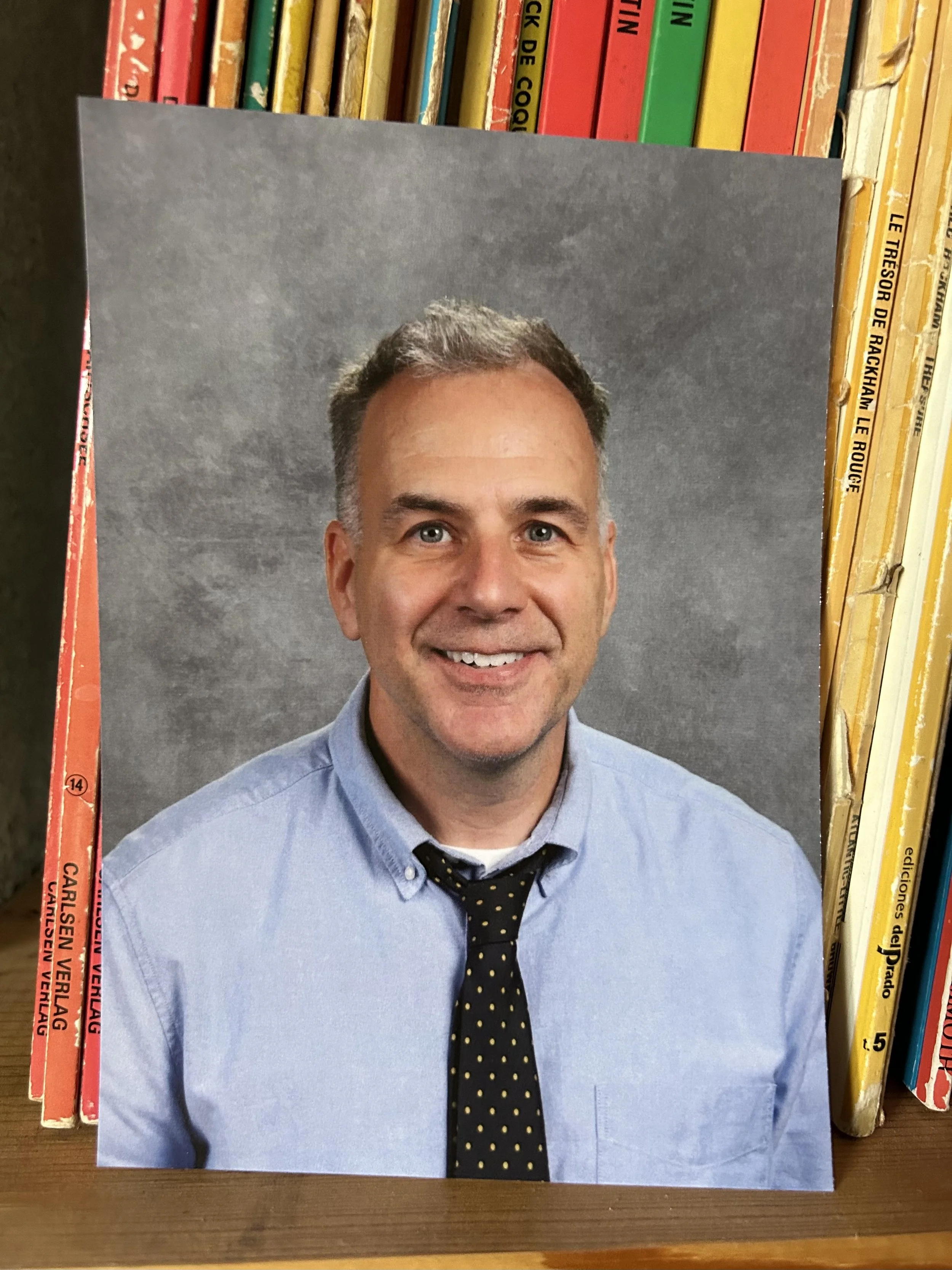
Photo of Peter Sipe
BIO: Peter Sipe's fiction has appeared in Glimmer Train and Guernica, and his op-eds in the Boston Herald and USA Today. He teaches 6th graders at a public middle school in Massachusetts.