by Kahlo Smith
This was before life, when the earth was bone dry and thirsting for things that didn’t exist yet. There was no water to fill the hollows and no man to rend the soil with his hands. God had made the heavens and the earth, and was decently satisfied with them, so it went on with mist. Great clouds of fog swept across a ball of dirt, turning it to muddy water. God dug deep into earth’s new muck. From the grime it formed a body of dust.
Even for a lump of clay, the thing was inhuman. His head was too small. His face held the crude slash of a mouth and two thumb-divot eyes. His nostrils were snake-slits, and God breathed into them: an exhale of mist and dust and power.
He woke up slowly.
He looked confused, this first man. Naked and shivering under a blanket of fog, he flexed his soft hands and the wrinkled pads of his feet. He reached for God, which it had not expected, and it pulled sharply away.
In the East, where it would be good to plant a garden, God did. Trees sprang up like Worms writhing from the wet earth (though there were no Worms yet). Rivers ran from Eden and did not return. God lifted the new man by the back of his neck and deposited him in the middle of the garden.
“This is yours,” it boomed. “Tend to it.”
The man took a step and stumbled. His second was more certain, and with a third and fourth he hobbled between the trees, pawing at fruit and bark, trying to make sense of his own existence.
God watched him for a while. He was a pitiful figure. His body was still resolving out of the mist and dirt. Some parts of him—the downy hair on the nape of his neck, his genitals, the knobs of his joints—were fuzzy and indeterminate. The earth gripped his heels, aching from a sudden loss of self.
God was surprised by how uncomfortable man made things in the garden. He stood out from the earth and mist and plants. He made guttural noises, contorting his body in ways God hadn’t envisioned. The air shivered where God’s spine might have been. “It is not good that man should be alone,” God whispered. “No. It is all wrong.”
It scooped up a clod of dirt and shaped it into something simpler. A small black crawling thing with a hard case and a taste for dirt and leaves.
The man collapsed under a tree, looking lost, though there was nowhere else he could be.
God drew near. “I made something new,” it told him. “Like I made you.”
The man opened his mouth. A low moan escaped as he fought to control the shape of his lips and tongue, still speckled with dirt.
God inched back and waited.
“Da.” The man grunted, his face screwed up in a fleshy frown. “Da...da…ma?”
God considered the man. “Is that what you wish to be called? Adam?”
The man knocked his head rhythmically against the trunk behind him.
“So you shall be Adam.”
Adam trailed off, surely comforted by the name that was his. God was relieved. His slack features looked much more like mud. God knew mud, understood it, liked it well enough. “Name this new thing, Adam. What will we call the black six-legged dirt crawler?”
“Be…” Adam sat up straighter and hit his head on the tree trunk, letting out a harsh sound of pain.
“Beetle. A good enough name for a crawling thing.” So that was its name.
God dropped Beetle, and it burrowed into the dirt. God was pleased. It had made a man and a six-legged crawler, and Adam named himself and Beetle, and so far, Beetle followed its purpose perfectly.
Briefly, God allowed itself to worry about Adam’s purpose.
The man was working his mouth, producing stilted sounds that echoed feelings God hadn’t fully conceived of yet. “Are you…angry, Adam?”
The response started with choking in the back of Adam’s throat, but emerged as: “No.”
“You’re a quick study.” God did not feel ready to press further. It took a pinch of earth and crafted another ground-dweller. Pink-wriggling-long thing. It dangled the tube of flesh in front of Adam’s face. He shrank against the tree, lips wobbling like two pink-wriggling-long things.
“Worm,” Adam groaned.
Pleased again, God nodded. “Worm. Worming around. Yes, that suits it.”
God released Worm into the dirt to chase Beetle. That settled things. Beetle’s purpose was to tunnel in dirt, Worm would eat and churn it, and Adam would name God’s new creations to save it valuable time. God’s confidence in its power and correctness was restored.
Out of the ground God formed other things that lived. Things that flew and slithered, crawled and cantered, sang and hunted. God was very particular about how they should move and behave. It believed it had learned its lesson from Adam’s awkward birth.
Into the porous earth it slipped the star-nosed clawing digger, which Adam named Mole. It turned to more complex riddles of the flesh, crafting lace-skinned Jellyfish and light-boned Bird; Stickbug and Mammoth. Cave-Dwelling Fish. Colonial Slime Mold.
Adam worked his jaw, scraping fruit peel and dust from the cracks between his teeth. He sought out new sounds like Bird picking through the earth for Worm. Each name came to him as a reflection stilling out of troubled water. He felt its rightness like he felt the constant, distant presence of God.
One Day, God brought something familiar. It was almost Dragonfly, but larger, a long body undulating with many pairs of wings.
Adam shifted from side to side. His thoughts buzzed, but no matter how hard he focused on the creature, he could not understand it. He did not know its name. “Beetle,” he finally announced, and his mouth went muddy with relief.
“Ah,” God said, in a tone of voice Adam did not like, “you have used that name already.”
“I have not,” Adam protested.
“You have,” God countered, and it was right. “Think of a new name. There is time.”
God left Adam alone to think. It did not yet know what an awful thing it is to leave humans alone with their thoughts, though perhaps it could have guessed.
Adam stewed in the juices of his brain, aflame with fresh neural pathways, none of them about what to name not-Beetle. He had never failed to name a creature before. He could not comprehend what it would mean to fail.
Meanwhile, not-Beetle settled on a boulder. Its wings shifted iridescent in the light.
Naming, Adam knew from God’s sparse declarations, was his purpose. He did not know what would happen if he failed in his purpose. Would God leave him?
Adam’s fingers closed around a rock that jutted from the earth like a tooth from his raw gums. His own hand became the hand of God, untouchably apart from him. If he could not name not-Beetle, he was unfit for creation. Or perhaps it was.
He slammed the rock down upon the not-Beetle, crushing it between two faces of stone. Its body crunched and sprayed yellow-green viscera up Adam’s wrist. He twisted the rock, grinding not-Beetle to a paste of not-creation.
When it was done, he stared at the unfamiliar blood dripping down the blue shadows of his own veins. He stared for a long time.
And then there was Night.
God came to Adam, who sat with his face between his knees, ready to return to mud. God hesitated. Finally, “Adam,” it said, and he shivered. “Where is the flying creature I brought you to name?”
“You mean Bird?” Adam asked in a whisper.
“No,” said God. “The new creature.”
“It flew away.”
God was silent for some time.
Adam pushed his toes deep into the dirt, feeling for the backs of Worm and Mole. Hoping to join them. His body burned. He thought back on that first breath through the newborn soil in his nostrils. Why, he wondered, couldn’t God have left him as a pool of mud?
“I know the plans I have for you,” God reassured them both, its voice low in a way that was as new to God as it was to Adam. “I am the Lord.” When Adam did not respond, it added: “I made you for a purpose.”
“I am very tired,” Adam whimpered.
Again, God was silent.
All around him Adam heard faint buzzing. He ran a palm across his head, feeling for Bee, but there was nothing. He breathed in. The air was burning too. It seared down the length of his stunted sinuses.
He dug his fingers into the ground, rooting himself like a tree to the earth that had given him up. Tears welled like mist rolling over Eden. Adam bit down on his lip and tasted salt. Worms curled to the surface, their wet pink bodies brushing Adam’s fingertips. He pulled his hand from the dirt and stuck it in his mouth, replacing salt with other, older minerals.
The hum faded. “I will leave you to your rest, Adam, Son of Earth,” God said. Its voice trembled like disturbed air.
Adam was still until God’s presence left him.
After that, his work was harder. Not-Cat could be Cheetah or Panther or Puma. Sometimes he watched yet another not-Antelope frolic and thought of finding a sharp rock and chopping it into pieces that would sink in mud and stay nameless.
Each time, he remembered the sound not-Beetle’s body had made against the rock. The crunch of armor splitting and spewing blood. The suspicious hum of God’s creation. Adam’s teeth wore their shape into his lower lip, and he learned a deeper kind of patience.
It was Night when God sent the great-white-thing. That day Adam had named Scorpion, Tarantula, and Zebra. So many creatures God had ceased to introduce them.
Adam’s temples pounded from the effort of pulling each one back from the brink of nonexistence. His lower lip was split. Blood peeked through shards of skin like Fish glinting underwater.
The great-white-thing loomed over him. It was twenty-five hands high and three cubits across, covered in a mat of thick white fur. Its eyes glowed yellow in the moonlight.
“Llama,” Adam said, though he knew he had said it before. He rolled his shoulders, heard the joints crackle. “Polar Bear.” He rose from his seat and started down a nearby game trail. The great-white-thing followed obediently in his wake.
“Goat,” Adam muttered. All old names.
He wrapped his hands around his body and twisted as he walked, shaking like a windblown tree. His teeth ground together. They walked until it was Night, and the great-white-thing left large footprints in the mud, but it offered no suggestions. Adam’s small, shuffling feet slowed as they arrived at the ravine.
Adam told himself he had not known where they were going. The great gash spread out in two directions, slicing through meadows and bogs and steppes, cradling a river that Adam called Pishon because God had thrust yet another thing at him to name.
Adam looked over the cliff at the rushing Pishon. The great-white-thing stood at his side. It watched the water too, and in the bare light of dawn its eyes misted over. Old names buzzed in Adam’s brain like a not-Beetle might have, given time to fly.
There is none, he thought. There is none.
Adam reached for the great-white-thing. He felt the soft give of fur beneath his palms. The great-white-thing did not cry out as Adam pushed it over the cliff into the river.
He watched, panting, while it hurtled through the air. The splash its body made was barely visible among the rapids, but he saw the blood. It was red, and it foamed over the rocks, tainting white spray for a long moment. Then the whole of it was washed away. Adam stood trembling on the cliffside. His body ached, but he could not rest. Instead, he turned and ran into the forest. Branches smacked his face as he sprinted, damp earth sucking down his desperate feet.
That evening, a storm raged on the horizon. Wind razored Adam’s cheeks. He felt the presence of God, but it did not speak. It only howled through the treetops. Adam reached for it, but he could not catch the wind, and it did not shriek a name.
In the Days that followed, God kept itself busy. As the land filled with insects, arachnids, and digging mammals, the sky filled with birds of prey and songbirds. The river in which the great-white-thing’s shattered bones lay teemed with fish and algae.
Adam labeled Squid, Octopus, Nautilus and Cuttlefish. His head never stopped hurting. The pain ran from the base of his skull down his spine, into his knees and elbows. It lingered in his molars to remind him of the teeth-gritting grace of a God who spoke less and less.
Deep in the garden, at the base of a mountain too small for God to make him name, Adam knew a cave. It was a steep drop to the stone floor.
When yet another tentacled mass wriggled up the sand to greet him, gelatinous organs heaving with effort, Adam grasped it in one hand and hurried to the mountain. The gasping thing in his palm was still dripping sea water when he launched it over the cliff’s edge into the cave beyond. He stumbled some paces away, waiting for it to die and wishing he was not waiting for it to die.
He took a deep breath of forest air. It was damp with mist and rich with the waste of Worms and Moles, stinking of green things and decomposing leaves. For a blessed moment, the pounding in his skull quieted. The thing would die nameless.
Two hours later, he peered over the edge and found a smear of gel across the cave floor.
The trees shuddered in his wake. God kept silent, and so it went. The pile of bones grew Day and Night. Adam felt its size as a weight around his neck.
He shunned the cave unless it was to fling another unnamed creature to the bottom. Standing at the mouth of his hiding place, smelling its rotten breath, he told himself that God would not abide the death he’d wrought on its creation. But there were no more storms in Eden, and Adam pressed his hands together under a clear sky.
Adam was hiding under a tree near the edge of the garden, his aching head cradled in his arms. He flinched at the searing nearness of God’s presence, and then he cursed himself for flinching, and then he reached out a hand to it.
“Adam,” it said, “my child.”
It had never called him that before. It sounded relieved, and Adam did not know why. He let his hand fall back to his side. “My God.”
“I have made you a helper,” God said, “to be your partner.”
A creature stepped out of the forest. Its hair was wet with mud. It had two arms and two legs, much like his. Adam knew how alike they were because its eyes and skin were the deep brown of dirt. It opened its mouth, and muddy saliva dripped out.
God waved its benevolent hand. “This is she. Be fruitful and multiply. Fill the Earth, as have the other creatures which you named before her.”
Adam rose to his feet. “What is she?”
“She is of you, Son of Earth!” God rejoiced, greatly pleased with itself. “Name her and live with her. Show her how to be, for she is still new. I know the plans I have for you.”
“What is she?” Adam asked again, but God was leaving. He reached for it again and the mist slipped through his fingers. The newest of earth’s creatures stood alone before him.
Adam turned away. She followed, and together, the two of them wandered through the forest. Adam’s head buzzed with the aftershocks of God’s presence, and the creature’s unfamiliar noises, and the secret bones he carried ghosts of in his stomach.
Like his creator, Adam could not look the thing he guided in the eyes. She made him nervous. She was less gangly in her stride already.
They walked for many aching pulses of Adam’s skull. “Kangaroo,” murmured Adam as the creature plodded behind him. “Ape.” She breathed in heavy puffs. “Ostrich.”
Under her breath, she made noises like the crying of a Wolf pup. Her footfalls stopped.
Adam turned to find her gazing through the mouth of the cave. She squinted over the steep ledge and huffed, nose wrinkling at the stench wafting up from the darkness.
He told himself he had not known where they were going.
She drew closer to Adam’s hidden grave, stumbling in the shade until she stood upon the cliff’s edge, gazing at the tangle of bodies rotting below. A shiver rattled her spine like a splash in the river Pishon.
She raised her eyes to Adam, and they burned with the wrath of God. She pointed an accusing hand. Adam swallowed a mouthful of mud. Over the scent of decay, he caught a sharp, familiar tang.
He turned his back on the cave and felt the wind howl through thin hairs on the nape of his neck. He was lighter than not-Beetle, and the hum of its iridescent wings filled his ears. She backed him closer to the cliff, and his steps were small but certain.
She reached for him, and he opened his arms, ready to be named.
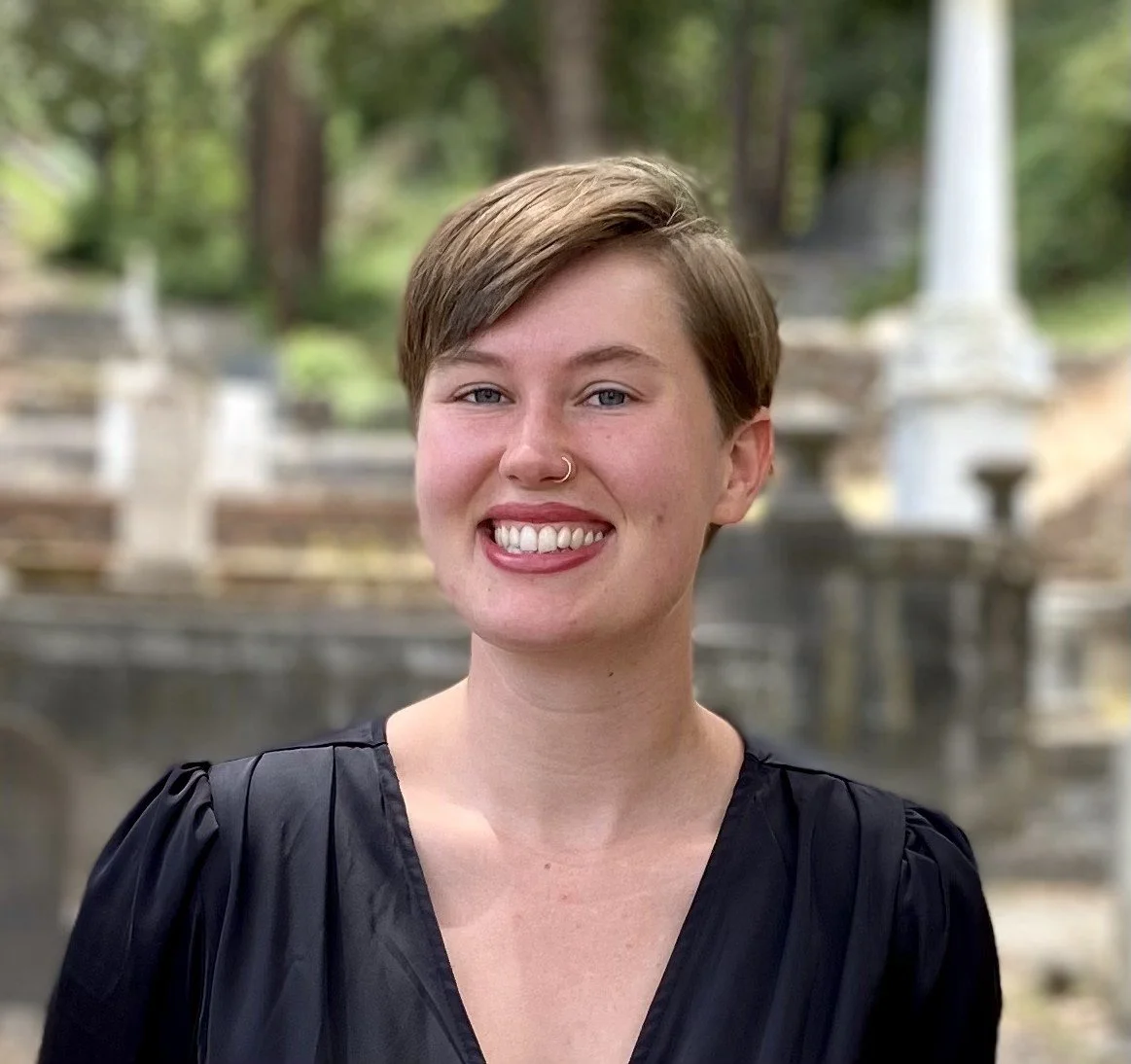
Photo of Kahlo Smith
BIO: Kahlo Smith’s fiction has been featured by F(r)iction, Luna Station Quarterly, Last Girls Club, and Trembling With Fear.