by Christina Ellison
You’re still in Oklahoma. You didn’t start there, and you’re not ending there either. You’re passing through, roadtripping back to Dallas from Chicago—all four of y’all are. Celia in the driver’s seat, who just took over at y’all’s fill-up back in Missouri; Brecken in the passenger seat, because she gets carsick; Maudie with you in the back, somewhere behind a pair of shoes stacked on the second snack bag stacked on the smaller cooler. It’s a summer hurrah before your final year of college, the last summer bookended by a school year, the last “real” summer, as y’all have been calling it. A childish conceptualization, maybe, but the notion had been born from childhood routine.
There’s a song playing from the speakers, but you don’t know it. It’s a slower song, a sadder one, so it’s probably Celia’s. She’s always playing those songs where the artist is whispering in your ears, like their sadness is a secret. You let the tune drift you outside, the plains near-barren save for the stubborn gray-green shrubbery stubbornly growing.
You ask no one how much longer until Texas. Someone answers, “Four hours.”
You’re still in Oklahoma. You curse summer for its long days, its endless hours of sunlight. You can’t go to sleep if you try, your mind too aware that it’s day, that it’s time to be awake, to be productive, to be driving out of Oklahoma.
Gray-green floats on a sea of dust and dirt, and you imagine the plants staring back at you with hundreds of invisible eyes. Brecken wants a granola bar, so you and Maudie dismantle the tower between y’all to fish one out. The bar is in crumbles already, you can feel it in the package, and when Brecken rips it open, it explodes across the front seats, wedging oats in the console, embedding into the seats’ creases.
Maudie groans—it’s her car, after all—but mumbles something about needing to get the car cleaned after y’all’s trip anyway. It’s a newer car, one she’s only had for a few months, one of those with a lot of letters in the name instead of a real word. You have a personal vendetta against the steering wheel, how it fights against your grip if you veer an inch out of what the car considers the middle of the lane, how it slows your cruise control if it thinks you’re too close to the vehicle ahead. As if a brainless machine knows how to drive better than you do.
But you’re not driving now, you’re still in the back, listening to the song of Celia arguing with Brecken because she has to drive with granola dust on her for the next however long, and Brecken saying y’all could stop so she could clean herself off, and Celia giving her a knowing look because at this point in y’all’s journey y’all know the last thing Celia wants to do when she’s driving is stop.
Brecken lets the conflict die out, which you know would happen eventually. You don’t argue with Celia and come out the other side winning. Even more so with Brecken, whose conflict avoidance includes baking a batch of cookies in anticipation of a disagreement happening, regardless of whether she was involved. She doesn’t have any cookies now, though, much less an oven to bake them in. All she has are the remnants of her granola bar, which she eats in silence.
You’re still in Oklahoma, and you know y’all didn’t stop because Maudie had said enough times for you to threaten to jump out of the moving car that y’all could make it to Dallas without needing to take a break. And yet, it’s Maudie who’s in the driver’s seat and Celia in the back with you. You peer around your middle-seat tower and find Celia hunched over a novel she’s trying to finish for her book club.
She notices you staring, asks, “What?” You wave your hand at her, like you’re erasing the interaction, and stare out the front windshield. You developed the habit of doing so from years and years of family road trips, of wanting to know where you’re going but being stuck in a rear corner, legs spiking with pain because with six other people and luggage and food for the journey you had no space to move, no room to stretch. But you could lean inwards, fractionally, locking in on the portion of window between your parents’ seats, watching the road.
The gray-green looks the same out of the front windshield as it does from your window. You can feel the eyes that aren’t there, how they watch you as you pass them by, leaving them to fend for themselves.
A speed limit sign approaches and the car slows down a bit. You try not to let it show on your face, your opinion on Maudie’s style of driving. Slow and careful, not exceeding the limit, her eyes flicking from the rearview to the sideview to her speedometer to the road, flick flick flick. You can almost hear the sound, like a grasshopper jumping from spot to spot. She said she got it from her mother, who had told her, “You’re driving other people’s children,” and the paranoia had let itself in and never left.
So you can’t fault her, as much as you want to get behind that robotic wheel and push the car to eighty. You were raised by a Houston man, inherited his roadrunner heart, that need to go. Inherited his special kind of anger that spikes when cars are in your way or someone turns too slowly. You have a place to be. Move over.
You’re still in Oklahoma, and Celia’s back behind the wheel, but Maudie’s in the passenger, meaning Brecken’s in the rear with you. You definitely don’t remember stopping. You don’t even remember dozing off. What did Maudie say? You have the memory of the concept of her talking, but you don’t remember any words, don’t remember the sound of her voice. Brecken and Celia are laughing, though, so it must have been funny. You smile, as if you’ve been listening all along.
A mile marker flashes by, but you’re on the far side of the car, so you can’t read it. You should be close to leaving Oklahoma. With two seat swaps, y’all must be. You lean toward the middle, against the tower of things, hoping to spot a casino in the distance. There are always casinos crowding the Oklahoma-Texas border, waiting for the southern neighbors to walk in. You don’t see any. Just gray-green and brown.
Celia asks for a water bottle, and Brecken fiddles around at her feet, where the larger cooler sits. Celia takes one from her, and her grip must be too tight because the contents explode a little, wetting her lap and her shirt and part of Maudie’s arm. You grab some of the napkins in the seatback pocket in front of you and hand them to Celia, who dries as much of herself off as she can while watching the road. Then Maudie offers her arm and Celia gingerly mops it dry, too.
Celia hands you the used napkins to put in the McDonald’s-bag-turned-trash-bag, then the unused ones. You put the latter back in the pocket, and you’re surprised for a moment that you don’t find those airplane sickness bags in there, too. Your family’s car had the backseat pockets stocked because two of your sisters had motion sickness throughout their formative years, and your dad traveled regularly enough to collect the bags and deposit them in a vehicle that would never see flight. But this isn’t your family’s van. It’s Maudie’s soccer-mom-style car that you kind of want to have a fistfight with.
Why Brecken’s in the back with you, you have no idea. But with the threat of her carsickness, Maudie might want to invest in some bags. Y’all probably should’ve thought of that on y’all’s way up to Chicago, instead of the last leg. It’s fine, though, y’all are almost to Dallas, almost out of Oklahoma.
You’re still in Oklahoma, and your seat belt catches, like whoever is driving the car stopped too suddenly. But you can’t see who’s driving, only the back of their neck showing through the raised headrest. Your three friends blend together, CeliaBreckenMaudie. It’s her who’s driving, her who’s in the passenger seat. Her who’s behind the tower, because someone’s there, panting so clearly heard over the steady hum of the engine. You peek behind the tower, but you can’t see her, only the back of CeliaBreckenMaudie’s head and her shoulders rising and falling.
You stare out your window. A car passes by, cutting through the barrenness. You can just make out the features of someone in a rear seat, too, staring back. You think to wave but also think that’s odd. The backseat person doesn’t blink, doesn’t break contact until that car has passed.
You’re not someone who remembers dreams. When you were small, you tried to combat this. You heard of the phenomenon of recurring dreams, and decided you would make yourself experience this.
The dream was this: fiery rocks raining down from the sky, cracks in the earth sending lava quickly to the surface—a child’s idea of the end of the world. You and a group of faceless children were ushered from a public pool and onto a school bus heading who-knows-where. You remember thinking that this was a fruitless choice, because the entire world was on fire, but you were stuck on a bus with other shivering kids in bathing suits who had nothing but towels to keep them warm. You looked out the window and saw cars doing the same thing, speeding toward something, somewhere. Then you saw your mother driving one of the cars, your two grandmothers in there, too. You called out to them, but they couldn’t hear you, didn’t even know you were on the bus. You had a sense you would die without them knowing. And they would die without you knowing. And everyone would die without anyone knowing because everything was on fire, on fire, on fire.
Then you woke up, teary-eyed and scared. It was for the sake of your experiment that you made yourself dream it the following night. Who knew when you’d remember a dream next? After that, you didn’t try again.
You think of the dream, sometimes, when you travel. How every car is its own world, nearly impenetrable from the outside. How easily a world can go up in flames.
You’re still in Oklahoma, and a grasshopper is driving. It’s just you and this human-sized bug in the car, belt securing it to the driver’s seat, antennae curled against the roof. Its greenness jars you, near-neon against the muted outside. It adjusts an air vent with one of its top four arms, the other three spaced evenly around the wheel. Its wings rustle, restless. Flick flick flick.
The grasshopper is Maudie, her depthless, oval eyes watching the road, the speedometer. She observes you in the rearview. You want to tell her to watch the road, there are people’s children in the car, but the words don’t leave your mouth, don’t even start to form.
She clicks her mandibles, flicks back to the road. You reach across the seats, down to the larger cooler, fetch a water bottle. You open it for her, make sure it doesn’t spill. She grabs it with one of her free hands, pours the contents in her mouth. She hands the empty bottle to you, but you have nowhere to put it. The car is empty, too—no luggage in the trunk, no backpacks or snack bags or extraneous shoes clogging the available space, save for the water cooler. You reach for the cooler again, but your seatbelt restrains you. You hold the bottle in your hands, crunch it softly. Maudie clicks and flicks, and you set the bottle in your lap, shrink against the door. You wish she would drive faster. You think that if y’all crossed into Texas, she’d become human again, like some Frog Prince variant, the spell broken.
You’re not sure if it’s a spell, but you think it’s worth a shot. You ask her how much longer. She clicks back, but you don’t understand.
You’re still in Oklahoma, and you’re the one driving. You wonder when that happened. It’s dark, now, the universe painted in pitch. Or it would be, if not for the headlights blinding you as people travel north, the glaring red of those driving south. Colored lights dance in the distance; you hope it’s a casino.
You hear panting again, and you glance beside you, to Brecken in the passenger seat using an airsickness bag to control her breathing. She does that sometimes, before she’s about to vomit. You’re glad you thought to bring some on your trip. The bag crinkles as she inhales and exhales, and you find it funny how alike paper and plastic can be. You let out a hum, let yourself smile. Celia asks, “What?” and Maudie asks if you can slow down. You’re going eighty, maybe eighty-one. You’re nearing another vehicle, and yours automatically slows to seventy-five. You consider swerving off the road, flipping side over side over side until the car becomes unrecognizable and possibly explodes.
There aren’t any cars heading north, now. Just a mass exodus southward, red on black on night. Those hundreds of eyes aren’t invisible anymore. You can see them, shining rubies in the dark. They make an ache build behind your eyes. You wish you could look away. You wish they would look away.
You’re still in Oklahoma. You’re in the backseat again, and the sun is stagnant and beaming, and you’re still in Oklahoma. Maudie, in the passenger seat, asks for a granola bar. You and Celia dismantle the tower. You take down the sneakers. She takes down the cooler. You take down the snack bag. She takes down the cooler. You take down the cooler. She takes down the sneakers. You take down the snack bag.
You look up and you can’t see the top of the tower. The roof of the car rises with it, miles and miles high. You try to think of a larger unit than miles. You ask them what unit is longer than a mile. Maudie clicks back, gaze fixed ahead. Celia leans forward from her spot in the back to answer, her voice gargled water. It spills over her chin, pools on the floor. She splashes her feet in it, like she had when y’all walked curbside in her old Chicago-burb neighborhood. Brecken turns to you from the passenger seat, and there’s something on her chin, too, something viscous and gray-green, and the more you wonder what it is, the stronger the stench becomes. You want to hand her a napkin, but there’s no seatback pocket. Brecken speaks in crinkles, in collapsing plastic and expanding paper.
You repeat your question and your words come out like fire, crackling and roaring. You say something else. Your tongue meets your bottom lip and it burns, thin and scorching. You whistle and a flame shoots out, scorching the back of Maudie’s headrest. She clicks in concern, quick and sharp. You close your mouth before you burn something else in your world.
You’re still in Oklahoma, and the world is ending. There’s that ache in your eyes again, like you need to blink but can’t bear moving, can only watch as Celia careens down the highway dodging cars and meteors alike. You remember her driving in Chicago, how there was an art to the way she traversed the span of lanes, a salmon trying to outrace the others upstream. You wonder if her Chicagoan father has a roadrunner heart, too, wonder if the two cities weren’t that disparate, despite the distance.
Brecken’s panting again, and so is Maudie. So are you, because y’all are driving to nowhere, driving to nothing. You’re still in Oklahoma and y’all are swerving around spontaneous fissures spewing red-orange magma. The scientists were wrong, the sun had been inside the earth the whole time.
A car passes and you catch sight of someone in the backseat, staring, unblinking. It’s you, and now you’re in that car and your mom’s in the front seat, her mom in the passenger, your dad’s mom in the back with you. You speak but your mom answers in sobs, her eyes spilling water down her face, down her chin. You ask if she can slow down. It’s fine, you’re together. Her mother speaks in crinkles, coughs out brown dust from her lungs. Your dad’s mom adjusts herself in her seat, her bones clicking in and out of place. You tell her to stop, she’ll hurt herself, but she keeps moving, keeps squirming, keeps clicking and clicking and clicking. She becomes a wooden snake, multi-ribbed and endless. She swipes her tongue, a tongue of fire, tasting the heated air, the copper and iron and nickel, the space rock mingling with earth rock. You look for yourself in Maudie’s car. You’re still staring, still unblinking. You return to her car and turn away.
You’re still in Oklahoma, and everything is fine, except your friends don’t have faces. The impressions are there: bone structures giving hints of where a nose would be, depressions where eyes would sit, creased lines from absent lips. From the passenger seat, Brecken hands you a cookie. It tastes like water, slides down your throat like liquid. She watches you eat it, as much as she can without eyes. You tell her it’s okay. You don’t remember what you’re apologizing for, but she baked cookies, so there must have been some kind of argument. You take her word for it, as much as she can give without a mouth.
Celia is unlooking at you in the rearview mirror. You note that Maudie isn’t untelling her to watch the road. Celia’s not even holding the wheel. The car is driving itself, and y’all are all just sitting. Waiting. Y’all are passing other cars, but when you glance out your window, the scenery isn’t moving; it’s waiting, too. Or maybe it’s stalling. When y’all drive past, it’ll be forgotten, the shrubs and the dust, the power lines that fence the highway in, the cars driving north. Everything will be tucked away, a forgotten moment that you’ll never be able to unearth. It’s stalling, and it doesn’t know what’s next, and neither do you, and neither do your blank-faced friends. They look at you. They’re waiting, too.
You’re still in Oklahoma, and the end is nigh. You saw a sign, one of those green ones that includes city names. Only twenty miles left. Y’all cheer as you reach a marker, a New Year’s Eve countdown twice as long and half a year early. A song plays from the speakers, one of those from the early 2010s that’s catchier than it has any reason to be, one of those songs y’all know like the lyrics were in y’all’s mouths when y’all were born. You and Maudie took apart the middle tower so y’all could sing off-pitch in each other’s faces, and Brecken is using a water bottle as a microphone between herself and Celia. The drive is almost done, the journey nearly complete.
You’re still in Oklahoma, but you’ve come to terms with this, because you’re leaving Oklahoma. You wave goodbye to the casinos that you can finally see, the shrubs and their eyes that you don’t think are watching you anymore. You don’t feel them watching. You wouldn’t know if they were, anyway, because you’re focused on singing a chorus as loud as possible. You’re not looking outside. You could be in Texas by now and you wouldn’t know it. You’re not sure you would care.
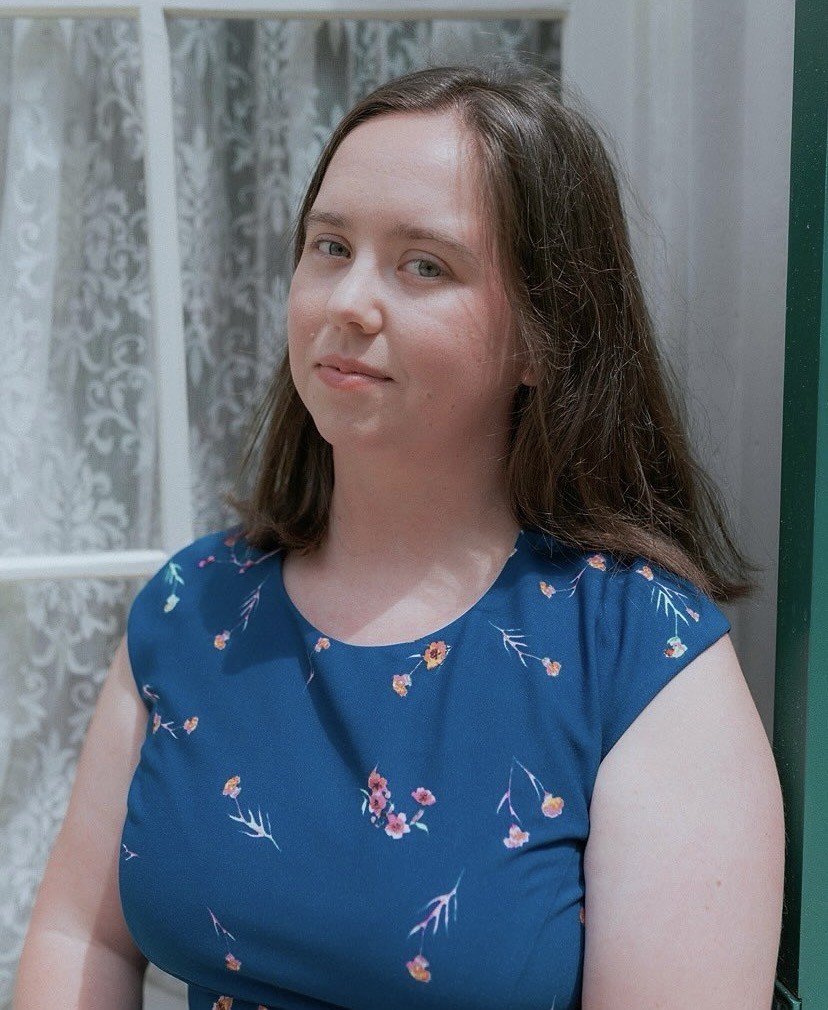
Photo of Christina Ellison
BIO: Christina Ellison is a fiction and poetry writer from Texas. Born and raised north of Houston, she is currently working among the cornfields of Nebraska. She serves as a fiction editor for Iron Horse Literary Review and New American Press, and her work appears in journals such as tiny wren lit, fifth wheel press, and Hyacinth Review.