home
by Esme Chen
August the third. He marked it on his calendar and wrote beneath the date. Home.
Home. A puzzling concept, indeed. いえ, 家, chez-moi. In many languages he whispered the word. Yet what it really is, he could not penetrate. It was supposed to be his birthplace, a poorly-lit house, where he was fed on porridge and mince and taught to speak English once he turned five. The memory of his childhood blurred when he left the continent at thirteen, including the years he spent with his father and mother. It was a peaceful remembrance, though.
He took out a ticket from the desk drawer, held it to the light. In print it read: San Francisco to Nanjing. Beneath it: Alfred Rong. Alfred was a name he gave himself, borrowed from a British drama. When asked to introduce himself to the class, it was “Alfred.” with a subtle sense of awkwardness, as if he was a spy under the guise of a fake name.
Shy was the word for him. He had trouble making friends when he first moved to Vancouver at thirteen. He had a remarkable reputation for his algorithms and handwriting among his peers, yet few people would ask him for help. He spoke near-perfect English, in a measured manner, making mistakes in grammar or vocabulary from time to time. Some classmates would ask him out for a date; in which case he would reply, I’m very sorry. I don’t think I’m the right person.
It was the end of July, the air still cold in the Bay Area. He opened a window and rested his arm on the windowsill, watching passersby below. A house next to his apartment was just lit, warmly lit by shiny chandeliers. He looked a little away. A raccoon was shuffling across the path.
He felt the prickle of nostalgia in his nose. A hotel address and pieces of battered memory were all he prepared for this trip. He thought of the hundred-year-old bricks left by the Ming Dynasty with engraved brickmakers’ marks scattered across Nanjing. Maybe neither
Canada nor the US was for him. A man who pondered in a language of square characters. He felt the need to seek not only a house, but an actual home. That’s probably why he wanted to go back.
*****
Friday came and he was on the flight. When he got off the plane, the city presented an alien look. He spent several minutes remembering his mother tongue, and a few more minutes figuring out the traffic system. A taxi took him the longest way around the city, deliberately, which cost him fifty-seven yuan. Not a big problem. He wanted to see the city.
For dinner, he ate baked rolls with red bean tangyuan soup. 燒餅 and 赤豆元宵. He practiced his pronunciation, surprised at how easily the sounds pleased him. When he tried to speak to the waiter, however, the experience completely changed. He felt flushed with nerves, and it was difficult to open his mouth wide.
Along the streets, motorcycles and taxis were soliciting rides to the Sun Yat-sen Mausoleum, or Zhongshan Ling. In childhood, his mother often brought him there to walk under the massive trees and bird songs.
Leaving the center city was a good idea. The bustling blocks teeming with shouts and laughter somehow only warned him of the desolate afterward. The silent, tall trees and long hiking path that comprised Zhongshan Ling would be a relief. He stopped a cab.
He walked along a thin pedestrian path, shortly before reaching the grass. He climbed up the hill a little, and sat down in the dark. Then he lay down, tried to relax his back, and felt the cooler nocturnal breeze on his cheeks. It was the calmest place he could think of; a place where he could be himself.
Toward the upper hill, there were sounds of children playing and adults laughing. Beyond the shadows they cast, there were trees whose names he didn’t know, and a star. A moving one. After a while he decided that it was in fact, a plane. A kid ran down toward his direction, calling him “brother”.
“大哥哥!球往你那邊滾了”
He caught the rolling ball at ease before he understood the words. The little girl was out of breath, hands on her thighs. 球呢?Where is the ball?
He offered the ball to her in both hands, careful not to touch her slim wrist. The girl didn’t say anything, but the look on her face had already made everything worthwhile. He tried to wave his hand and said goodbye. 去吧。
He realized that he had been smiling. He thought he had lost the ability to feel pleasure after taking medication, so the moment made him happy. Yet at the same time, there was a sour nostalgia spreading in his veins like mercury; he sat down again. The strangeness and awkwardness since he got off the plane had been chasing him. What else was he looking for, if this is the motherland, and this is his mother-tongue?
The girl was talking to her mother about him, he could barely see their faces turning toward him. The mother smiled at him. He nodded back into the darkness and walked away.
*****
Years before, he had attempted to take his own life. Twice. The second time was interrupted by a phone call. He was in the bathtub when the ringing of the telephone jumped in the air, between white tiles.
When he cleaned himself and answered the call, it turned out to be his friend in middle school. The young man’s voice stirred many memories. A sense of longing struck him. He spoke of no matter how many languages he urged himself to learn, he felt in the wrong place. The friend listened. He left his hometown at thirteen, and nobody told him how to be a person with global backgrounds, in other words, chaotic self-identification. By becoming global, he had made himself a citizen anywhere, and a citizen nowhere. No one to share his peculiar grief with.
Then, why not go back and see the place again? The friend suggested. Back to the place where you were born, if other places feel foreign.
He spent the next day running around the city, trying to gather clues of that old house his mother bought. He asked for directions and thanked the street peddlers with a formal politeness that set more eyes on him. The impersonal glances passersby tossed at him, as if discreet whispers: 外地人. A stealthy outlander. He felt unusually hot— perhaps from the muggy summer of Nanjing.
The asphalt road reflected strong sunlight. He stopped by at a newsstand and drew some coins for water. As he drank, the newsstand owner fanned himself with one hand and said, “來南京玩?”
He paused for a while before denying himself as a tourist. “我出生在南京。” Simpler than it may seem, a visit home. He grasped the chance to speak before the owner could interact. “請問您知道銅鑼巷五號該怎麼走”
The owner was visibly impressed by the address he just gave. He said, “前面那個路口右拐,走到頭, 餛飩店旁邊” and looked at him from head to toe, as if saying, you’re a real Nanjing kid? He thanked the owner and strode in the direction he indicated.
銅鑼巷五號, where his small family ate and slept. A taste of bittersweet crept in when he thought of the house he grew up in. His family was strict on his diet, prohibiting him from eating snacks. He was trained early on in English, by his uncle, and punished constantly. In most cases it would be to stand. There was a certain way they wanted him to do it; heels against the wall, and hands on the side seams of pants. Wobbling would be considered disgraceful. He never understood how a person could transform from smiling and talking to shouting at him in rage when he misspelled a word. The world did not make sense, even when he was young.
When he finally arrived, the old building was gone. His memory was indeed out of date. In front him was a high-rise, bright with white paint. He tasted bitterness again on his tongue.
*****
How many doors he had knocked on, he could not recall. He was overwhelmed by great relief and sentiment at the same time when he heard the answer. Someone directed him to an alley where unowned items were placed. After the old building was taken down, all the stuff that belonged to the Rong family was carried here in a box. He opened it, and the limp chairs, old clothes and crumpled paper exposed.
Most of his past belongings went missing, but there were stacks of paper that were intact. In it he found a notebook, stamped with a nametag that said 容淥. Rong Lu. The actual him. The actual name. He caressed the cover, tears in his eyes. How many years had his name been forgotten, buried here in the box?
He flipped through the notebook. The first half of it was sloppy characters written by pencil, a stroke here and a stroke there. He could still feel the warmth of his mother’s hand wrapping his, as they wrote together, from one to five. He imagined their old home, wooden tables and chairs, and the plane tree catkins that flew through his window like snow during summer. Such strong, bright summers. Light traveled between the lines, gilding his pen with gold.
He put the notebook carefully into his arms. Towards the bottom of the box, he found his mother’s letters and books. He patted away the dust and started to read the letters one after another. There was a sealed one in a black envelope that attracted his attention. He removed the seal and drew the letter. It was a little card, actually.
On it, there was a name and a few handwritten lines, ending with a red stamp at the bottom right corner. He held the thin paper like it had warmth. It was his mother’s death certificate.
He put the paper back into the envelope and slipped it into his pocket. The sun had dropped beyond the horizon, sending cooled winds. The highrise next to this filthy alley was lit by household lights one by one. It was going to be a cloudless full-moon night.
He closed the box when he finished his packing, stood, and spared a minute to wipe his tears, before walking onto the streets. Behind him, the sky of Nanjing was sombre. No stars. The night had settled.
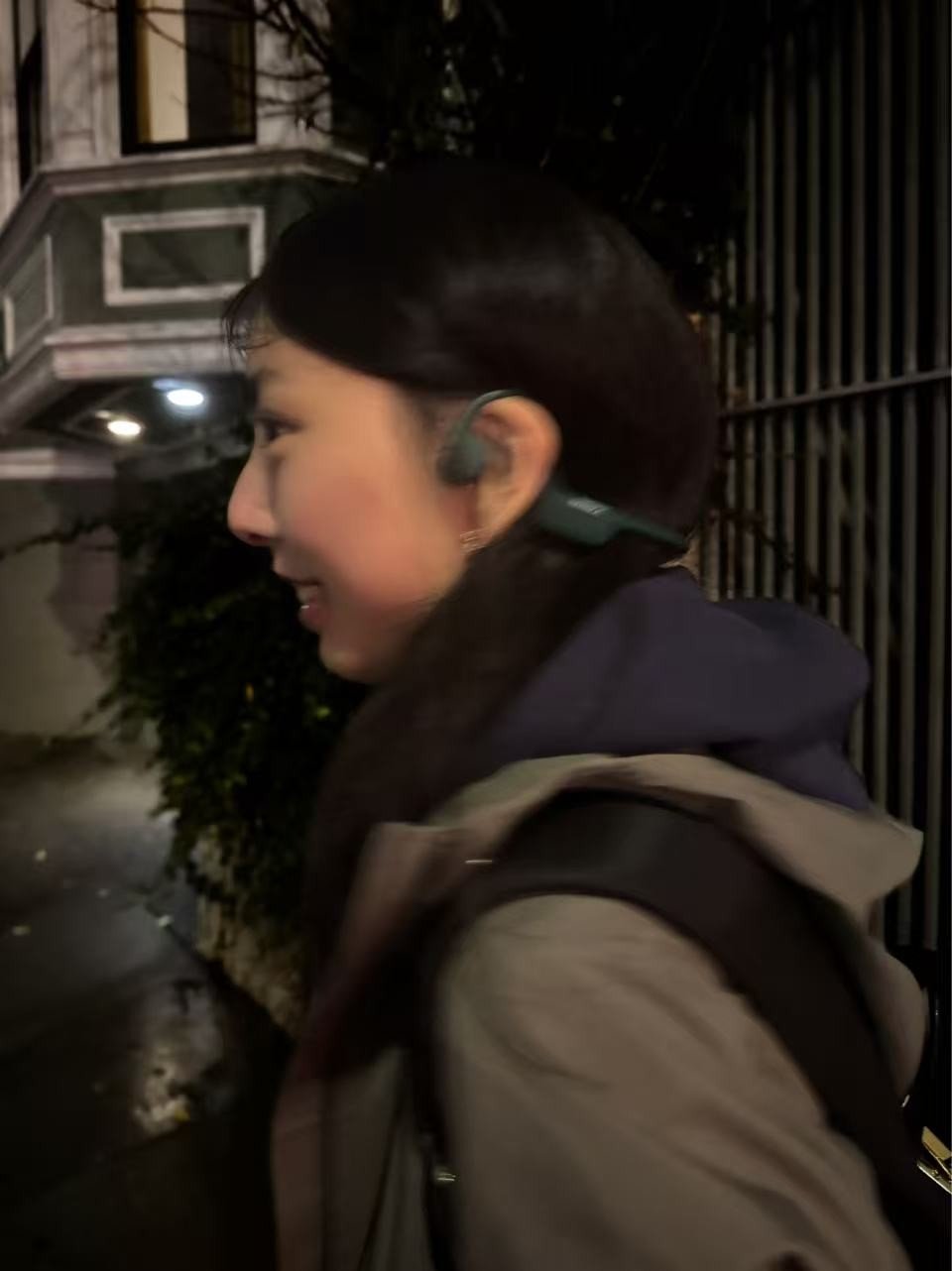
Photo of Esme Chen
BIO: Esme is a writer & college student based in Bay Area. She enjoys exploring themes of death, loss, and complex and confusing human feelings in her works. In her free time, she likes to read books and enjoy sunshine.