have you ever seen a cat in a cape?
by Joseph Quilindrino Niduaza
The time was ten to six. The chickadees were chirping, and Earl woke that Wednesday already thinking about dinner: a cheeseburger, extra onions, no pickles, and a Coke. It was Earl's thirteenth straight day of work, and with four more days before a much-needed day off, he kept his mind at ease by focusing on things he could control. He could not control his work schedule. But he could control dinner. Yes, he thought, I will get a cheeseburger for dinner. He also considered a Cherry Coke in lieu of original. And then Danny called.
Danny only ever called when he needed favors. This morning was no different. As Earl's supervisor for the last seven years, Danny had come to rely on Earl for his loyalty, his dedication to the job. But while the job paid the bills, yes—to Earl, it was shit. Literally.
The wastewater treatment plant for the City of San Mateo treats an average of four billion gallons of water per year, roughly eleven million gallons per day, and when Earl got off the phone that morning and crunched the numbers, he realized he would have removed fecal matter from approximately 231 million gallons of water by the time of his now-rescheduled day off. What a load of shit, he thought, but In-N-Out sounds good: a Double-Double, animal style fries.
*****
The time was ten to five. Dawn, pale sky. Danny awoke that morning and ruined Earl’s day. He did not intend to, but when he scrolled through texts and read one from his boss, he had no choice.
"D-man," the text read, "need extra hands on deck this week. State survey coming up, a State official coming today too. Get it done now."
Danny hated how his boss ended all texts with, "Get it done now." As if Danny and his staff did not have other pressing things to do, lives outside of work. As if Danny wanted to be a deadbeat father, which is what he thought that morning, because he knew what his boss' text meant: he knew with the survey that he was going to work extra hours too—he knew he was going to miss his daughter's softball game, the fourth one this year. He knew what his ex-wife would say, what she had said. And he knew he had to call Earl.
*****
Heath Powers spent eight years in the U.S. Army before slithering into politics. He was never much of a soldier, more a dolt, yet his superiors admired his loyalty—but they were responsible and made sure he never rose above the rank of E-4 as a Unit Supply Specialist. God forbid we actually let him lead, his COs would gossip amongst themselves.
Heath cared little for such chatter, which is why he chose politics after discharge. He was loyal enough to be a useful pawn, yet incompetent enough that no one ever wanted him to lead their team. But voters of San Mateo did not know this. Like most citizens in a democracy enmeshed in a wide web of complex civic issues, they knew nothing about Wastewater Superintendents, nothing of wastewater treatment plants, except that they are there, somewhere, but not in my backyard—so who cares?
Heath Powers cared. And despite zero experience with wastewater, engineering, or leading—anything, he was elected in a landslide victory after promising to lower taxes, which the Wastewater Superintendent had no control of. And this was the genius behind Heath's idiocy: he knew nothing except how to talk, and it was talk that San Mateo citizens adored. Heath Powers' gift was his gab. His superpower was the power of interpellation, the power of hailing, of hypnotizing, like a siren, soothing others with things they wanted to hear.
Danny did not vote for him. Neither did Earl, because Earl does not vote. And at ten to two, in the dead of night—whiskey drunk, in no shape for work by sunrise—Heath texted Danny, hypnotizing the obedient foreman, deflecting responsibility, and in turn, flipping Earl's switch.
*****
Earl flipped a switch, and overhead lights illuminated his cold kitchen that morning. He would flip many more switches that day, at the wastewater treatment plant, controlling inflows and outflows, separating shit from more shit, contemplating his life choices, mourning the In-N-Out he would not eat that day. When Danny told Earl he would have to work a sixteen-hour shift, Earl died a little inside. He said: "Danny, man. What the fuck? You know what you're asking, right? You’re asking me for twenty-one straight fucking days, man, and a double today. This isn't right." Earl pictured the Double-Double from In-N-Out, that divine cheeseburger he would not eat tonight.
"I know. I know. But Powers says..."
"Fuck Powers," Earl snapped. "Him and his haircut."
"Earl," Danny's tone sharpened, "he'll be there this evening. By six. If we get enough done by then, maybe he'll let us leave early."
Earl repeated four numbers in his mind: six-nine-six-nine—the combination to his gun safe, and in it, a new Sig Sauer P320-M18. "By six, you say?" Earl smirked. Maybe he would eat a cheeseburger that day. "Okay, Danny, okay. I hear you. Let's get it done." He paused a moment—his cat brushing against his legs—and asked: "Don't you have a game to go to tonight?"
"Yes," Danny said, "that's why I need you. You're the only one who can get shit done." This was true: with treatment plant's budget cuts—orchestrated by Powers himself—Earl was literally the only one who could get shit done, his fellow comrades on furlough until Friday.
Earl liked Danny, despite his incessant solicitations for favors, professional or otherwise. Earl knew, from his own experiences—losing his wife and daughter years earlier to a drunk driver—how important family was, how important this Wednesday was for Danny. So, he snuck in a favor for himself and said, "Get me a Caramel Frappuccino, a venti, and I'll see you at seven."
*****
The time was ten to seven. Bumper-to-bumper traffic. His car ambling southbound from Daly City, KMEL blasting from his stereo, Danny sipped his coffee and could already smell the shit from work, six miles away. Like Earl, he too contemplated his life choices. He hated working for the man. Working for men like Powers. Incompetent men. Vain men. Stupid men. Idiots, the lot of them. But what choice did he have, saddled with that debt that he and so many of his generation were chained to? “Go to school," men in sleek suits had told him. "Get a job," they said. "Marry and have babies," they insisted. They talk a lot, but in Danny's mind, they didn't know shit. Not like him and Earl. In another life, he often imagined, men like him and Earl would take men like Powers to pasture. But in this life—a life of struggle, of work—men like Powers called the shots, and men like Danny and Earl were their subjects. Danny mused these realities throughout his commute. He texted his ex-wife, telling her he was sorry and was not sure if he would make it to Holley's game that evening. He hated himself in that moment. But then he pulled up to facility, Earl already there, grinning, lit cigarette in his hand, a funny look in his eyes.
"Morning," Earl said.
"Morning," said Danny, crestfallen, handing Earl his venti Caramel Frappuccino.
Earl flicked his cigarette, wrapped an arm around his dejected comrade. "Come on," he said. "It's a big day. You got an important game tonight. And I got a date with a cheeseburger—let's get to work."
*****
Heath Powers loved his shoes. After defunding the treatment facility, pocketing the money, eliminating its security—the guards, the cameras—he bought a pair of Ferragamos, imported directly from Florence, Italy. Though they offered little traction, they were stylish—brown leather, glistening under that California sunshine. He wore these shoes only twice: at his wedding last year in Napa, and at his mother’s funeral in Cheyenne, Wyoming.
This day, he would wear them again, and he would show the State official how the City of San Mateo gets shit done. At ten to five, neath the roof of a sunny home in Belmont, he snorted a bump of cocaine, texted his wife, kissed his mistress goodbye, texted his other mistress in Los Gatos that he would be there by nine, donned his fancy Parisian suit, stopped by Starbucks, and merged onto Highway 101, bounding north for San Mateo. The traffic, to him, seemed to defer to his excellence, his style, his lavish and top-of-the-line vehicle: that sleek Mercedes, a testament to fine German engineering. In reality—coked out, caffeinated—he drove like a madman, like a shit, like one of those vain and incompetent men that Danny, Earl, and his COs detested. He almost ran a family-packed minivan off the highway after nearly missing his exit. "Fucking Pajeets!" he yelled, flipping them off, recklessly accelerating past two more cars like he was playing Grand Theft Auto on PlayStation with the cheat codes on—the cops, oblivious to his blatant crimes.
Such are the affordances men like Powers enjoy, upheld by a culture plagued with outdated and misguided ideologies, prioritizing profits over labor, hard men over soft men. Idiocy over integrity—nostalgia over grim realities.
When Danny received Heath's text with an ETA, he gulped.
But Earl smiled.
*****
Earl decided to shoot Heath that morning. In Earl's mind, it was the only moral and decent thing left to do—and who could blame him? Like Michael Douglas in Falling Down, he’d had enough of this shit. And as he and Danny separated shit from more shit, he formulated his plan: he would work, he would clean, he would hose down catwalks, he would input the numeric activation code to the facility's control panel—four-two-zero-four-two-zero—and he would serve the citizens of San Mateo, expunging impurities from the people's water.
He told Danny none of these things. Earl simply had nothing left to lose. Yes, the job paid the bills, but it was shit, and with his wife and daughter gone, so was his life. But Danny still had a chance. Sure, Danny was balding—which Earl perpetually teased him about, what with his glorious hairline and long locks—but Danny had a family, a life, a daughter with an important game tonight. Danny had everything to lose, to which Earl had nothing, not even a cheeseburger. The only thing he had was this shit job with its shit-stained overalls and his shit apartment overlooking the sewage outflows of Emeryville and Berkeley. So, when Heath Powers pulled up to the facility, Earl readied his Sig Sauer and tucked it into his oversized pocket.
*****
Danny endured Heath's verbal tirade like a castrated shell-of-a-man, a wretched untouchable—his voice, silenced. Earl, bearing witness.
In lieu of pest control for the facility, what with budget cuts and whatnot, Danny had "employed" two cats to "control the vermin," and at that moment—in the midst of Powers' castigation—they ambled amongst catwalks, hunting for rats. The tabby, Slim Jim, and the Manx, Miss Misery—Earl can attest—did an exceptional job deterring rodents. But when an unfamiliar voice beckoned from near the facility's entrance, the cats scattered. Danny, Earl, and Heath froze. Ominous footsteps—tap, tap, tap—echoed down the hall and approached the control room. Heath's devilish face morphed, projecting a TV-host-like smile.
"Ahoy," the stranger said, smiling back, "You Mr. Powers?" He extended his hand for a shake. "Anthony Freeman—I'm here for the State survey. Nice to meet you."
"Ahoy," Heath mimicked. "Yes, I'm Heath Powers." He gestured to Danny and Earl, introducing them, forgetting Earl's name, calling him 'Champ' instead.
"Wonderful," Freeman said. "It's great to meet you, Mr. Powers. And you, Champ—Earl, and Danny, nice to see you again.”
Heath winced: in his short tenure as Wastewater Superintendent, it had not occurred to him that Danny and Earl might have met Freeman in previous surveys. Shit, of course he knows these fuckers, he thought. Perpetually alienated from anything laborious, ever-projecting competence he did not possess, evidently, he knew little of his staff and his important civic duties. He cursed his mistake, a critical one, and in front of his boss—his superior, no less. Suppressing embarrassment, deflecting accountability, he said, "Well, Mr. Freeman, I'm confident you'll find our state-of-the-art facility in tip-top shape. Danny and Cha... Earl are fine workers."
"I see," Freeman pressed, gazing at notes, "you've cut your budget by twelve percent. The governor's taken quite an interest in this facility, how it's managing since those cuts."
Heath gulped. He hated the governor, that liberal—that radical leftist—with that haircut. But Heath was a professional, a patriot, and he was not going to tolerate any slander against his impeccable reputation. "I assure you," he said, "the facility is as efficient as ever." Of course he did not know this; it was only his second visit to the plant, but he persisted: "Please, Mr. Freeman, allow us to show you around."
Freeman—bemused, jovial, suspicious—said, "Okay, Powers. Let's get." As they marched out the control room, Danny and Earl close behind, Freeman surveyed Heath's suit, those shoes, and asked, "Veteran, right? Served eight years?"
Heath's jaw clenched, the cocaine in his bloodstream intensifying his bite. Despite the militaristic air he projected, he was ambivalent toward his enlisted past. He was never much of a soldier, more a dolt, and he would never admit it, but the only reason he enlisted was because of the uniform and the authority it displayed. It was not love of country, but rather his vanity and sartorial snobbery, that compelled him to volunteer. Feeling cornered, attacked, Heath responded, "Yes. Eight years. And proud of it."
"Me too," Freeman said, sliding up his sleeve, revealing a tattoo of a bull. "Third Battalion, First Marines: Fallujah."
Danny and Earl stood back and watched this pissing match. Danny was nervous. Earl wanted popcorn. And somewhere else in the facility, two cats plotted. Earl reached into his pocket, felt the gunmetal. Maybe not, he thought, not yet at least.
From atop a catwalk—the stench, foul—Heath, Danny, Earl, and Freeman surveyed a large pool of shit. Freeman interrogated Powers. Powers uttered non-answers. Earl visualized his shots: one in the chest, one in the head, one in the dick. And Danny typed a sad text: "I'm sorry Peanut. I know I promised, but I can't make it tonight." He stared at the text, read it again and again, feeling oppressed, left with no choice but to send the message.
Miss Misery, the sly Manx, loafed on the catwalk directly above them. Why she did what she did, God only knows. Freeman later said it was probably Powers' cologne. Earl agreed, noting its foul odor, despite the literal shit floating in the air. Danny thought he saw a fly land on Heath's hair—maybe that is why she did it. And before Danny could send the text, Miss Misery launched like a superhero. As if in slow motion, Heath spotted the incoming feline, and feeling the need to preserve his integrity, and keep his suit clean from cat hair, he evaded the air assault, but with his ungraceful maneuver—the catwalk still slick from Earl's early morning hosing—his traction-less Ferragamos betrayed him, and he slipped, plunging headfirst into the pool of shit. Heath panicked. He gasped. He pleaded. He could not swim—he was never much of a soldier, more a dolt.
Danny froze. Earl smiled. Freeman stalled. None of them wanted any of that shit either. And by the time Freeman found some life-saving rope, Heath was dead. The autopsy report would later reveal what none of them knew in that moment: alcohol and cocaine in the bloodstream, three clogged arteries, a quarter liter of shit-water in the lungs.
Because there were no active security cameras, Freeman was obliged to offer an extensive account. Danny and Earl stood close, absolved of any wrongdoing by Freeman's statement to the officer. Outside, red and blue lights flashed against the corrugated metal of the main building, Freeman talked to more officers, Danny called his daughter, and Earl lit a cigarette. He reached into his pocket, felt the gunmetal. Even though he still had to work the next day—for the citizens of San Mateo must have their water—he smiled at the prospect of coming home before midnight. Maybe I will get that cheeseburger after all, he thought.
The time was ten to six.
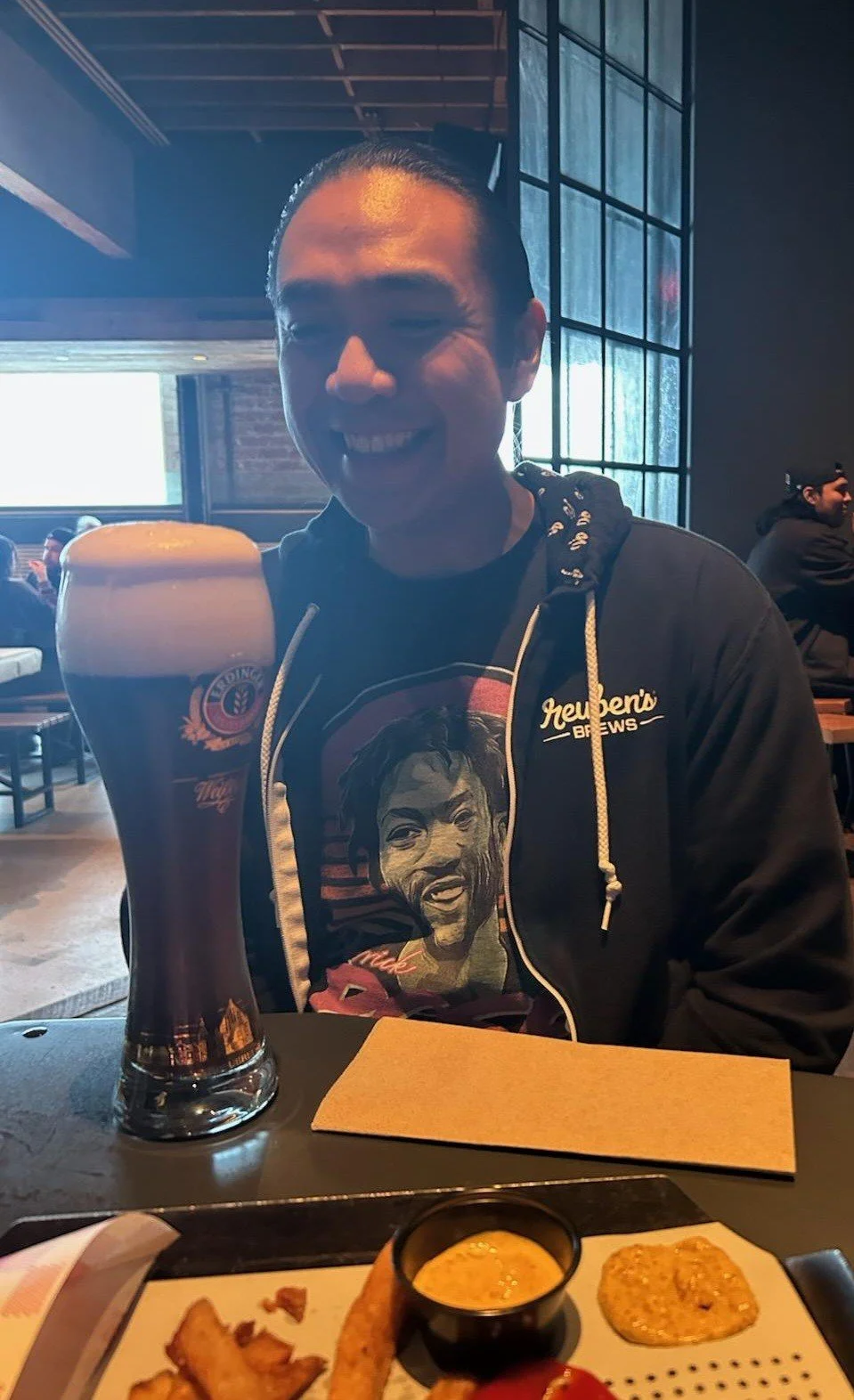
Photo of Joseph Quilindrino Niduaza
BIO: Joseph Niduaza is a writer and educator. Originally from Salinas, California, he has also lived in Blue Lake, California and Seattle, Washington, and now resides in Portage, Michigan. He holds an MFA in Creative Writing and Poetics from the University of Washington Bothell and is currently pursuing a Ph.D. in Creative Writing at Western Michigan University, where he has served as Fiction Editor at Third Coast. His work has appeared in Clamor and The Homestead Review.