general lew wallace confronts fake news, 1899
by Benjamin Goluboff and Mark Luebbers
The General would fill in the moat after a few years because it was endangering the foundation of the palatial study he'd built for himself back home in Crawfordsville, and because as an attorney he understood the moat to be an attractive nuisance for his grandson and the neighborhood children.
But the General was an angler before he was an attorney, before he was a military man or novelist or poet. So until then he stocked the moat (it was only four feet deep) with bream and bluegill and assorted pan fish, and it was the General's folly to fish the moat from the open window beside the desk in his study.
Waiting on a fish, the General had learned, dreaming his way along and down the line into an element where vision gives way to inference, helped him hear his characters talking, helped him see how a legal argument must step from precedent to principle, like a water strider stepping along the surface tension of the moat.
This overcast day in the last autumn of the century, the General had left hanging a relative clause in his latest letter about the Shiloh business when he dropped a line out the study window and waited for what might come.
It wearied him to persist in the argument about his command at Shiloh, but command is a grave responsibility whose claims do not expire when the battle is done. This conviction was one of the factors that had led the General to seek a command in last year’s Cuban war, and when he was refused, to try to enlist as a private soldier and to be refused again.
Another factor, to be sure, was a certain grandiosity in the General’s character that heightened his concern for his place in history. The general was 72 in the last autumn of the century and had entered that time of life when a man begins to order his tomb.
Shiloh was on the General’s mind this overcast day, as well as his place in the pantheon. And like many veterans of the war between the states, Wallace had misgivings about the character of the Union they had fought so desperately to preserve.
The General did not stand with Mark Twain and the anti-imperialist crowd because he had absorbed the fashionable arguments about sea-power and the nation’s sphere of influence and accepted uncritically the idea that the United States had a duty to liberate the peoples of the Atlantic and Pacific islands from the colonial prison-house.
But as an old abolitionist the General could not fail to see the irony of McKinley’s employing the language of freedom for the Cubans and Filipinos, when despite the war and the peace blacks in the former confederacy were still not free.
The election dispute in ‘76 was a terrible setback but it was a crisis endured to avert a larger and potentially bloodier one. Still, everything Wallace read (he took seven newspapers) showed that the south did not want to stop fighting, did not want to give the blacks an inch more than they could get away with, and that the blacks were starting to get restive.
There had been so many discrepancies in how the papers reported the violence last year in North Carolina that the General didn’t know whether to think of the Wilmington events as a race riot or a coup d’etat.
Disturbing in another way was contradictory reporting about violence between black and white troops at the port of embarkation for the Cuban war, a Florida town called Tampa. It seemed a detachment of Ohio volunteers had mixed it up with troops from the 24th and 25th Infantry, Black troops transferred from Arizona.
The Register told the Tampa story differently from the Plain Dealer, from The Blade, and The Tribune (Harmless fun, provocations by the Blacks, Colored troops unfit to serve), and then the story disappeared from the press. The General did not believe the claim in The Picayune that seasoned troops from the west would have discharged their weapons in the streets or inflicted property damage on businesses that had refused them service. The General felt he knew the Blacks, knew their capacity for discipline.
In the old days it would have taken just a few days and some well-chosen words to learn the truth about Tampa. Today the general was confronted with silences, lacunae, inconsistencies, and with one more reminder that he was an outsider to power.
That January nearly everybody in the English-speaking world would read a poem by a bitter old Englishman about the bird who sang a note of foolish cheer in the dawning century.
The General would not see enough of the new century to lose the last of the optimism that was so much a part of him. He would read the poem with the conviction that the Englishman had missed the point, and this spared the General some pain. Perhaps it is by such mechanisms that God’s grace moves in the world.
But on this overcast day in the last autumn of the century, among riots and the rumors of riots, the future of the Union lurked invisibly, a fish below the surface.

Photo of Benjamin Goluboff
BIO: Mark Luebbers has been a teacher and administrator at several schools in the Northeast and Midwest; Benjamin Goluboff teaches at Lake Forest College. Sometimes they write stories and poems together.
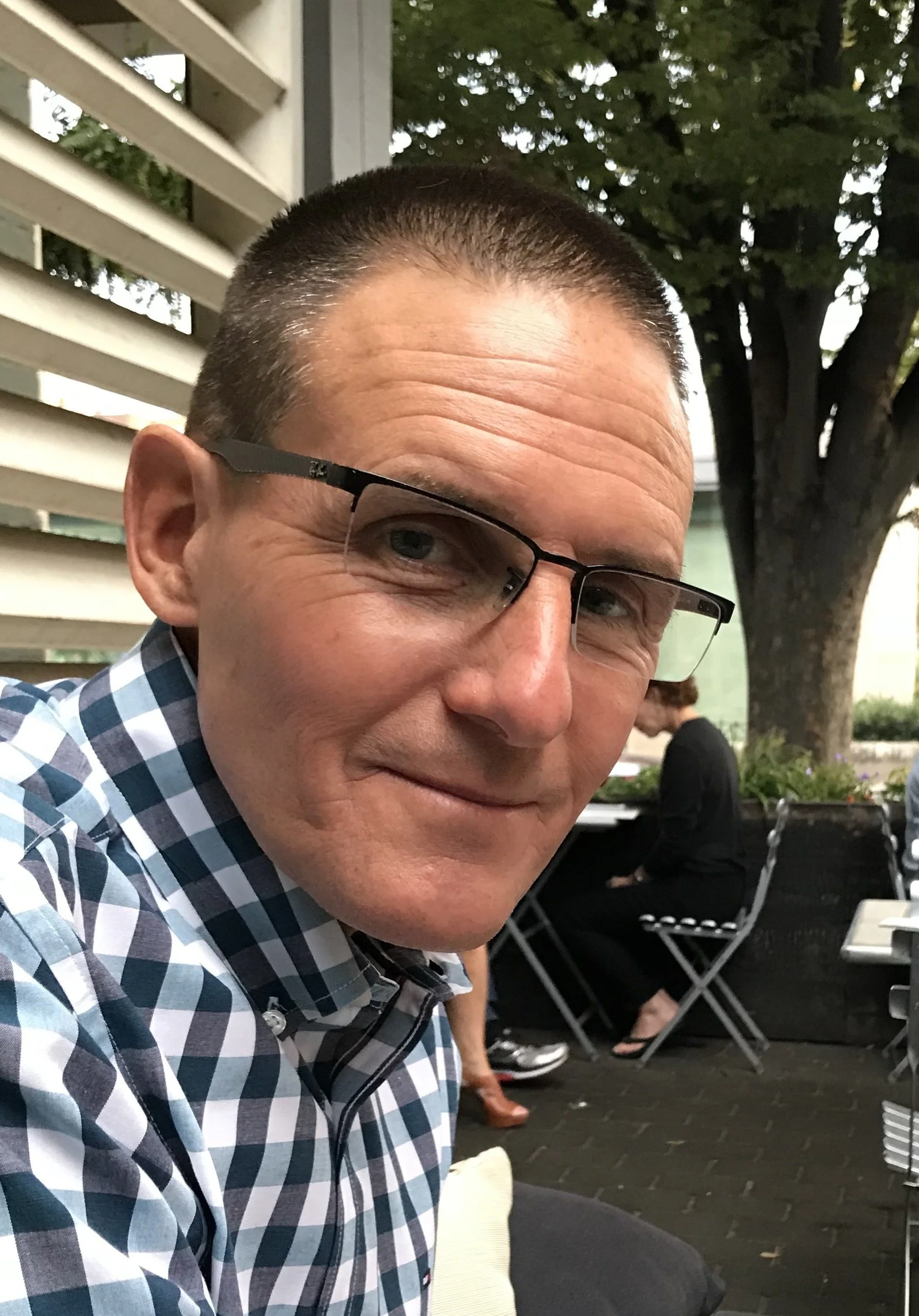
Photo of Mark Luebbers
Mark and Ben’s collection of speculative biographical poetry, Citizens of Ordinary Time, appeared in 2023 from Urban Farmhouse Press. Their very cool chapbook Group Portrait: Poems on a Photograph by Herman Landshoff is just now out from Parisian Phoenix.