by Frank Reardon
The fray of the yellow curtains blowing in the window caught Robert’s attention. At any time, the fray of fabric captured his attention. A stare from a buffalo looking down at the barrel of a gun. Nowhere to run, vast open fields in every direction. The waiting for nothingness to arrive even when it’s already there.
Wrapped in a blanket, Robert lit his third cigarette in a row. He took his attention away from the open window and the blowing curtain and studied his body. He ran pencil shaped fingers across his ribs like a musical instrument. His face once plump, turned narrow and sharp enough to cut paper. The cigarette dangled from his thin lips, and he thought about shutting the window he’d opened the night before. Suicide by exposure was his thought due to the winter storm, but all he could manage was a frigid living room.
He lived off Vienna sausages from the can and sliced pineapples. He drank black coffee throughout the day, and bottles of beer at night to keep the ghosts at bay. It hardly worked, the ghosts only got drunk, louder, and obscene. His frail body. The confused gait of movie zombies frightened the customers at work. He put twelve years into his job at the Demoulas bakery. He even won employee of the month once, but corporate suspected an illness. One fleece vest wearing man with thin hair mentioned, “HIV.” Another decked out in a fake gold watch and gold-plated necklaces, mentioned “drug addiction.” Neither true, but was reason enough to terminate him, regardless of the years he put into the company.
He noticed the time. The clock had fallen on the ground weeks ago; he needed to get himself dressed. His size thirty-six waist pants hung low off his now size thirty-two-inch waist. The large button-down shirts hung on his skeleton frame like a dress. He tucked in the purple checked flannel to disguise vanishing meat. Slender horror movie fingers pulled the brim of his Red Sox cap over his face to hide the narrows.
When he entered the meeting in the basement of Saint Paul’s they were all sitting in metal-folding chairs in a circle. They had saved him a seat, James Fabian patted Robert on the leg to welcome him. Robert noticed the other empty chair where Leonard Phillips always sat. They all took the same seats every meeting.
“Where’s Lenny?” Robert asked.
James lowered his head, as did the group leader, Charlie O’Neill. The only one of them in the basement not dealing with the same problem as the rest of them.
“I’m sorry to inform you, Robert, but two days ago, Leonard took his life. His wife notified me last night.”
“What. Huh?” Robert said, eyes filling up.
“I’m sorry,” Charlie said, “I know you two were close. Fishing buddies, was it?”
Robert nodded his head. The paper cup that held the black coffee started to leak from the bottom of the cup. He let the liquid create a small coffee river in the palm of his hand.
“Every Tuesday,” Robert said. “We threw them back every time.”
“There will be a memorial service next Monday, if you’d like to go, Robert.”
“Thank you,” he said, rubbing the coffee river onto his brown pants.
The men sat around talking about past experiences, which all sounded the same, but Robert didn’t know where else to go.
“You suffer for your entire life…” Robert said.
“Something to add,” Charlie said, looking up above the glasses hanging on the edge of his nose.
“I was just saying,” Robert replied, picking at the empty coffee cup. “I suffered most of my life. Sleepless nights. And the smell. The god damn smells. Any of you ever smell them?” Robert continued. “I could be out walking, a smell hits my nose, and I’m taken back in time even though I’m in the present. I’m here, right fucking now, but I am in the past too, get it? And the bitch of it is, I look around for the smell, but it’s nowhere to be found. It’s a sweaty and controlling smell. A phantom.”
“That’s a PTSD response,” Charlie interrupted.
“Maybe so, Charlie, but that’s not what I’m talking about, God damn,” Robert said, frustration turning his face towards the basement window. “Life is a series of smells now. Death without meaning. I once had meaning. Lenny had meaning, and now, Charlie. Now, it’s nothing but smells and a time machine back to a moment. One moment that changed everything.”
“You been taking your medications Robert?” Charlie asked.
“Yes. Charlie, but what are you not getting Charlie? The smells. They’re everywhere I turn. One minute I’m watching the Bruins, thinking I might be okay. There’s a reason to keep living. And I feel good, positive. Some bastard walks into the bar and he’s got this cheap cologne on. After shave. I don’t know what you call it. And there I am, alive now, yet I’m transported back twenty-five years, but I’m still on the stool. The Bruins are still playing, at least I think they are. People are going about their lives, but I’m stuck in the fly paper, unable to move. Why me?”
“Why any of us?” Charlie asked
“Why what? The hell philosophical namby-pamby garbage is that? I’m trying to tell you that we are flies on gooey paper and you ask me that,” Robert shouted, pointing at Charlie. “The ‘why’ is not you, Charlie. It never was. It has never been. You and that silly clipboard. Ever smelled things that are not there? Ever hear sounds that don’t exist? “
“Okay,” Charlie said, tossing his clipboard onto the empty chair where Lenny used to sit.
Robert walked over and swatted the clipboard off the chair, “That’s not okay, Charlie. That’s Lenny’s seat. Not okay.”
“It’s time for deep breathing exercises everyone,” Charlie said, ignoring Robert’s anger.
“All I am saying, Charlie, is our lives are ruined, in some cases destroyed, and in Lenny’s case, over, and all we’re offered for a lifeline are meetings in a damn church basement. You know how offensive that is?”
“How you mean, Robert?”
“They’re the criminals is how I mean. Are you that thick? They did this to us and here we are discussing what they did to us on their home field. Talk about a kick in the nuts. Have you ever been kicked in the nuts?”
“I’m not sure I follow?” Charlie said.
“I didn’t think so.”
Robert took his seat and James patted him on the leg to thank him for speaking up. They all took turns talking. Robert ignored the stories because he’d heard them a million times, he kept looking at the empty chair. Thinking about fishing with his friend, the beers they drank. Endless stories about the women they had once loved. The cars they dreamed of owning but never would. They bitched about the Red Sox, their jobs, and the friends they lost.
What he remembered the most about fishing off the pier with Leonard was how enormous the Tobin Bridge looked a hundred feet above them. Puke green like the walls of Fenway. Thousands of cars driving across going to places he’d never go. They both respected the steel bridge with its green rivets and bolts. He often wondered how such an enormous hunk of puke green steel managed to stay that high up in the air and hold so much weight. Robert stared at the bridge with awe as a child the same way he did with Lenny. Neither of them mentioned the Tobin and what it meant to them, how it made them feel, but they both couldn’t take their eyes off it. A momentary dream of escape, an idea bigger than both.
Robert refilled a new paper cup full of coffee for his walk home through the icy streets. The donuts Charlie had brought were two days old, Robert noticed a fly died in a honey dew donut, forever trapped in the glaze until someone picked it off, or ate it.
“You should take some of them home with you,” James said. “You are losing a lot of weight. Everyone can see it, Robert.”
A sadness fell over Robert. He understood James had it the hardest of them all. Not only having gone through the same horrors they all did, but being gay on top of it had to be a lot harder for James in 1990 Boston, yet he saw James as the strongest, often reaching out to everyone in the circle who decided to speak about the torture chambers clamped down inside their heads.
“You are loved, Robert,” James said, rubbing his back. “Take those donuts home. Eat.”
He wrapped a few of the donuts up in napkins and stuffed him inside his coat, gave James a hug, and shot Charlie a dirty look before leaving. After he stepped outside, he handed the donuts to the first homeless person who looked hungry. People gawked at Robert’s zombie gait. One child pointed out his long skeletal fingers Robert used to scratch his chin. Women pulled their children away from walking death. Men moved their bodies away from Robert out of fear of catching a disease.
It was after six in the evening when he arrived home. He wrapped himself in a blanket and opened a can of Vienna sausages. His gums bled all over the hunks of canned meat pulverized by discolored teeth. The yellow curtain blew in and out. He studied the frayed curtains, each one brushing back and forth in a different direction. Why did one want to escape the others? He washed down the sausages with cold coffee and brought the blanket over his head and drifted off to sleep.
When he awoke the next day, it could’ve been three weeks later or four years before, he awoke to the same day in the same way, nightmares inked into his face. A fortune told through stressful memories digging into the brain. The knock on the door grew louder. He wrapped himself in the blanket, nothing underneath but boxers.
“Where’s my rent,” his landlord, Chuck, asked.
“I lost my job. I’m looking for a new one. I’m sorry about the money, Chuck. You know I’m good for it.”
Chuck looked inside the apartment and noticed hundreds of empty cans of Vienna sausage and empty coffee cups sprawled throughout.
“Pick up after yourself, Jesus, Robert, it’s a damn mess in here. Repulsive,” Chuck said.
“I’ve been meaning to. I’ll get on that.”
“You’re not looking good. You should see a doctor.”
“That’s what they tell me, Chuck.”
“Three weeks, Robert. I want the rent in three weeks.”
“I’ll have it.”
Robert put on a sweater and walked over to the window. Outside he could see his old neighborhood, in the distance the Tobin Bridge. In the other direction the cross on top of St Paul’s studied the streets below it. Robert put on pants and grabbed his tackle box. “One last fishing trip for Leonard,” ran through his head.
He stopped at Cheever’s Packie and picked up a couple pints of Guiness and a pack of cigarettes and headed down the road to the Mystic, pier number sixteen, where he fished as a kid and with Leonard. He drank one of the pints on the walk. Specks of stout collected in the crevasses of his tan woven sweater.
He cast his line into the river and placed his pole in between broken fence and wood, and sat down on pile of wood, setting up the cigarettes and the unopened pint of Guinness next to him, above cars and trucks honked their horns on the Tobin. Across the river longshoremen unloaded freight from boats that had come in from the harbor. Robert always looked at the writing on the ships, trying to figure out the country from which it had come.
He remembered his mother who had died ten years ago. Lost her mind to the void before her body gave out several years later. She had been a devout Catholic like his father, Arnold, but not devout in the way of prayer and forgiveness, but devout in the way a man beats his kids when they take lord’s name in vain. The day Robert stopped being afraid of his father was the same day Arnold left him and his mother. He never knew what happened to him. He didn’t seem to care much about it, but he wondered if he was still alive. Out there in the world beating a new child for not counting the correct number of beads on a rosary. Smacking around another wife who stood in between him and the child. Robert turned his attention back up to the Tobin Bridge. Arnold must’ve taken the Tobin somewhere, he thought, hopefully he’s still driving towards the rot.
He opened the pint and took a swig, lit a cigarette, and thought of Leonard. A rage grew in him, thoughts of “why,” mixed with “fuck you, Lenny,” and “I miss you,” scrambled for supremacy in the brain. Then he drifted back to his parents. Due to both being devout he couldn’t tell either one of them. Back then a priest was God himself. A priest visiting the family home was like John F Kennedy walking through the front door. He didn’t understand if he was fearful of having to take another beating or being ostracized by the family for speaking such things about a man of God. He chose to carry the shame; a life splintered in the weights of the broken strong.
The day it happened Father Byrne had asked a then eleven-year-old Robert to go into the church basement and gather a box of Christmas wreaths to put around the altar. Picking him over the other kids made Robert feel special. He’d been down there in the basement surrounded by old stone statues from a century before when Father Byrne closed the door behind him. Robert didn’t think anything of it. Not until the Priest walked towards him unzipping his pants.
The faces of the statues stared at Robert. Motionless like they’d seen it a thousand times before. One statue whose head had decayed and fallen to the ground next to his granite body looked on in horror when Robert was forced to put his hands inside the Priest’s zipper. The only thing he smelled was aftershave. It went on like that for the next six months. Robert was sent to fetch something else the Priest needed and then the door shut behind him, several moments later new acts of horror were committed. No matter what the Priest decided to do that day, Robert focused on the faces of the statues. Over time they changed from reserved to nightmarish grins. Stone lips in the shape of the letter O.
Robert felt more shame in telling his parents. He didn’t want to let them down, called a liar, or take another beating. A vicious cycle made of soaked rusted steel where only the blood of the victims collected in between the bolts of a Holy Sunday feast could return when called upon. He touched his ribs and tried to clench his eyes down on the memory he walked around with every day.
He stood in the middle of the cracked beams of Pier Sixteen and held his arms up towards the sun. His skeletal face wrapped in skin took in the winter rays, cold but life affirming. He turned towards the Tobin and stretched his arms out as far as he could. Memory cancels out best when the idea of escape begins to take shape.
He let every drip of sun fill up the frail ridges of his skeleton body covered in a knitted sweater two sizes too big for him. “Pageantry,” he thought, “What good is any of it.” Hunks of broken ice floated down the river. Robert stood with his back to the water and looked out at his old neighborhood. He remembered his mother the day after his father left them. It was the first time she ever smiled. That night she made pancakes, sausage links, and for dessert they had banana splits. She let Robert stay up late and watch anything he wanted. He spent the night eating leftovers and watching reruns of old western television shows until three in the morning. It was the first time he’d ever felt silence, the perfect sound. A sound unlike any other, motionless, and ongoing. He’d been trying to find and feel that freedom every day since but couldn’t.
When Robert let go, the water felt like knives penetrating his skin. His eyes wide open turned paper white. The depths layered with sunlight swallowed the skeleton into the deep dark. The cars on the Tobin kept going to and from, horns honked. People screamed out their windows. The church bells chimed over the water. The fishing line began to twitch.
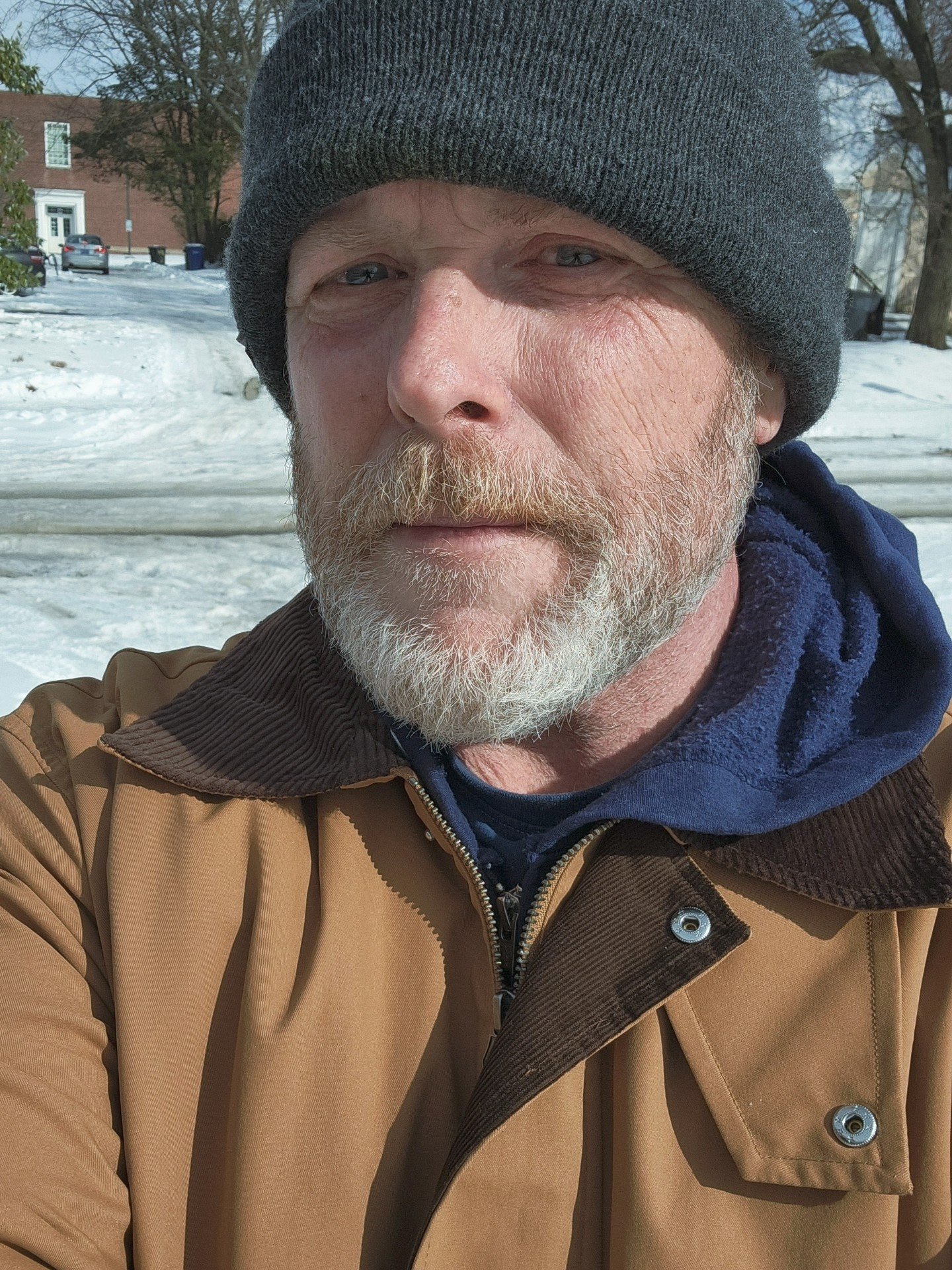
Photo of Frank Reardon
BIO: Frank Reardon was born in 1974 in Boston, Massachusetts, and currently lives in Lexington, KY. He’s published short stories and poetry in many reviews, journals, and online zines such as STAND; TOUGH; STARLITE PULP; ENCLAVE; COWBOY JAMBOREE; BULL FICTON, etc. He published five collections of poetry with Punk Hostage, Blue Horse, and NeoPoesis. Frank is currently working on a nonfiction column for both Hobart and BULL, writing more short fiction, and will have a short story collection completed later in 2026.