carnations, thrice
by Shrutidhora P Mohor
Carnations, she mumbles.
I bring the best that I can find. Light yellow and light pink.
Their fragrance is stifled as I enter. Injection fluids, antiseptic water bowls, used cotton balls, just washed pillow covers, half-consumed boiled rice with boiled potatoes, a dash of ghee. All of these get the better of the carnations.
I sigh, she smiles vaguely.
The attendant takes away the bouquet from me and shoves it into a vase at one corner. I wonder if she can see the flowers from where she is. Immobile without assistance.
Piku is twenty-nine, baby face, but handsome physique, three live-ins old.
We attempt a joke. Our forced laughter collides and crawls away to the corners of the large L-shaped room.
I ask him, how his work is going. His eyes shine with enthusiasm. This time his protagonist is an Egyptian woman, Doaa, he declares, with pride, with affection, the way creators nurture their creations. I ask him how his last novel has done in the market. “Oh, The Blue Bazaar is a bestseller!” His cheeks turn red in satisfaction. I share his joy although graphic novels are not my thing. All this time, she sits still, motionless. Her eyes show no sign of understanding or recognition. Piku’s success as a graphic novelist began after her first biopsy report came. She got no chance to celebrate her son’s dreams being realised.
Piku gets up to take a call.
I focus on her face. The face of an outsider. A terminally ill patient is always an outsider to everything. Somewhere we have already started planning how to renovate her bedroom upstairs, how to fumigate the toilets, how to redo this room once she is gone. She has passed while she is still present, she is in the past as we secure the present.
Thirty-six summers ago, she and I, besties as Piku’s generation calls us, had been to Turkey. Old-fashioned parents and grandparents coaxed, neighbours ignored, ‘they are too young to travel alone’ brushed aside, giggles, squeals, panics, last minute rushes, more giggles, fancying pilots as boyfriends, aping airhostess hairstyles, a suitcase full of forbidden dresses, pencil heels which give way the first thing on the trip, that was us, at eighteen, a whole gulp of freedom, a fortnight of dizzy swirl, tizzy whirl, sleazy Turkey, flopping down to a hidden part of our memory banks as we settled into domesticated lives just as outgrown, old clothes slink behind everything in the wardrobe.
There, one evening, after our hot air balloon ride, our adrenaline running high, we spotted a flower seller at the crossing of the busy market. I was trying out polka dotted bandanas. She tugged at my arm. I followed her eyes to the opposite side of the road.
“Roses. Carnations. Tulips. Fresh, fresh. Good smell.” The seller, a young man, his nose sharp as a beak, his cheeks a faint green, unshaven, saw us, and tried to draw us towards his bouquets. “Come, you Miss, come, fresh flowers, good smell.”
Rushed and excited for no definite reason, we pushed each other. “He is calling you. Go!” We took turns in pushing, falling, pulling, laughing, pushing again.
The market was crowded. Souk, they said. Some local festival tomorrow, a senior clothes merchant explained. We nodded and quickly forgot the name of the festival.
“Go! He is calling you!” She gestured explicitly.
“No! You!”
“No! You!”
“You, you, you!”
We were bending forward, clutching our waists in painful, insane laughter when she gave me a loud push and I, about to fall, looked up and saw the flower seller right next to us.
We gasped as his unshaven, green cheeks came before us, within touching distance. I drew my lips in, breathless, and saw out of the corner of my eyes, her open mouth, staring at him.
He looked like a Greek god.
Our thoughts swerved between our conservative, guarded, girls’ school upbringing, measured steps, cautious decisions, conventional choices of eighteen years, and a fleet of unknown experiences lying in the space of a feet or so between him and us.
She muttered something about loving Carnations. I saw him handing over the entire bouquet to her. Then he asked me what I liked. Immensely sweaty, I whispered, “Anything.”
That night, carnations and roses, roses and tulips, tulips and carnations, thorns and petals, buds and leaves, stems and roots, soil and dust, ashes and mud, bees and bee stings, cuts and bruises, bumps and dips, thrusts and jerks, chrome yellows and chromosomes kept both of us awake. Three of us, actually. Besties, she and I, we shared everything.
In the early hours of dawn, as the first slither of a pale yellow crept through the horizon, I fell asleep. Just before closing my eyes, I saw her, covered in carnations on the bed, on the pillow, in her hair, sleeping peacefully.
The flower man was gone.
On the wide sofa today at her home, she is sleeping as fulfilled as on that night.
Months later, Piku has converted the ground floor into a homely café. Café and bistro. A plaque outside says, ‘That Red House’. I step inside. Mellow yellow lights crisscross the L-shaped room. My eyes fall on the centre of the room where she sat the last time I saw her and she spoke to me. I picture her broad structure, covered in loose outfits typical of a patient whose body no longer belongs to herself, spread out on the single seater in front. Her hands are numb, hanging on either side, her fingers needlessly tapping the air as though in command. I smell injections and fluids, syrups and sedatives next to her on an antique bedside table squeezed in between sofa sets to give place to her inevitable accompaniments.
I am absent-minded as I recall our Turkey secret. Buried forever with her now. I wonder if shared secrets make grief worse.
The vase is still there at the corner.
There are no carnations, of course.
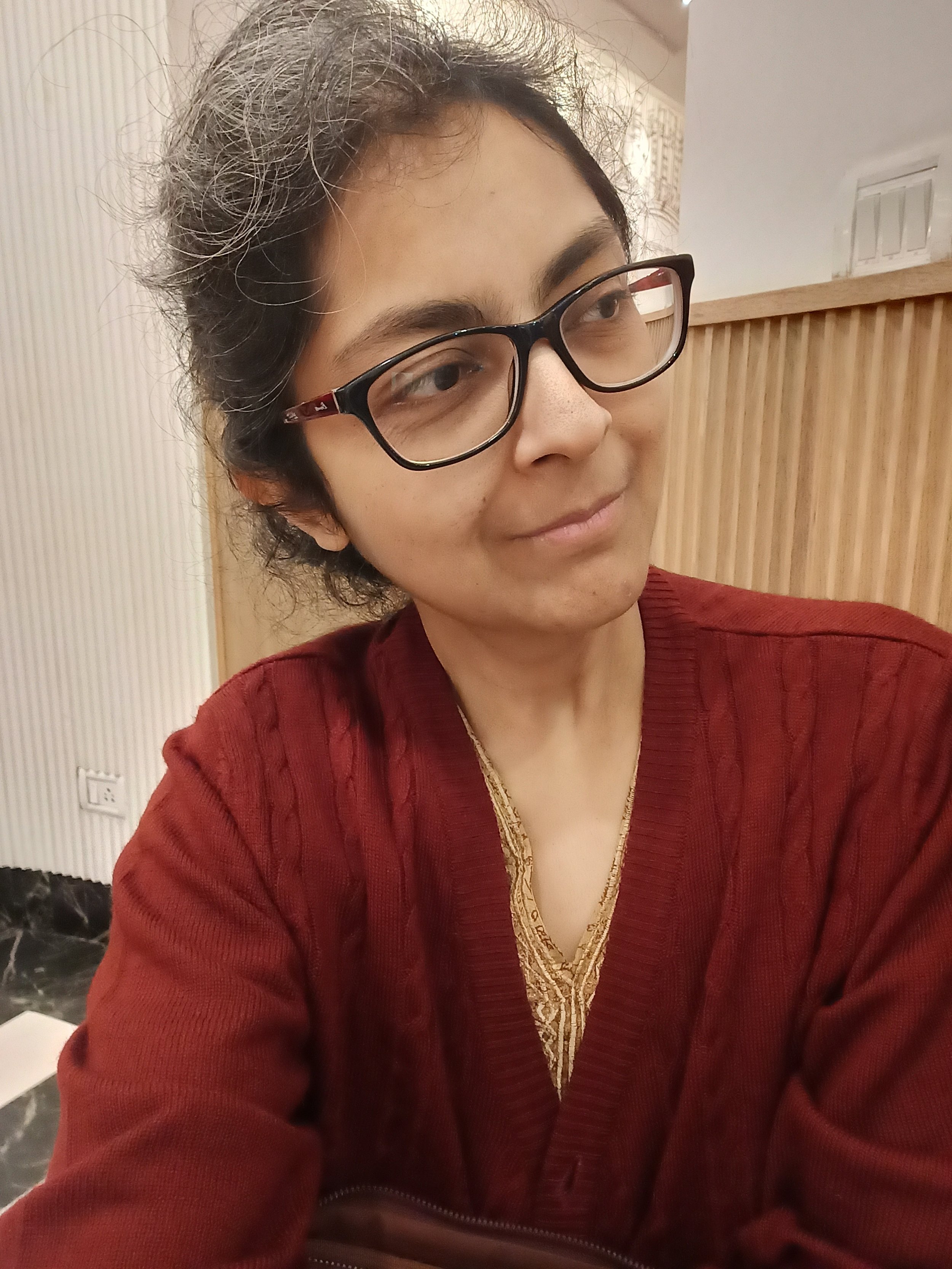
Photo of Shrutidhora P Mohor
BIO: Shrutidhora P Mohor (born 1979, India) has been listed in several competitions like Bristol Short Story Prize, Oxford Flash Fiction Prize, the Bath Flash Fiction Award, the Retreat West competitions, the Winter 2022 Reflex Fiction competition, Flash 500.