by Frederick Schardt
Bright lights in the great light of confusion take place on some frantic and lonely night in Taichung City. The skyline is spectral at night.
Taiwan is the eastern center of the new industrial world order and everything which exists within the sick modern world. All of the world suddenly wants some piece of action, some piece of unmoving meat, and to play the game of cat and mouse with little Taiwan.
The sea hides nothing from money and politics and blood.
There is no hiding and no loving which feels real. Family is merely a game of money and continual appeasement, which nothing can really fill up, as the cup is too large to ever amount to anything satisfying for the awakened individual alone. The children in Taichung city want to roar over the earth like mad lion’s in the nineteen fifties, yet the spirit of the children is just beginning and the space for perpetual movement and swinging is disintegrating—everyone goes and goes—the name of the movement is: GO!
To go is to expand, and to expand is to explode. To throw away your books, to rally in the streets, and find new roots and branches.
Familial satisfaction is the name of the game in Taiwan and nothing ever happens in real society to children in Taiwan without the help of family, but that is the nature of these kinds of happenings, and so the children are left to desert everything in order to carve out a piece of earth for themselves—and so that kind of thing mostly happens underground or in places abroad.
The children are grass without roots.
We are satisfied for a moment, then we cry, then we shout, then we drink, and then we no longer think. The bells ring under the surface of this little piece of earth and so the people sweat, beginning to think of death and lonesomeness, and their own spiritual unbecomings.
We are the marvels of music making
—music-maker—dream-maker—love-maker
We want the experience of marvels
Hopeless except for the act of LOVE.
A marvel of dancing, eating, drinking, playing the fool for the sake of entertaining women happen up and down, time and time again, and so a good natured and good looking fellow named Ash begins to play the violin for the parade of madness.
The tune he plays is called Summer Music for Sex
Sex takes place and drugs take place and money takes place. Everything is cyclical. There is no way out of the crime infested air. The muck and grime has reached the core of every being, and here there is a boy named Ash who wants no part of these happenings anymore. The boy wants to take to the stand to believe in LOVE.
A careful illusion takes place in Taichung City one night and all of the performers stop their playing—everyone goes home to the sweat of their unsatisfaction. The bridge of the underground world is suddenly closed and cold. The show has ended and the performers are left without satisfaction, and the showgoers go on looking for more highs. No one really wants to go home, so everyone spreads to the end of their small hidden alcoves of earth in Taichung City, which warms them enough to an eventual satisfaction before they’re left to find the warm coldness in the bed of their rooms, so they eat street food late at night, find a laugh and drink, and eventually take to a helpless sleep.
The green earth ripples and the sea continues to storm.
A boy named Ash is looking for something different, out of the way of the usual kind of things he’s come to accept. He wants a way OUT, once and for all, and that means for good. A spectrum of ash reaches the winds of the city, from top to bottom. Everything scatters and soon there is no way out of the confusion, everything is happening quickly and silently, madly enough for a prophet to go insane.
The way is LOVE. The body is LOVE. The answer is LOVE.
Who knows where to go to find this ephemeral seeming thing. One reads the Gnostics for these kind of far seeming answers. Jesus spoke of Love, but what is Love and how does one recover it in this kind of place and space the mind now preoccupies itself with?
Ash ripples on top of a skyscraper and pours lukewarm chocolate milk down his throat while smoking a sad cigarette in vain. He goes to where no one goes to cleanse himself of his own becoming, but it is not his becoming, as he was born in what this is and what he has become, but it is his choice nonetheless to see it all as a problem, and something which he must change for himself alone.
Ash sits atop the skyscraper he climbed after a night of another performance, found himself there, deserting women, friends, drugs, and every other form of unclean satisfaction. Alone he sat, muddled and feeling unclean, yet cold and righteous in his actions to come.
There is a silent repose in the midst of the fogged night while gleaming one last gleam before he jumps into the abyss of the quiet streaming air of the city. The air of unsatisfaction speaks once more—speaks to song—sleeping, fucking, eating, drinking, and drugging. The boy does not care and wants to continue on to another plane of existence, one he does not know yet, and one which will always remain a quiet mystery. And so Ash storms in a quietly mad and sad mind toward the action of death.
There is death and there is little to say. There is birth and there is much to say. There is language and no sounds come.
Life is mute, or we are deaf, someone said that a while ago.
No one really knows the causes of these sort of things, so they sit there in silence contemplating everything all at once, trying to at once, but it is too much to bear, so they drink the pleasures of chocolate milk and smoke cigarettes, giving themselves no room to think save for the fact of their over joyous pleasures and little nothings.
Ash sits atop the skyscraper facing the vast expansive view of Taichung City. There were many times he sat and looked at this view of the city, but now he knows this is the last time, and that yesteryear is forever and more.
He wants to cry, but cannot, so he sits in the innocence of the windy night and smiles one more gleaming smile—smiling at sun and moon—smiling at mother and father—smiling at everything!
The smile dissipates and the despair sets in quietly. Everything is still and it almost feels cold.
Ash prepares himself to jump off the skyscraper in the coldness of his heart, and so he will do. He drinks the rest of the chocolate milk and finishes off his last cigarette. Everything is finished.
He takes one last deep look into the city of Taichung and stares darkly into the great lights, which culminates a deep forming of memory, love, sorrow, excitement, and the so forth. The boy has made his decision and it is time to go off.
Ash jumps ahead toward eternity, thinking he is ending his life, but instead he falls onto the edge of some balcony a few stories below. He is stuck with broken bones, most especially in his back. He calls his mother and the police become involved quickly. They pick him up and take him to the hospital where he takes to treatment for his back and sinews of his spine. He’ll forever need treatment for this kind of thing. And he’ll never be the same in the eyes of anyone, most especially to the eyes of himself and his family.
And in the end he’ll find a continual use of drugs and an eventual gnostic sobriety—sabbatical of truth. This is where he’ll make peace with the entire consciousness of what he feels to be his broken life and broken heart.
The boy soon finds a longing for spiritual mysticism in the unknown wisdom of forgotten texts, bells chiming, and women weeping below the stage of another soon to be conformity—a kind of conformity that changes with the way of the ‘cool’.
Jesus? Is that you Jesus?
He met Carl Jung one night and purged everything out of the continual satisfaction he had been experiencing, and that turned into a sort of ritualistic sense of living, despairing and meandering, but nonetheless his own way of being, which was away from the others who knew him to be a cold performer on the stage, and this took him long away from the women who creeped into his dreams through ghastly tails of nightly frights.
The boy burned.
But they don’t seem to understand
- ASH
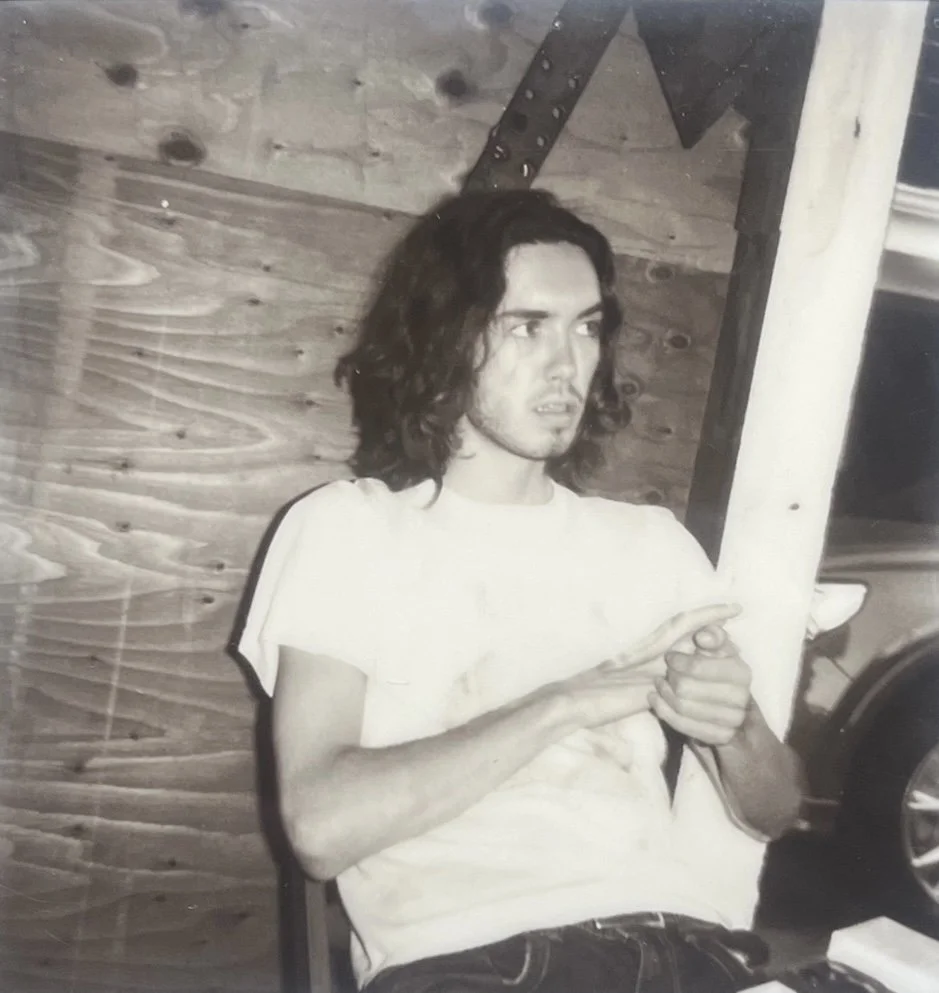
Photo of Frederick Schardt
BIO: Frederick Schardt is a writer and poet from North Carolina. He studied Comparative Literature and Philosophy at the University of St Andrews in Scotland and now lives in Los Angeles. His work has appeared in The Closed Eye Open.