book review: take it personally by claire hopple
by Christie Chapman
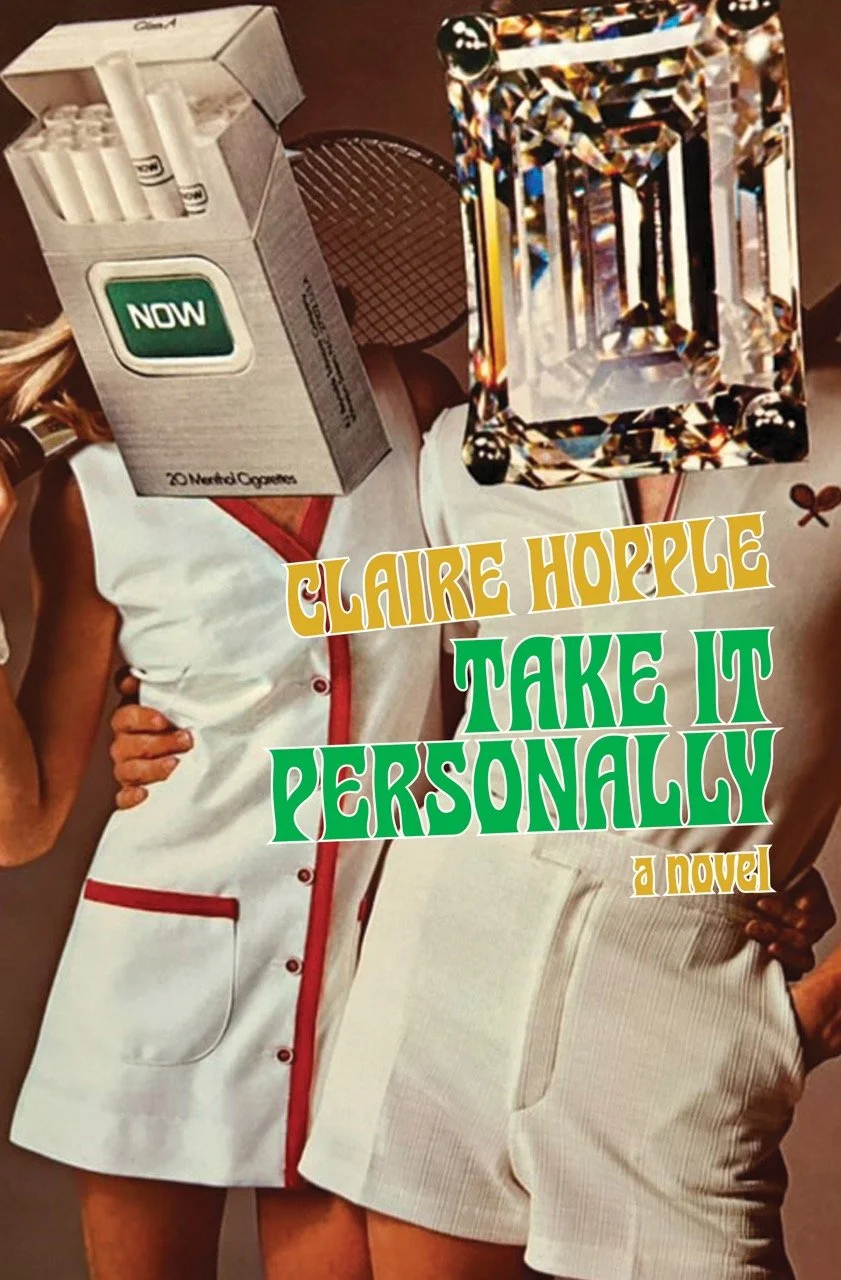
Take It Personally by Claire Hopple
Stalking Horse Press / February 2025 / 124 pp
How to adequately convey the oddball charms of Take It Personally, the first novel—and sixth book, each from a different indie publisher—by Claire Hopple?
For starters, there’s her signature brain-tickling compaction. Crow Jonah Norlander, co-founder of HAD, an online lit mag with such a cult following among writers I know that we will set our alarms to 4 a.m. for the privilege of submitting to one of their sporadic calls, wrote in a Goodreads review of Hopple’s work: “Each sentence is doing at least four different things, and yet I’m completely untaxed by detangling them, and am rather energized by the effort.”
Bonkers are the shenanigans and hijinks contained within. Think Wes Anderson scenes described by Amy Hempel; or Waiting for Godot but with Enid and Becky from Ghost World. Writer Kevin Maloney gets it, proclaiming in a back-cover blurb: “Claire Hopple writes like she’s planning a bank robbery on acid, only the bank is a hot-air balloon, and there’s no such thing as money.”
Did I mention the novel is only about 21,000 words long?
It feels almost beside the point to describe the plot of Take It Personally, in part because the characters seem to have adopted that very perspective. Particularly our protagonist, Tori. The novel’s broad outlines are laid out in the first paragraph: “Unbeknownst to everyone, I am hired to follow a famous diarist.” Immediately afterward, we find this standalone sentence, floating blissfully free from context or elaboration: “Most days I follow her around a manmade lake named after a colonizer.” We never find out who that colonizer is, and we don’t need to. It’s that kind of book—the kind that makes you think 1) “You can do that in a book?” and then 2) “Why don’t more people do that in books?”
From the get-go, we’re set up for a whimsical tale of amusingly low-stakes espionage. But soon, the scenery (if not the tenor) of Tori’s days shifts: It’s time for her to go on tour with her band. A band that hasn’t yet been introduced, nor did we previously have any inkling she could carry a tune. “That’s right, I’m the lead singer of Rhonda & the Sandwich Artists. You’ve probably heard of us.” Tori explains this inconvenient rock-band-tour situation to her anonymous employers, and the whole spy-on-the-famous-diarist gig is put on pause with no repercussions (in case you wondered how truly low-stakes her assignment is).
Such a pivot would likely have members of a traditional writing workshop apoplectic, sputtering: “You can’t do that!” Ah, but Hopple does. With aplomb. At a recent literary event where I had the pleasure of hearing Hopple read her work, an audience member asked what the heck people in writing groups had to say about her style, and Hopple said she doesn’t really do those. This could be for the best; a strong flavor of idiosyncratic purity can get diluted when a committee gets involved. Plenty of us are more than willing to go along with Tori/Hopple for the joyride. The unpredictability is part of the thrill.
That said, what made me devour the book in less than two days, even amid busy-mom life, was the guffaw-inducing voice of the writing, the tossed-off absurdities and asides that can only be written by a writer who is clearly amusing herself. In an interview with Four Way Review, Hopple said: “I think humor should be about amusing yourself first and foremost. If other people ‘get it,’ then that’s a bonus, and it means you’re automatically friends." An example, about a member of Tori’s band, while they’re on tour: “Reggie keeps trying to initiate a food fight. He’s working too hard. It all feels contrived.” (I don’t think it’s a huge spoiler to say Reggie finally gets his food fight, then instantly waxes nostalgic about the memories the food fight has instilled in its participants; he has to sleep in a shed apart from the band to “come down” from the experience.)
There’s a comedian who shares the stage with Tori’s band; he carries a boombox around and hits “Play” on a tape of a laugh track after every joke. Tori rummages in a garage while feeling low “... until I find a bifurcated red ribbon with ‘A+ Reader’ in gold script. I tape it to my chest for the rest of the day. Negative feedback won’t stand in my way, and neither will any required reading. A plus.” There’s her getaway after a disastrous confrontation at a neighborhood gathering: “I escape on an empty pedal tavern abandoned in the cul-de-sac, which makes for a furiously slow getaway.”
And there’s this, which comes apropos of not much, and puts me in mind of a more upbeat Holden Caulfield: “I’m not trying to sound ambitious or anything, but someday I’d like to star in a movie ‘as herself.’ Big Scott seems like the guy to get me there.” Big Scott, incidentally, is at this point a just-introduced figure about whom all we know is that he’s embroiled in drama related to a Possum Festival.
But as the saying goes about a stopped clock being right twice a day—when a writer has this many chuckle-out-loud bon mots sprinkled through her book, at least a few are bound to also be profound. How about this one, which comes at the end of a chapter in which Tori has been talking about her amateur scream-therapy sessions: “We’re all the sum of what we do or don’t do with the stuff screams are made of, I tell her between bellows.” Or this one, about trying to repair her reputation within the band: “If you volunteer for things long enough with this crowd you can erase some of your more unforgivable acts.”
Another reason to read Take It Personally and others from Hopple’s oeuvre is her gleefully indie ethos. In interviews, talking about going with a different independent publisher for each of her six books, she speaks in speed-dating terms, excited to see what each small press has to offer. On the novel’s cover you’ll find an image that fits the book like a glove despite having no literal relevance to anything in it; it’s a collage by Hopple herself, using a page from a 1970s sewing catalog. In this pressure-cooker world, where so many seem to be chasing after the top dogs, the glitz and clout, the Big Five, the “template for success”—Take It Personally, in its unbothered originality, is refreshing. “A+.”
Photo of Christie Chapman
BIO: Christie Chapman is a three-time participant of the George Washington University English Department’s Jenny McKean Moore Community Workshops, in creative nonfiction and fiction. Her work has been published by The Lascaux Review, The Good Men Project, Washington Writers’ Publishing House, Ghost Parachute, and Blood+Honey, and was nominated for the Best Microfiction anthology. She lives in the Washington, DC area with her husband and daughter.