a shapeshifter’s confessions: a book review of ‘is this my final form’ by amy gerstler
by Hugh Blanton
Amy Gerstler's fourteenth book of poetry shares the wisdom of an aging hippie and a humane sympathy for today's wayward youth. She takes turns both comic and tragic into surrealism, her imagination is sprightly and devious—and too quirky by half. There are enough elegies and apostrophes to the departed to make the reader think Gerstler has a Dickensonian obsession with death, but her obsessions really lie in capitalism and the patriarchy. Gerstler comes from a generation not doomed or damned, and to her credit she doesn't act the part—she in fact fears for the generation today, growing up in the screens of their smartphones. The showpiece in Is This My Final Form? is not a poem at all, but a ten-minute Shakespearean tragicomic play.
When Gerstler says her ideal woman is the bride of Frankenstein, it's difficult to tell if she means the character or the actress (Elsa Lanchester). Gerstler is captivated by the bride's swan-like screams, and has romantic fantasies about her: "On stormy nights our bed/ would become an elevator, ascending the floors/ of a blackened castle, bursting clear through/ the roof, penetrating an electric sky." Most of the poems in this collection are like this, prosey and often non-poetic, even though at times she tries to sneak in a rhyme or two: "Rain for a week. Atmospheric river, they say./ The dog nuzzles your hand. You haven't spoken today." (She may have been channeling Dickinson there, too.)
Like Frederick Seidel, Gerstler writes of her Jewishness, but you could say that Gerstler is the anti-Seidel: "What/ did I know of pogroms, Russian winters, forced/ immigration, of the value of fat, its anti-/ starvation richness." She's speaking of schmaltz here; the chicken fat drippings that were used to make calorie dense sandwiches. When her friend texts her "schmaltz alert" to warn her of an incoming twee text message, she automatically thinks of "that gross noble sandwich." (I don't want to think about how Seidel would commemorate a slimy schmaltz sandwich in one of his poems.) Gerstler finishes the poem up: "we both come from Russian Jews who fled first/ to Europe, where they perfected that sandwich/ as well as an ability to simultaneously mock/ and embrace the excessively sentimental."
Poets love to write about themselves, for many they are their own favorite topic. Not that Gerstler doesn't write about herself too, but she takes abundant notice of the people, places, and things around her as well. From her poem "the meek":
They sit apart at parties, wilting
like neglected houseplants. Their music
is easily confused with white noise.
When the booze runs out, none
of them has the nerve to shoulder
into his coat and hike to a nearby
liquor store.
(You don't have to go any further than the table of contents to see her capitalization is whimsical.)
A reader may get the idea that Gerstler loves to write about women behaving badly (there's even a Mae West sonnet in here), but she says what she's really writing about is women behaving boldly. She writes a long prose poem about her friend Mari who has flown off to Mexico and believes in UFOs. "She wants to be called Marigold now, to leave her sad past/ behind and bask in the mysteries of sex and drugs/ and panhandling and side hustles and is that really so bad?" Gerstler goes on to say that that indeed does seem bad, but that she, too, was a hot mess in her twenties. Gerstler was born in 1956, she would have come into adulthood around the time the Vietnam war protests were winding down and the hippies were looking for something else to protest about. (Their candidate won the election in 1976 and their protesting days were over.) Gerstler answers the hypothetical question "What were you fools trying to do back then?": "Hell if I know. Lay bare/ our exceptional animal talents? Drown in the stickyfinger jizz/ of the sixties?...Infinite alternatives were blowin' in the wind."
If Gerstler was a terror in her twenties, she's mellowed out all these decades later and in fact offers a litany of apologies for all the wrongs she may or may not have perpetrated. In "Leniency Letter" she apologizes "for my body and its bloat, for my wadded up mind,/ for getting drunk in my underwear so many times." (Nice little subtle rhyme there!) She apologizes finally "for populating my ark, as floodwaters/ rose, turbid as a dry martini, solely with animals/ I found sexually attractive, then allowing the mouths/ of some to rust shut...Are we square now? Can I go?" Poet Matthew Zapruder says reading Gerstler's poems makes him feel the pleasures and pains of being an imperfect being in this imperfect world—and that Is This My Final Form? might be her best book yet. (I think her collection Bitter Angel was stronger, as did the National Book Critics Circle.)
Like Whitman, Gerstler contains multitudes: "Tonight, your mind's shy/ as an otter drying a saint's feet with her fur./ Is the dilemma not having a self, or possessing/ too many? Some scrappy as cats in a bag,/ others melting like drugstore chocolates,/ plus selves who invade you by mistake, as though/ they hopped on the wrong bus after midnight." The otter and the saint here is a unique use of metaphor to be sure, and the scrappy cats are her youth—which comes up often throughout the collection—trying to reassert itself. Poets, as they age, will wonder if they've become a dull ghost of their younger poet who used to breathe fire. (It's often the case.) Gerstler's National Book Critics Circle Award came thirty-five years ago and while she sometimes seems wistful looking back, it's plain to see she has definitely not lost her fire. All of these multitudes inside her seem to be keeping it stoked.
The low point in Final Form is a sonnet sequence titled, what else?, "Fourteen Sonnets." One might think we are getting a crown of sonnets here, but we aren't. Gerstler doesn't follow the redoublé schema of last line/first line repetition as if her rebellious hippie is saying, "I can't play by your rules man!" These are also the most opaque poems in the book, the meaning of some of them as elusive as an Antioquia Brushfinch. A few of the sonnets could be beaten on for a year and not become any less opaque. In places she gives us rhymes that seem like they came straight out of hip hop:
find other ways to investigate her breasts
slobber on her dress
force the river to say yes
sip her residual fertility at your desk
The poems throughout the collection shift form, they have a wide range from elegies to satire, but none as bewildering as the sonnet sequence.
Back in April of 2021 Gerstler said in an interview with Dinah Lenney in the Los Angeles Review of Books that she doesn't consider herself political in any overt way, overt being the operative word here. She refers to the "hopefully outgoing government" in one of her many plague poems, not wanting to mention Donald Trump by name (Auden always left his political poems comfortable with ambiguity, but there was a war on). At age sixty-nine, Gerstler is not becoming repetitive, or worse, an imitation of herself. Maybe she'll follow John Ashbery into scribbling poems into her eighties. Hopefully without the faddish plague poems, though.
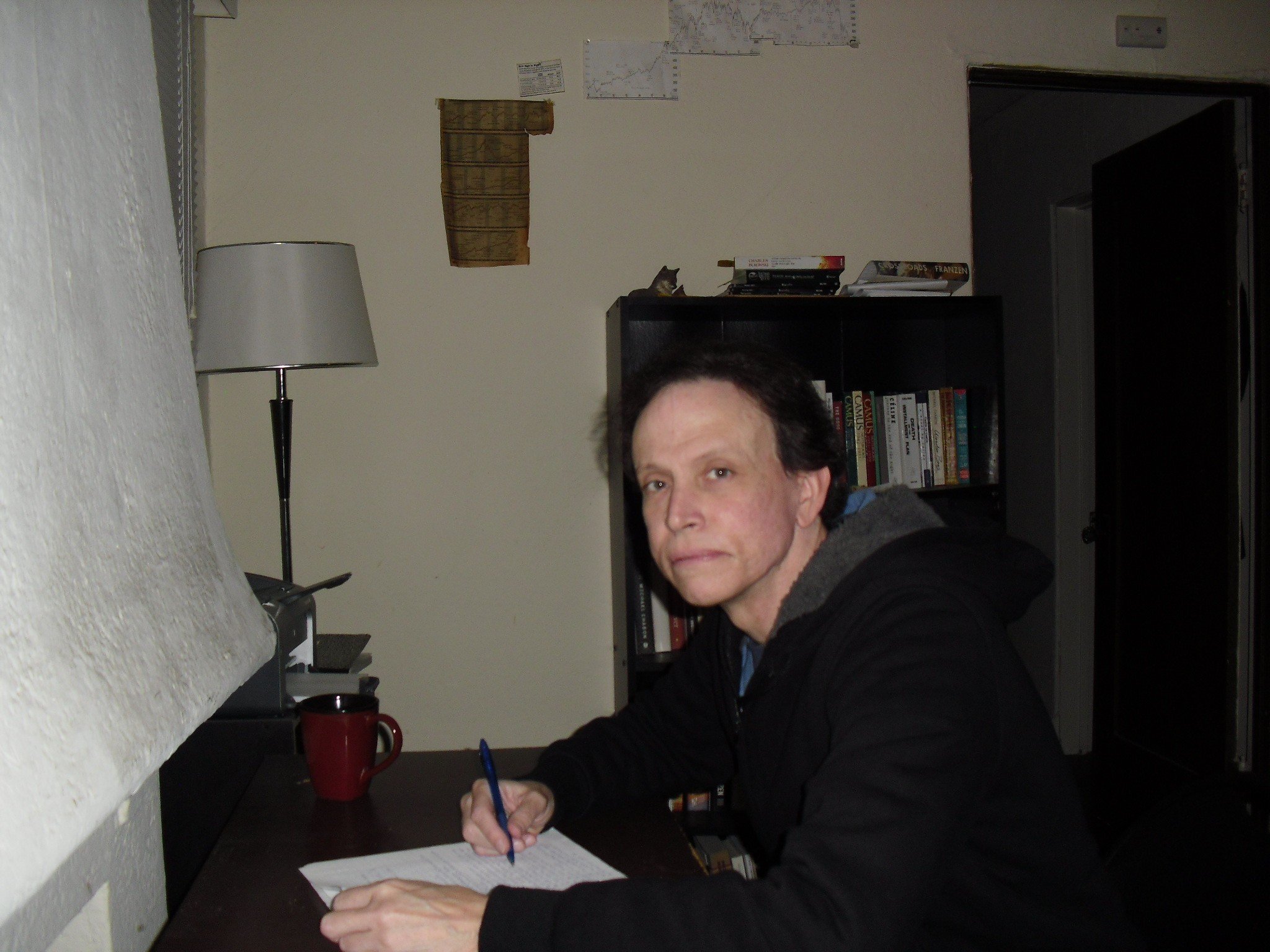
Photo of Hugh Blanton
BIO: Hugh Blanton's latest book is The Pudneys. He can be reached on X @HughBlanton5.