the five man band
by Gail Andromeda Vanhart
On Halloween of 2006, instead of being out trick-or-treating, I was sitting in a hospital waiting room with my grandmother, playing with wooden toys while my mother gave birth to my brother. At only four years old, I didn’t really understand what was happening. I’d been told, of course, that I would have a new sibling soon, but I didn’t know what that meant for me beyond my room being repainted to more gender-neutral colors and crowded with a crib I couldn’t use. So I just sat there, bored and lamenting all the candy I wasn’t getting, for what I thought was entirely too long.
When the time had finally come to meet my brother, my grandmother walked me to the door of my mother’s hospital room, and from outside I heard my brother cry for the first time. Did it finally sink in that I was a sister, that he was a real person who would forever be a part of my life? Did I appreciate how incredible this was?
No.
Instead, I turned to my grandmother, and I asked her, “Why is he crying, isn’t he happy to be alive?”
Thus began my relationship to my brother.
In the typical five-man band structure, The Heart is the glue that holds everyone together. Everyone’s best friend, the healer, the emotional support. These are all inaccurate terms to describe my brother – one of many problem children my parents managed to produce – but they are accurate ways to describe his role in the family structure. My brother is the baby of the family, the only one still living with and relying on my parents. My mother once told me she only stayed with my father for the sake of us kids. An inevitably doomed relationship she clings to so that we can have two parents rather than one. When my brother leaves, or rather if he leaves, what’s left of that foundation will crumble.
It would be pretty entertaining to watch.
True to the stereotype, the baby of the family can do no wrong. When I failed to turn in even a single assignment, my parents would hound me about it for weeks. He failed nearly all of his classes before my parents even noticed he wasn’t doing homework. It took me an extra year to get my driver’s license, and the entire time my parents complained about how inconvenient it was to drive me everywhere, reminded me nearly every day to practice. Last I heard, my brother hadn’t been behind the wheel a single time despite being 18. My mother once implied it was my fault he might not graduate high school - my fault for not talking to her after she disowned me, even though he was already struggling in school long before that.
He has always been allowed to do and be whatever he pleases. The rest of us were never extended that same courtesy.
*****
The youngest of my older half-brothers is the one I remember best, and the only sibling I wish I had never met. He was only a part of my life for a year, when he came to live with us while I was 8 and his mother was in rehab. I think that’s where she was, at least. Nobody ever told me. My memories of him are scattered – him making fun of my attempts to learn to shuffle a card deck until I cried. Him hitting me and knocking out one of my loose teeth. And what I remember clearest: Him looming over me, backing me into a corner, asking me questions I don’t know the answers to. Pressuring me to do things I don’t know how to do. My parents were home. My door was open. Those are the only things that stopped him from pushing as far as he wanted to. Too scared to risk getting caught.
My walls were painted yellow. I put a chair in that corner because I thought it would make a cute reading spot. I don’t think I ever sat in it again.
The Tough Guy is a role defined almost entirely by its consistency. They’re never the most powerful or valiant of the group, but they are never slowed down, never struggling. My worst brother isn’t tough, or strong in any capacity, but he is nothing if not consistent. Since he lived with me, I haven’t seen him at all, but the families coming through the family grapevine have always been the same. He screws up, he does something we all agree is morally wrong, everyone is mad about it for a while, and then we move on like it never happened. Even the things we say about him are consistent. He’s had such a hard life, can you blame him? It’s all he knows. It’s not his fault. He didn’t know any better.
The rest of us have had hard lives, too, but that never seems to matter. The broken record is choosy, and it’s been repeating for him since minute one.
I never fully processed what he did to me until I was older, when that repressed memory floated to the surface and wrecked my life for weeks. I entertained the idea of telling my parents, of finally doing something about it, until I overheard my father on the phone with him, talking about how he was doing in rehab.
I want to be empathetic. I want to be able to say I feel sorry for him. I know addiction runs in our family – in both sides of his – I know this particular mess isn’t his fault. But it doesn’t matter. He was awful before the drugs, too. It’s just another thing everyone can point to when they excuse his actions. So, I never told them what he did. It wouldn’t have mattered if I did. It would be buried under the usual phrases – he had a hard life, he was too young to know any better, he’s having trouble right now and I need to forgive him. His intentions matter more than his impact, his well-being matters more than mine. It doesn’t matter what it meant to me.
When I told my therapist the story, she asked me how I felt about it. In the moment, it was all horror and nausea. Now, the nausea still lingers, but more than anything else I’m just tired. Tired of living with the memory, tired of hearing variations on the same story from almost every woman alive, tired of all the small things that remind me of it day to day. Tired of the consistent ache he left behind.
I curse my father’s strong genetics for giving me my father’s face, my brother’s face. My brother had long hair when he lived with us. For years I kept mine short, so I wouldn’t look like him. I hid myself in baggy, unfitting clothes in the hopes nobody would ever look at me like that again. His features still follow me everywhere, and they always will. On my best days, I look in a mirror and see myself. On my worst, I end up curled up on a bathroom floor waiting for my stomach to settle. I fantasize about shattering the mirror, but I’ve never been able to be destructive on purpose.
My therapist said she was proud of me. It’s the same thing she said about my gender, my sexuality, my name, my stability. Always so proud that I made so much progress by myself, that I can say the self-hatred and fear are past tense. I’m glad she’s proud.
I’m tired of it needing to be said.
*****
I remember only pieces of my oldest half-brother. I popped a balloon we were playing with once, and he told me it was fine. He changed his name. He had a sister I don’t think I ever spoke to, who I wasn’t related to at all. His side of the family hated mine, and by the time I was five they gave up trying to interact at all, and I didn’t see him again. He became a face I saw in photos sometimes, and a person I only heard about thirdhand. Supposedly, he was something of a jerk in high school. I have my doubts.
When he graduated college, he cut off contact with the family and vanished from my radar forever. Which is a shame, because he’s the only one of my siblings I want to talk to.
The Smart Guy is often the same as the guy in the chair, a non-combative character whose role is to set up dominoes for the rest of the cast to knock down. They come up with the ideas and the plans and receive the most disrespect from the team. Labelling my oldest brother as The Smart Guy is based on very little evidence. He has an accounting degree, and he’s smart enough to get away from the mess. But that very little evidence is all I have, and if there’s anything that makes a person worthy of the title, its being the first to escape the sinking ship. The cycle persists because we all cling to familial connection as if it, alone, will be able to make everything okay. He chose to let go.
I know absolutely nothing about his personality. I doubt I ever will. But I respect him for leaving, and I try to be optimistic enough to believe he’s a good person.
*****
In my earliest memory of my sister, she is 11 years old, and we are playing with dolls together. She outgrows dolls only a year later, and we rarely share common interests again. It’s one of the side effects of being far enough apart in age to always be hitting entirely different milestones. She told me what to do, how to play - it always had to be her way. She played with my favorite doll, dictated a story entirely different than what I wanted to play out, and I kept trying to interrupt her, kept getting frustrated and telling her to play my way instead. Until, eventually, I snapped at her and yelled that I hated her.
My mother pulled me into the other room as soon as she heard, and told me I should never, ever say that. She told me it was a very mean thing to say, and that I should only say it if I really, really meant it. When I told her I did mean it, she told me I couldn’t.
Not about my sister.
The Leader is a fairly straightforward role. They’re the charismatic one who makes all the decisions, the one who sets a standard for the rest of the group. They are, as a result, also the most likely to crumble under the pressure. My sister was born with an unfortunate condition called Eldest Daughter Syndrome, which handily slots her into the leader position. Being the first daughter means being treated as a third parent. Take care of the younger siblings, set an example for them to aspire to; classic, easy to handle pressures that no child has ever suffered negative consequences from. You have to be the epitome of what a person should be. My mother’s expectations of what a person should be were focused on herself. For my sister, being what a person should be meant being exactly like my mother.
Maybe that’s why she started smoking.
My mother’s side of the family is filled with smokers, which had the side effect of convincing the rest of us to never touch a cigarette in our lives. This should have been easier for my sister. She was born far too premature and warned by every doctor she crossed paths with that her lungs would never be as good as they should be, and that she should never, ever, ever smoke. But being a copy of my mother means having a quota of bad decisions to make and unhealthy coping mechanisms to display. She followed my mother’s exact path: cope with stress by smoking, ditch classes, sneak alcohol out of your parents’ cabinets, nearly drop out of high school, go to beauty school and become a cosmetologist until you decide on something ‘better,’ and have a messy love life that produces children who will wish you hadn't stayed with him for them.
I don’t know that I ever met my sister. I know she’s there in my memories, but I suppose we never really talked. When I was in high school, my mother sent us on car rides together whenever she could, hoping it would make us talk more. We spent every ride nearly silent, and when we returned home my sister would complain that I don’t talk enough, I don’t hang out with her enough. When my mother asks why, I don’t give her the real answer. Because the real answer is that my sister is playing her role perfectly. She’s exactly like my mother. She never bothered to talk to me, never bothered to learn anything about me. She asks me about school, I ask her about cosmetology, and we go silent. We’re strangers making the same small talk over and over again.
My mother would have hated that answer. So, instead, I just shrugged and said something about not liking her music taste. My sister let me choose the music for the next car ride. She didn’t like my music taste, either.
She was a great artist when I was little, and it was all my parents could talk about. I suppose I envied the attention. I’d sit behind her while she drew, staring over her shoulder, hoping it would be enough for me to learn to be as talented as her. I picked up how to draw books and spent hours copying everything on the pages. I didn’t enjoy the process, and I didn’t enjoy the results. My sister gave up drawing when she got older, but my mother kept talking about how good she used to be, lamenting that she never did anything with it. I took up drawing in my own time, but I guess I never copied her well enough for it to matter.
In hindsight, it makes sense that my mother would disown me for refusing to help her commit tax fraud. My sister would have done it, after all, and I’m supposed to follow her example.
*****
When I was a baby, I kept my parents nearly sleepless for months. When they tried to put me to bed, I would scream through the night, barely pausing for breath. My parents tried everything they could think of, and then tried everything others could suggest, but I persisted in only sleeping when I was too exhausted to scream. Until, one night, I didn’t cry at all. My parents fell asleep so quickly, they didn’t even notice until morning. They panicked as soon as they woke up, thinking something terrible had happened, only to find me sleeping peacefully in my crib, sprawled out on my stomach.
You’re not supposed to let babies sleep on their stomachs. My parents tried to get me to sleep any other way to no avail, but they eventually gave up. If that was the only way I would ever sleep, so be it.
I didn’t die, so… it was probably fine.
It feels self-serving to classify myself as The Lancer, since they’re my favorite, but through the process of elimination and a small degree of accuracy, it’s where I’ve landed. The Lancer is defined by being powerful but reckless. The second-in-command whose hot-headedness causes a nearly endless list of problems, but who is usually willing to help clean up the mess. They play the role of The Leader’s foil, their equal but opposite, complimenting but conflicting with them as much as the story requires. The Lancer is also commonly the fan favorite. I am by no means my family’s favorite, but the rest I can stretch to fit me in some capacity.
Like everyone else in my family, I have anger issues. My fuse is short, and at its end I find myself following the same behavior patterns I always thought I could avoid. I snap at people who have nothing to do with my rage, I slam things closed. When others are around, I try to keep a handle on it. But by myself it all bursts out with nowhere productive to go, and then there I am closing a door on my hand so hard I lose my thumbnail and have to grow a new one. Pinching my fingers in a drawer, opening a car door into my leg, puncturing a can of soda and dousing myself in it. My mother’s voice yells from the other room, “That’s what you get.” The part of me that knows better whispers back: The fact that it’s you doesn’t make it okay. The fact that it’s happening to you doesn’t make it okay.
So, I’m the hot-head, the troublemaker. But more than that, I chose Lancer for myself because it is a role defined by being second place. They are The Leader’s second, and for many fictional Lancers this is a major source of conflict. I’m the second daughter, the second to last child, born on the second of the month, the second to go to college, the second to change their name. The second to cut all contact with the family. Middle children learn early on that they are, at best, a second priority. We learn to thrive in that space, or we simply disappear into it.
If I squint, I am my sister’s foil. We’re both an abusive father’s only daughter, we’re both saddled with a mother who expects us to be her perfect clones, we’re both disappointing our parents in our own special ways. She’s exactly like our mother, I’m exactly like my father. (My mother stopped loving him a long time ago. Maybe it was only a matter of time for me). My sister loves the Midwest too much to ever leave, I hate it too much to ever return. She’s social and fun, I’m antisocial and boring. We are each other’s equal and opposite – going through the same things together, but never the same way. The typical Lancer and Leader pair have a mutual respect for each other. I don’t know that I can say that’s true of me and her.
My mother and my sister had plenty of falling outs. Every time my sister did something my mother thought was stupid, she’d cut my sister off and tell her she was on her own. And, inevitably, my sister would come back with an apology, her life crumbling under her. Money and familial support were my mother’s favorite weapons, and they worked exceptionally well. My sister came back, again and again, and was forgiven on the spot. I’ve seen my mother once since I left, and the best she could do was tell me I’ve lost my empathy.
It’s common for The Lancer to have an arc where they strike off on their own. They argue with the group, they get kicked out, or they just want to prove themselves. This arc always ends with them returning, having learned some valuable lesson along the way. That’s where I hope to differ from my archetype. I don’t intend to go back.
*****
When I was 9, my little brother almost drowned in a lake.
There was a severe drought in Missouri that year, and for our yearly camping trip we did our best to escape the heat by going to a lake. It was much lower than normal, but it still held water, and everybody wanted in on it. Across a shallow section of lake was an island, with a cliff edge perfect for diving. We’d forgotten our life jackets, my brother and I, but my mother opted not to go back for them. She figured we would be fine staying in the shallowest waters.
Neither of us could swim. Him, because he was young enough nobody had tried to teach him yet. Me, because I hated water too much to relax, despite my father’s worst efforts to teach me to float. So, I sat with my feet in the water, digging in the sand and collecting shells while my brother wandered knee-deep in the water. The adults went cliff diving, checking on us as they passed by looping back to the cliff. Each lap, we had at most a minute of alone time.
Turns out, the edge of the island wasn’t a slope. It was an edge, which my brother was lucky enough to find with only one foot. He dropped under the water, but didn’t sink, just got stuck balancing on that edge, gulping down water while he fought to regain his footing. To me, however, he simply disappeared. So, I jumped to my feet, wanting to help, and instead froze in place. I couldn’t swim. I didn’t know I didn’t need to.
A nearby woman went out to get him, instead. She’d been there with her toddler, who she had to sit down and tell to stay put twice before she waded out. They kept trying to follow her. I remember yelling for her to help, begging her, too panicked to notice that she was already trying. But when she finally turned to go get my brother, and her toddler once again tried to wander after her, I had the tiniest bit of clarity and put a hand in front of them, kept them back. She hauled my brother out of the water without any more of my input.
My brother was fine. He drank more lake water than he breathed, and it didn’t even make him sick. I never learned the woman’s name. I can’t remember if my mother thanked her. We went back to the campsite, and everyone moved on as if it had never happened. I worried about him for days afterwards.
My younger brother is the only sibling I can say without complication that I love. He’s the only one I’ve spent a significant portion of my time with, the only one I’ve bickered with as a sibling rather than an adversary. The only one I still think about, now that I’ve been cut out of the family, and hope will turn out okay. I haven’t deleted his number yet. I don’t know if he’ll ever reach out. I don’t know if he’ll ever want to. I don’t know if he’d be on my side. I don’t know who I’d be if he’d drowned in that lake. Having him going through it with me was a crutch I leaned on long before I knew I was doing it.
I call him my family’s Heart. Sometimes I remember that includes me, too.
I was crying when that woman pulled him out of the lake. I don’t think he’s seen me cry since. I don’t know if he remembers me crying then.
That day doesn’t haunt him, anymore. He learned to swim, learned to enjoy the water. Maybe he’s lucky he was so young, maybe the memory didn’t have time to solidify. Maybe it’s just some flickering, faded thing he remembers once in a while but doesn’t dwell on. If you met him now, you’d never know he was afraid of water for years.
Sometimes I’m still there. Standing in the water, watching my family’s Heart drown, wondering where everyone went.
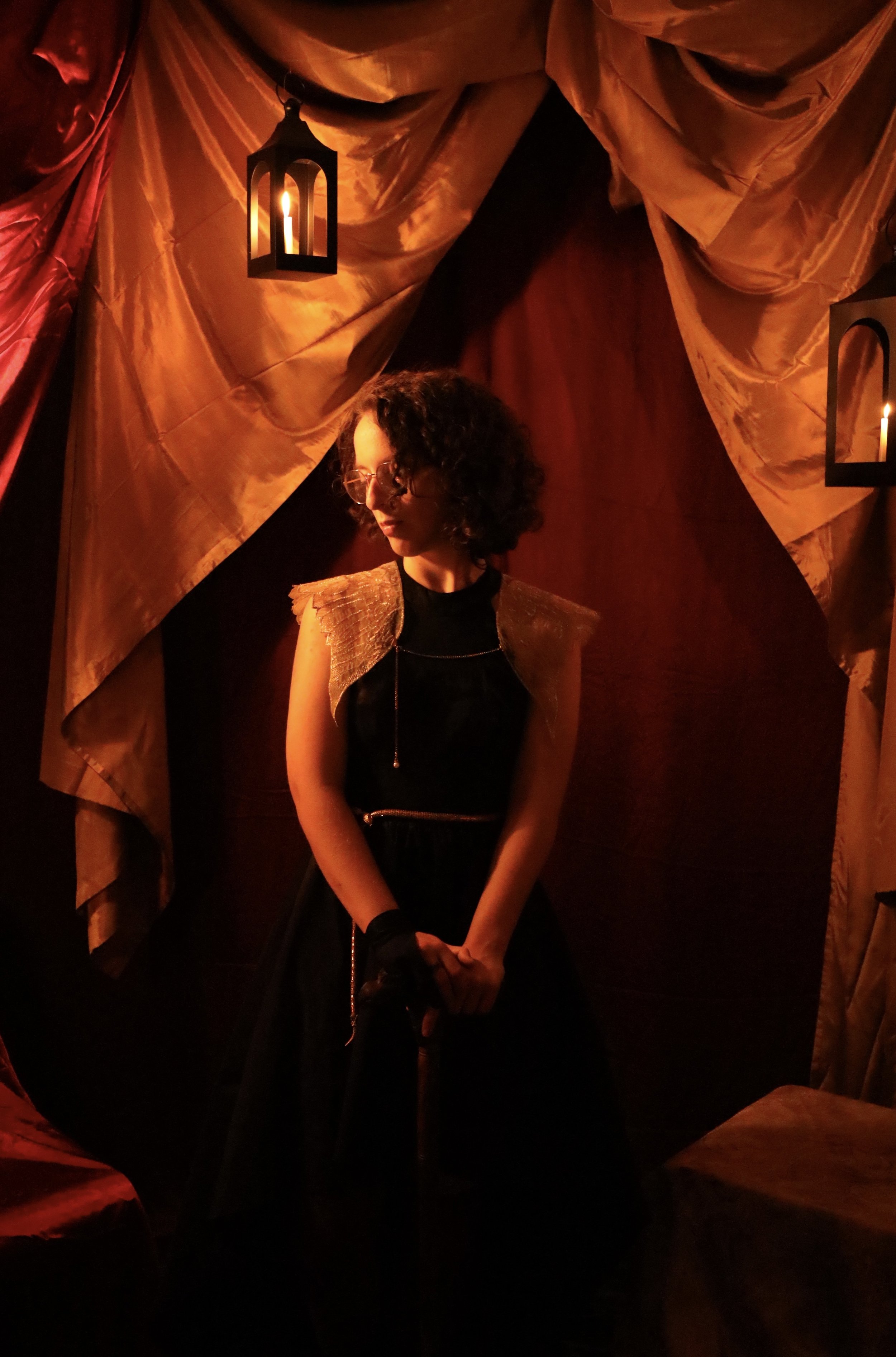
Photo of Gail Andromeda Vanhart
BIO: Gail Andromeda Vanhart is a recent graduate and social worker in Tucson, currently pursuing her masters degree. She writes fantastical, character focused fiction as well as analytical, reflective nonfiction delving into her past. This would be her first published work.