are you okay?
by Holly Carignan
God sometimes takes us into troubled waters not to punish us but to cleanse us – unknown
Sometimes good things fall apart so better things can fall together -- Marilyn Monroe
I miss the house, that job, those men and their tragedy and humor, with a terrible, lonely, agonizing ferocity. Fifteen years ago, I worked at a men’s group home situated in the countryside on the outskirts of Norwich, Connecticut. Located off the turn of a narrow, twisting two-lane road, it housed seven men. An old, thick oak partially obscured the front of the house and shaded a rutted, sparse lawn. The interior was painted an industrial green, the paint old and peeling in the corners. But the sun still leaked through the blinds and glazed it in a sort of untouched, light warmth. I loved that – the feeling that I had been transported to this clean, unsullied land. The yard always smelled of fresh rain. My own home, where I lived alone with three cats, was a cottage house on a dirt-road right-of-way. It sat at the edge of the city of Norwich, on the cusp of the city’s grime, grit, and deterioration. After harsh winters, the snow melt turned that dirt road into a soup of mud and garbage that always seemed to overflow from my neighbor’s trashcans and land onto my yard. My bulkhead door was rusted shut, and mice sometimes crawled into my house through a hole in my floor under the stove. It lacked the lightness of that group home, the feeling that life—no matter how tortured— flourished there, inhabiting a time and a place full of animation and momentum.
The residents of the group home were cast-offs from the long-since-closed Norwich State Psychiatric Hospital, shuttered in 1996. They had schizophrenia, depression, anxiety, substance abuse, bipolar disorder, post-traumatic stress disorder, anything—and everything—that made them unfit to stumble along within the bounds of normal society.
I loved those men, those disheveled urchins who smoked on the house’s cement porch and flicked cigarette butts off the rail day and night, who sometimes told us to go fuck ourselves when we asked them to take their meds, who talked and laughed to themselves and shouted obscenities at the walls and to each other.
One day, a client named Kenny came to the staff office, a small, square room painted a blazing pink, to request another roommate. He scowled and laughed simultaneously. His missing front teeth and the spray of frizzled white hair on the crown of his head gave him the air of a jolly scarecrow. He was often given to long, random fits of infectious laughter. His current roommate had, suddenly, taken to compulsive masturbation. “All he does is whack-a-doo, whack-a-doo, whack-a-doo,” he told us with an accompanying, illustrative jerk of his rolled-up hand.
We “workers” – that’s what the men called us -- were deemed “service coordinators” by the mental health agency for which we worked. We made a barely-living wage, all of us guiding these men through endless days of laundry, cooking, cleaning, appointments, medications – oh, the medications – taken every morning, noon, and night, capsules or oblong tablets or round, flat pills like white, flat earths promising the tamping of symptoms, the relief from suffering, though they caused suffering all their own. Tremors, involuntary jerks and lip-licking, sedation and agitation to the point where we couldn’t find the line, the boundary between ailment and mitigation. We saw ass cracks and bare dicks, cleaned shit smeared on bathroom walls. We all laughed and sighed our exasperations, told our stories.
Not long after Kenny’s request, a worker named Terri had gone upstairs one morning to knock on the door of the whack-a-do guy. He hadn’t come down for his morning meds. He was a gaunt, short man who had a tendency to leer and drool in tandem. She knocked on his door, he said come in, and she entered to find him jerking off with, as she put it, a shit-eating grin. He had timed it perfectly.
“It was, well, it was huge,” she told us, her eyes wide with actual terror, horrified, as if she’d found a shallow grave with a decomposed body in a forest, as if she’d never seen a dick before in her life. Terri was like that -- everything was a crisis.
Another worker, Linda, listened to this story, and popped up out of her chair. Linda was a crusty, older woman with a no-nonsense realism, a woman who knew how to lie, cheat, and steal her way to the top until everyone around realized her subterfuge.
Linda spun on her heel and said, “Oh, no. We won’t have this.” Linda was British. Her accent gave her words a regal finality. I had visited Linda at her house once. She had a parrot and a beagle named Sherlock, and the parrot would call out, in Linda’s accent, ‘Sherlock! I said I said no!’
I followed Linda up the creaky stairs, her steps a thumping, officious march. She threw Whack-a-Do’s door wide open to his grinning face and florid hard-on, told him to put his dick away, wash his hands, and come down for his meds. I hovered at Linda’s back, inches away from her long, lank gray hair. I found it both comical and repulsive, amusing and sad, that this man’s one bargaining chip was his hard-on. He eventually worked his way down – still grinning -- and took his medication.
“Did you wash your hands?” Linda asked. Whack-a-Doo smiled wider but said nothing.
How many degrees of separation were there between those men and me? I was a young woman of about thirty-five when I started working there, prone to my own hiding, wallowing in the black-tar grip of my own anxieties, fears. I had suspicions about my own personal significance. I’m entirely sure I didn’t like myself then, though why my line equation yielded a line with a negative slope, I didn’t know. Depression was, in my family of origin, a scourge. My father once walked in on his mother trying to strangle herself with a phone cord and had to wrest it from her hands. He, in turn, festered daily in a grim, disengaged silence while my mother would scream, cry, curse, and rage at him, at me, my sister, sometimes at no one like a trapped, feral cat. For me, depression came not as crying jags, but as more of a feeling, a sadness that descended at random moments, triggered by random phenomena, nonsense really -- like a specific sapphire opacity of a dusk sky, a certain key strummed on an acoustic guitar, a relentless summer heat, a dirty, yellow lightbulb in a rundown apartment hallway. This nonsense created sudden and unexpected twists of my mood from tranquil to (((lugubrious, pessimistic))), like a gray film had suddenly coated my vision. When calamity hit, when disaster befell me – a loss, a mistake, a failure – I took it as evidence of my worthlessness, like my being was destined for it. I starved myself, cut myself, pulled my hair out. But I also found joy…
I also had what I now know to be attention deficit disorder. My mind was a tempest of anxiety borne of a chronic tendency to forget, to misplace, to misunderstand. I lost things all the time – scraps of paper scrawled with phone numbers, credit cards, tax documents, dollar bills, my phone (so many times, my phone). I was, and still am, the person who tears apart the house, tears the cushions off the couch looking for her sunglasses, only to find they’d been on her head the entire time. I was the kind of person who forgot to pay her electric bill until the power flickered off during an X-Files rerun. Things disappeared and reappeared like they had gone from matter to anti-matter and back again. Shit just turned up. Things had always just seemed to work out.
So many times, I had careened close to the star-heat of near-disaster but had never really gotten singed. I was prone to sneakiness, obfuscation, lying to fit together the pieces of my fragmented life in such a way that I appeared somewhat functional. I impostered my way through my twenties and into my thirties with a sense that I teetered on the edge of an edge of an edge, that I could have stumbled on a pebble and fallen right off that cliff.
My struggles were miniscule, virtually inconsequential, but people noticed. My boss’s boss, the demi-God of the agency, Laurie, had had my number. Laurie, a woman who favored Kate Spade bags and wore unwieldy heels in which she could walk with a practiced grace I couldn’t achieve in sneakers. She was one of those people whose ‘nice’ was an endearing, almost motherly nice, and whose mean could leave you feeling like she’d just sucked out your soul with a straw and swilled it down a filthy sink. When I arrived late to a staff meeting, she stopped the meeting mid-sentence and said, with her own special haughty disapproval, “I don’t know about you, Holly.”
Somewhere around that time, a resident named Darrell showed me the potential for concern, for the basest, most earthy form of empathy to break through reveries and flights of psychosis, how anyone is capable of sensing the pain and pathos around them. On my way to work one morning, I had taken an antibiotic for a urinary tract infection, had neglected to read the ‘take with food’ instructions on the bottle. An hour into my workday, I developed stomach pain, a wringing, churning twist of my viscera that sent me to curl up on the faded flowered couch in the group home’s living room. A man named Darrell, who spoke little to us except to ask for cigarettes, who usually mumbled angry, unintelligible vitriol to himself, hovered above me. Darrell had a sweet, cheeky baby face and was so tall his head nearly grazed doorways. Every day, when I arrived at work, he would grin his cheeky grin and hold up his hand in greeting with his big hand, his long, slender fingers like a pianist’s fingers.
Darrell lay that big hand over mine and asked, with an unlit cigarette bobbing between his lips, “Are you ok? Are you ok? Are you ok?” in a mantra that let up only when I told him, “Yes, Darrell, I’ll be fine. I’ll be ok.” He patted my hand and went out to the porch with his cigarette. I’d like to say that like a miracle, my pain evaporated right then, but it didn’t. It faded over the course of hours, but that memory left a permanent mark.
Before I knew how much could turn to shit and ash, I worked and clawed and grasped my way up to the director position, half hopeful, half doubtful that I could get the job, that I could do the job. Our director, Beth, had gotten fired for throwing her shoe into a wall during a directors meeting – we all truly did teeter on a precarious edge, we service coordinators, we mental health workers. Laurie passed me over for Beth’s job, rejected Linda, and hired an external candidate, a man who had been a medic in the Iraq war. He, a married man, eventually got fired too, a year later for sleeping with Terri, who had complained to Human Resources when the affair tickled her conscience. I can still imagine her eyes when she told them -- big, black, horrified pupils. Laurie wound up hiring me. No one else had applied, though she made clear she’d had reservations: “I don’t know about you, Holly,” she said, her hair just so and pinned back in a rhinestone butterfly.
I had been running the group home for maybe six months when Darrell paced the house all night screaming threats at the ceiling, pounding the walls, and poking his head out the window and bellowing at the sky, at invisible, satanic infestations he said he detected oozing through the plaster of the walls.
Terri called me while I lay sleeping under a blanket and a pile of cats.
“He’s freaking the hell out,” she yelled into the phone—a literal yell, her voice so piercing I half expected her to blow the roof off the group home.
“Call an ambulance, Terri!” My own voice might have blown off my own roof. It was enough send the cats scattering off my bed.
A few hours later, the emergency department psychologist, in his wisdom, wanted sent this client home, as if that short span of time alone would have served to repair the man’s fractured psyche. I’d wrangled, sometime deep in the night, a spot for this beleaguered man at an interim clinical facility meant for clients too sick to go home but not sick enough for the hospital. I’d practically had to sell my soul to the client’s gelatinous, house-invading demons to get it.
The next day, a Friday, the autumn trees blazing with oranges and reds, I ran around packing Darrells clothes, fielding calls from my boss, my boss’s boss, doctors, Terri and Linda. This was a feeling I’d often had during my tenure there, this notion that I was constantly moving and fretting and dreading and never getting where I needed to go. Under duress, my thoughts blew every which way. I rushed to the pharmacy to pick up Darrell’s and other clients’ meds. I dragged all that shit – including the medications – into the interim facility only to have a pickle-faced nurse greet me with a list of demands. My phone never stopped – Terri to tell me about other clients with other minor emergencies, Linda to scold me for failing to order a fresh bottle of floor cleaner. The nurse told me I needed to lower my voice and “pipe down.” I felt like I had lost control of my sense of control, like I’d gotten sucked into a violent vortex of conflicting obligations. To-do lists generated more lists, steps in my plans webbed off into more intricate steps, and all so I could forget where I was in this process of pleasing everyone, getting everyone situated, of coming out that day with my own sanity intact. I got pulled over for answering Laurie the boss’s cell phone call.
Hours later, after I’d gotten home, I lay, limp with exhaustion and fully clothed, on my bed, over the blanket, my three cats piled on top of me. It was just before dusk then, sunlight still leaking around the edges of my shades. I awoke later to my phone’s shrill vibration, the white screen cutting into the darkness, my teeth unbrushed, my bra digging into to my clammy skin. Still lying down, I pressed the hot phone to the side of my face, muttered a hello. It was Terri. She spoke, her every sentence ending in the lilt of a question, and I could see it, her eyes big and round, all pupil.
“Holly!” came Terri’s shrill voice. “Where are the meds you were supposed to pick up? There are no meds, where are the meds?”
Then there was the dread, a sticky drip of dread that started as a tight knot in my core and spread to my head and limbs.
I had always done a thing when I didn’t know, when I needed a second to orient myself, to understand what I should have known. I told her to hold on. I was always telling my employees to hold on. Hold on, let me turn on the light, or hold on, let me hang up with my mother on the other line. Hang on, hold on, give me a second. It was always bullshit. Hang on, I don’t know, I need a second to pretend that I do know. I sat up and placed the phone on the bed. I breathed, concentrated on the feeling of cooler air drifting across my hot face. A movie reel of the day played back, a tunneling back into fresh memory.
The medications. I had never made it back to the group home that day. The only place, besides home, I had gone since leaving the group home was the interim facility. Maybe the bag of meds sat in my crappy little car, awaiting my bleary-eyed discovery. I imagined my future exhausted, fevered drive to the group home to drop them off. I left my phone on the bed, Terri still holding, still floating around in her sea of questions. Barefoot, I scrambled over the gravel driveway to my car, so sure that bag of meds sat there inert and pale under the streetlight. It wasn’t on the passenger seat, or underneath it, or behind it, or sitting outside of the car. I even looked underneath the car, as if they’d be hanging on the axle. I realized I had lost, for every single client living in the group home, every single medication I had picked up earlier at the pharmacy. Including, most notably, a big bottle of Vicodin.
“Oh, God,” I said into the silence. “Oh fuck.”
I don’t remember what I did, when I realized that I’d probably left the medication at the interim facility. It was like two memories bookending a gaping, blank void. The medication would turn up like everything else I had misplaced in my life. It would work out. It always did. It had to. I’d just wait. Until then, I would just marinate in my dread.
I lay in bed all weekend, stiff and inert, a cold slab of petrified wood. Day transitioned to night, shadows grew and shrank. I got up only to pee, and then only reluctantly, as if, by unwrapping myself from my covers, I invited the infiltration of bad portent. I employed an old childhood technique: I envisioned certain scenarios and outcomes and reasoned – really believed -- that the opposite would come true. I mean, I almost believed I possessed a clairvoyance. I fancied myself a sort of anti-psychic -- whatever visions I had wouldn’t come true. Of course, I saw in my head the worst-case: getting fired, shamed, arrested, ostracized, deported, obliterated – and reassured myself that this meant that the medications would turn up, that no one would find out, that I could move forward and let this incident fade into distant memory.
What I didn’t do was call someone, tell my supervisor, get shit in motion to stem the hurtling, spiraling devolution of my life. They’d turn up, the medications. Calamity happened to other people, not me. That I was no more special than any of those other people, never registered. That I could affect my own outcome, that I could take some measure of control – these things had not crossed my mind. I just slept and woke, waited and hoped.
I didn’t remember much about that following Monday except the cardigan I had worn. I loved that cardigan – wool, white (off-white, really, from too many washings) with a zipper-pull of two white pompons whose yarn threads poked out at varying lengths because I’d tended to pull the zipper open, closed, open, closed. I don’t remember climbing the three sets of stairs to see my boss, I didn’t remember sitting in front of her, or what she said, or how word about my transgressions had come down to her. Maybe she’d said something like, ‘You’d better hope they turn up,’ before I turned and took the descent of shame down the stairs and out into the brisk fall air, thinking about hope, the danger of hope, the delusion of it. I just remembered that cardigan, pulling the zipper open and closed as I huffed up those stairs, as I sat in front of her, as I later cried in car, and in the convenience store buying cigarettes, and while sitting on my deck smoking those cigarettes. I pulled those pompon threads out one by one until the zipper was an ugly, naked metal.
Days later, the staff at the interim facility found the bag of meds under a table their residents used for jigsaw puzzles. They found everything but the Vicodin. The doctor who’d prescribed the Vicodin called me, threatened to report me to the Drug Enforcement Agency, as if he suspected I had kept it for myself. I waited all night for the DEA to show, those righteous defenders of morality – I imagined a group of muscle-pumped, barking commandos ready to take down the drug cartel they thought I ran from my shabby, little house. I took all my personal medications out of my bathroom cabinet and lined them up on my coffee table, including my old bottle of Percocet, and waited to relinquish it all. When no one showed, I flushed the Percocet down the toilet, peeled the label off the bottle and shredded it.
The next day, wearing the cardigan, bereft of its pompons, the senior administrators of the entire agency called me in. They demoted me. They probably should have fired me. I don’t know why they didn’t. We would soon find out that one of the residents at the interim facility pilfered the Vicodin and sold it, made herself a tidy little profit. They were gone, those Vicodin. Gone baby gone.
I lived in a greasy film of shame. But why had I felt such shame? It was nameless, what I had done, the events my mistake had put into motion. I couldn’t give it shape or voice. I laid a callous of shame around it until it became a hardened kernel, tamped in, walled off, impenetrable. I have gone back into my head often to understand why I didn’t do things differently, make different choices, change the trajectory of what had happened, why my instinctual approach was hiding in my house and hoping, hoping, hoping.
I went on a three-month FMLA leave of absence. Why had I hid my mistake? What had I hoped to gain by hiding it? I was furious inward and outward, bursting with a raw loathing of self and others. What would have happened had I simply come forward and confessed my errors?
I developed a sort of quasi-sucidality. I took risks, stepped over the threshold into self-destruction. I went running on narrow country roads in the dark, cars honking and whizzing past me so close I could feel the current of their wind lift me off balance. I ran through questionable neighborhoods in the dark, where the junkies perched on stoops and street corners and whistled their misogyny in my direction. I ran in the sleet and, once, a blizzard. I ran over sheets of filthy ice coating the pavement. I ran when I hadn’t eaten all day, until I was on the brink of fainting. And when I got home, I didn’t eat, I smoked. Cigarettes, Marlboro Reds. I sat on my back deck, in my damp clothes, now clammy with cold sweat, and smoked and cried and read Eat Pray Love, though I was inclined to do none of those things. I lost weight and stunk like a stale cigarette. It wasn’t lost on me then, the thin line between the mental illness of the men in the group home and my current mental state.
One day, Linda called me, asked me how I was. I hadn’t heard from her in weeks, had forgotten about her in the fog of my sadness. I was sitting on my deck wrapped in a fleece blanket, cold, wet snow cutting through the material.
“How are you?” she said with her delightful English accent.
I took a drag from my cigarette and told her I was fine.
“What have you been doing with yourself?” she asked.
“Running.” I let a puff of smoke out of my mouth.
A silence hung between us until Linda said, “Well, you take care.”
The next day, Terri called and told me Linda had applied for my former job.
I was back on my deck, propped on the steps. I hung up and thought about that fact.
“Schadenfreude,” I said out loud to no one. I understood it then, Linda’s excitement, how good it feels when you contrast your own rise to someone else’s downfall.
The word amused me, so I said it again, “schadenfreude, schadenfreude, schadenfreudeit.” It felt good coming out of my mouth, so I laughed. For the first time in weeks, I laughed. It felt good that I had even heard of that word, that I knew it.
A few days later, Terri called again to tell me Linda had once again been rejected for the role. And then I felt my own schadenfreude. This was the last time I spoke to Terri and Linda. Linda left for another agency right after her rejection. Terri left, too, sometime during my leave. It was like we were spores on a dandelion scattering in a soft wind, up and away, forward into our own existences.
I had to super-glue the shards of my life back into something recognizable. I started seeing a shrink. Her office was in her house, in the wealthier section of Norwich, on the other side of town from my own home. I walked up to a side entrance on stony path flanked by bushes gone brown for the winter. A dog, an old, ragged Irish wolfhound sitting tethered next to a nearby bare tree looked up with doleful eyes when I knocked. The shrink herself had a piercing stare through glasses three times too big for her head. Half-blinded by a curtain of tears, I told her what happened, what I had done, what I didn’t do, what I should’ve done. At the end of the session, she said harsh words, a revolutionary sentence, something I needed to hear. She said it kindly, but with a direct, stony stare: “You have a choice: continue your spiral and wind up in a psychiatric hospital or move forward. What’s it going to be?”
I started taking a cocktail of medication. The Prozac lifted me out of abject misery and into a hazy sadness. The Adderall made me think with a clarity I’m not sure I wanted. The Trileptal, calmed me, gave me the gift of sleep. But taken together, they gave me a fine tremor that made things like spearing peas with a fork all but impossible.
At the end of my leave, I was to start a new job as a community service coordinator working with a similar population of people with mental illness, though these individuals lived on their own in the community. It was my job to help them manage their own lives. If they only knew.
I ran into Laurie one morning, Laurie with that rhinestone butterfly barrette, and she said to me, “If it were up to me, I would have fired you.”
“Then you should have,” I said before skittering off down the hall.
I took the job because I needed the money, because I didn’t believe anyone else would ever hire me, that they would smell the stink of my failings on my skin and hair. I felt stuck. I was angry, wry, sarcastic. I befriended a coworker named Jeri with whom to smoke at the back of the building. She was ten years younger than me, with a cute, freckled face and a winter hat topped with a fluffy pompom. I was sure she’d heard something about my story. So I said, “I’ve stopped giving a fuck about giving a fuck,” which wasn’t true, but I liked the way it sounded.
“That’s why I like you,” Jeri said.
We flicked our cigarette butts into the snow crunched up next to a nearby dumpster.
A new worker appeared out back to smoke with us one day, and I told him, “Beware, smoking causes low birth weight.” And we all laughed and Jeri said, “Oh, my God, Holly, I love you.”
One client, a man with schizophrenia and the kind of drinking habit that started in the morning and peaked long into the night, taught me how to play chess in his dark, ramshackle apartment across the street from a Revolutionary War cemetery. He excelled at chess and beat me – flounced me -- every week when we played and discussed whether he had food in his refrigerator (only beer) and rehab options that he made clear he'd never pursue. He noticed my tremor and asked if I was having delirium tremens, to which I laughed a wry laugh. I had to see him early in the mornings to catch him before he got too drunk. Maybe he figured I needed a drink, too, though he never offered.
I found meaning in these kinds of interactions, but I still smoked on my deck in freezing temperatures, I still ran mile after mile, I still tread the earth in a haze of sadness and shame, though those feelings made a slow fade like my stomach pain the day I took those antibiotics. I saw the men from the group home at an agency function once, a large gathering of all the agency’s workers and clients. The men traveled in a pod with a worker I did not recognize. I saw Whack-a-doo and his former roommate, that jolly scarecrow. Darrell was with them, too, the man whose crisis set off the chain of events leading to my downfall. Darrell, with his cheeky, baby face and the demons that screamed inside his head when his meds stopped working. He spotted me across the room full of streamers, balloons, loud music, and chattering, mingling people. He smiled a sad, kind smile, and raised his hand, held aloft his slender, pianist’s fingers, in his usual greeting. He turned and retreated toward the dessert table, but I waved back anyway. A hello and a goodbye.
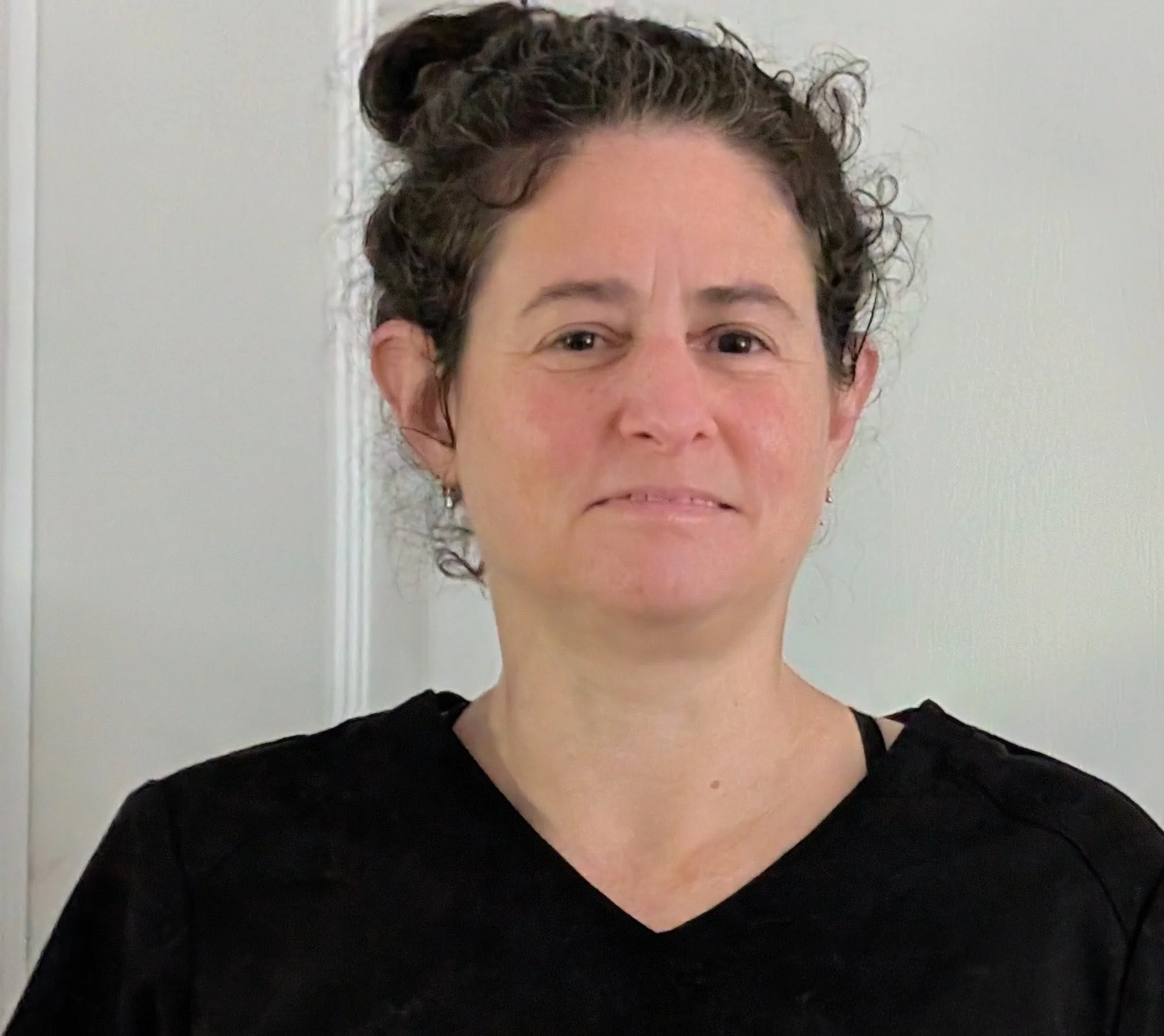
Photo of Holly Carignan
BIO: Holly Carignan lives in St. Augustine, FL with her three irresistible, pesty, entertaining cats, one dog and a boyfriend. She has an old, unused MA is psychology and, more recently, a BS in biochemistry. When she is not slogging away in a hospital lab, she is home writing by computer light in the comfortable darkness of her messy house. She is a proud member of a weekly writing group called The Scrawl, as well as the Westport Writer’s Workshop – she is forever indebted to them for their friendship and support.